
Five Eyes
An intelligence-sharing partnership among five close Anglophone allies
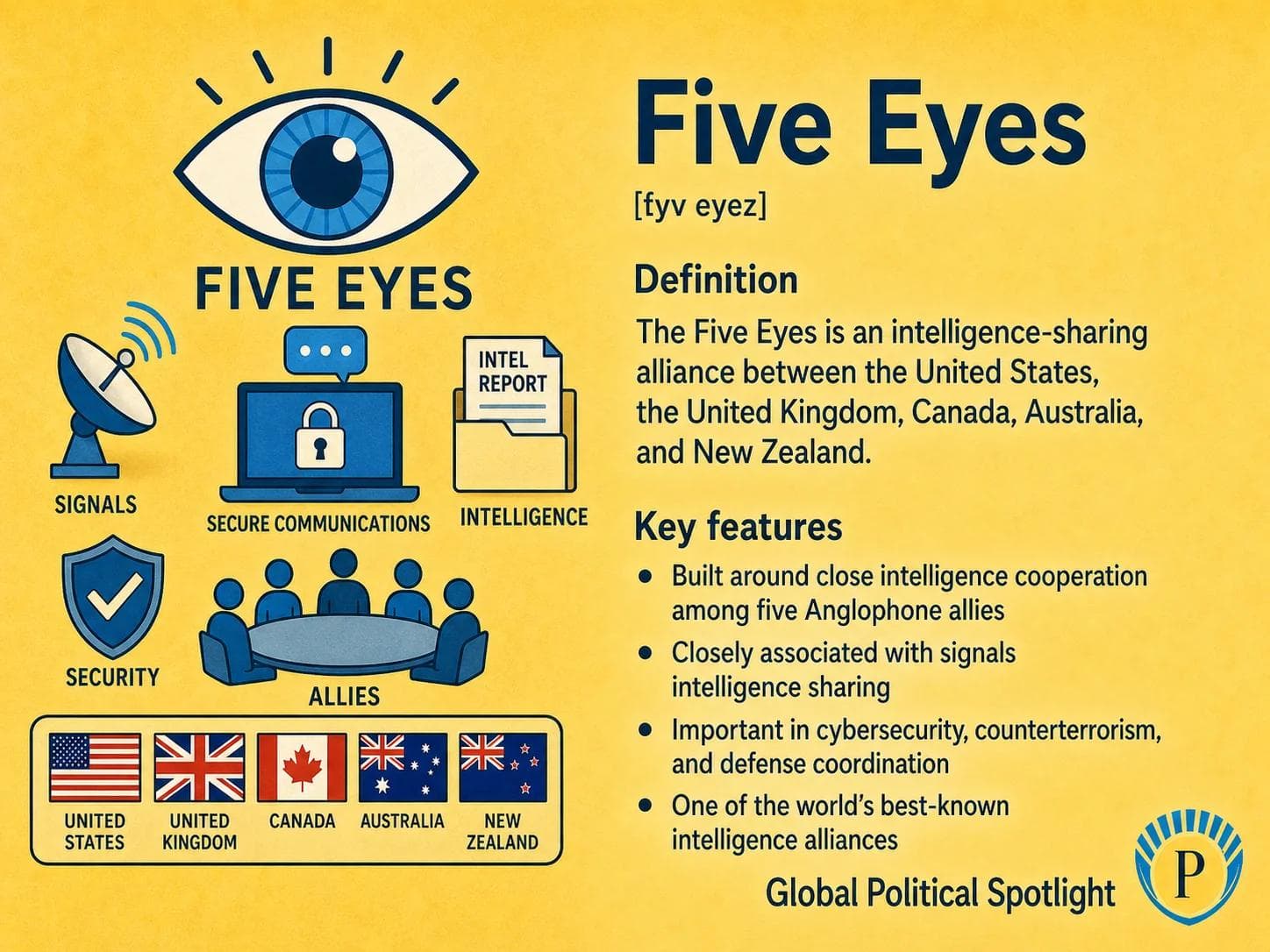
Five Eyes is an intelligence-sharing partnership among the United States, United Kingdom, Canada, Australia, and New Zealand, rooted in signals intelligence cooperation and wider security coordination.
Definition
Five Eyes is an intelligence-sharing partnership among the United States, United Kingdom, Canada, Australia, and New Zealand. It grew out of wartime and postwar cooperation on signals intelligence and is closely associated with the UKUSA Agreement framework.
The partnership is not a military alliance like NATO and does not have a single public command structure. It is best understood as a high-trust intelligence network through which the five governments cooperate on signals intelligence, national security assessments, counterterrorism, cyber threats, foreign interference, and strategic risks.
Because Five Eyes deals with intelligence collection and sharing, many operational details remain classified. Public debate often focuses on the balance between national security, democratic oversight, privacy, surveillance powers, and civil liberties.
Why It Matters
Five Eyes matters because intelligence sharing can shape how allied governments understand threats before decisions become public. Shared assessments can influence sanctions, cyber warnings, counterterrorism posture, defense planning, technology restrictions, and diplomatic coordination.
The partnership is strategically important because it links five advanced intelligence communities across North America, Europe, and the Indo-Pacific. That geographic spread gives the network relevance to Russia, China, cyber operations, maritime security, terrorism, foreign interference, and global communications infrastructure.
Five Eyes also raises governance questions. Intelligence cooperation relies on secrecy and trust, but democratic systems require legal limits, parliamentary or congressional oversight, judicial review, and safeguards against misuse of surveillance authorities.
GPS should track Five Eyes as a durable intelligence-sharing architecture linking U.S., British, Canadian, Australian, and New Zealand security policy. Key watchpoints include China and Russia threat assessments, cyber warnings, technology controls, foreign interference claims, counterterrorism cooperation, privacy debates, and whether wider partner formats emerge around the Five Eyes core.
Key Facts
- Type
- Intelligence-sharing partnership
- Members
- United States, United Kingdom, Canada, Australia, and New Zealand
- Origins
- Rooted in wartime codebreaking cooperation and the postwar UKUSA signals intelligence framework
- Core domain
- Signals intelligence and wider intelligence cooperation among trusted allied agencies
- Strategic role
- Supports allied threat assessment, counterterrorism, cyber defense, foreign interference monitoring, and security coordination
- Key concern areas
- China, Russia, terrorism, cyber operations, espionage, disinformation, and critical technology security
- Institutional character
- A close intelligence partnership rather than a public treaty alliance with collective-defense obligations
- Governance debate
- Often scrutinized through privacy, surveillance, civil liberties, legal oversight, and democratic accountability questions
FAQ
What is Five Eyes?
Five Eyes is an intelligence-sharing partnership among the United States, United Kingdom, Canada, Australia, and New Zealand. It is especially associated with signals intelligence cooperation, but it also supports broader national security coordination.
Which countries are in Five Eyes?
The Five Eyes members are the United States, the United Kingdom, Canada, Australia, and New Zealand.
Is Five Eyes the same as NATO?
No. NATO is a military alliance with a public treaty and collective-defense obligations. Five Eyes is an intelligence-sharing partnership. Some members overlap with NATO, but the institutions have different purposes and structures.
Why does Five Eyes matter for China and Russia policy?
Five Eyes matters because member countries often coordinate threat assessments, cyber warnings, espionage concerns, foreign interference responses, and technology-security positions involving China and Russia. It can shape allied policy before public decisions are announced.
What are the limits of Five Eyes?
Five Eyes is constrained by national laws, oversight systems, political trust, classification rules, and each member government's policy choices. It does not make member countries automatically adopt the same foreign policy or military position.
Why is Five Eyes controversial?
Five Eyes is controversial because intelligence cooperation involves secrecy, surveillance capabilities, and cross-border data sharing. Critics focus on privacy, civil liberties, oversight, and the risk that intelligence-sharing arrangements can reduce transparency.
Recent Developments
Five Eyes agencies jointly warned about Chinese state-sponsored cyber activity
Cybersecurity agencies from the Five Eyes countries and partners issued a joint advisory on activity attributed to a China-linked actor targeting critical infrastructure. The advisory illustrated how Five Eyes cooperation is increasingly visible in public cyber threat warnings.
CISAFive Eyes security chiefs continued public coordination on foreign interference and technology risks
Public statements and joint engagements by Five Eyes security and intelligence leaders have increasingly emphasized foreign interference, espionage, cyber threats, and risks around advanced technology, showing the partnership's continuing relevance beyond traditional signals intelligence.
FBISources6 references
- National Security Agency - UKUSA Agreement release
Official declassified material on the UKUSA Agreement framework associated with Five Eyes signals intelligence cooperation.
- UK Parliament - Intelligence and Security Committee
Official UK oversight body relevant to intelligence accountability and democratic scrutiny.
- CISA - Five Eyes cyber advisory
Example of public cyber threat coordination involving Five Eyes cybersecurity agencies.
- FBI - Five Eyes security chiefs summit
Official FBI public material showing Five Eyes coordination on security, technology, and foreign interference risks.
- Australian Signals Directorate
Official Australian signals intelligence and cyber agency site connected to the Five Eyes security ecosystem.
- Government Communications Security Bureau of New Zealand
Official New Zealand intelligence agency site relevant to Five Eyes intelligence and cyber cooperation.

GPSNews App
Read GPSNews on iPhone
Daily geopolitical briefings, government updates, and prediction signals in one focused app.
Newsletter
Stay Ahead Of The Next Signal
Get briefings in your inbox when new analysis and reports are published.