
MI6 / SIS
The United Kingdom’s overseas human intelligence service for foreign intelligence, national security, and strategic warning
MI6, formally the Secret Intelligence Service, is the United Kingdom’s overseas intelligence agency responsible for foreign human intelligence, national security support, counterterrorism, and strategic warning.
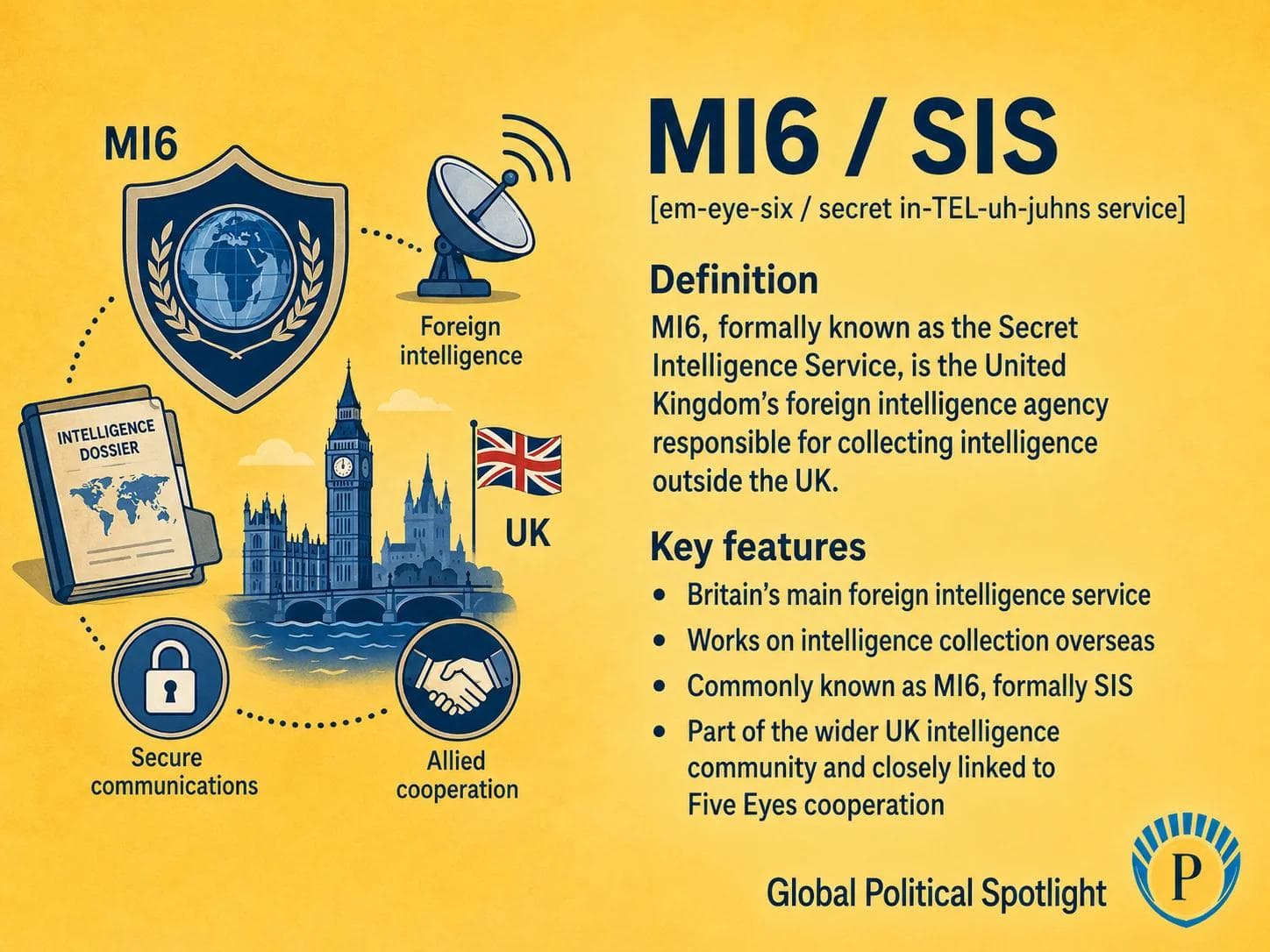
Definition
MI6, formally known as the Secret Intelligence Service or SIS, is the United Kingdom’s overseas intelligence agency. Its core role is to collect and assess foreign intelligence, especially human intelligence, in support of UK national security, foreign policy, defense, and economic security.
SIS operates outside the United Kingdom and works with ministers, diplomats, defense institutions, law enforcement, and allied intelligence services. It is part of the UK intelligence community alongside MI5, which focuses on domestic security, and GCHQ, which focuses on signals intelligence, cyber security, and information assurance.
Because intelligence work is classified, public knowledge about SIS is limited. Responsible analysis should distinguish official institutional descriptions from fictional portrayals, alleged operations, media reporting, and claims that cannot be independently verified.
Why It Matters
MI6 matters because the United Kingdom is a nuclear-armed state, a permanent member of the UN Security Council, a NATO member, a Five Eyes intelligence partner, and a country with global diplomatic, financial, military, and security interests. Overseas intelligence helps policymakers understand threats before they reach the UK or its allies.
SIS is geopolitically relevant because human intelligence can shape assessments of terrorism, hostile state activity, proliferation, sanctions evasion, cyber-linked threats, Russia-related security risks, China-related strategic competition, hostage cases, organized crime, and conflict dynamics.
The agency is also important for understanding democratic oversight of intelligence. SIS operates under ministerial authority and legal frameworks, with parliamentary and judicial oversight mechanisms intended to balance secrecy, operational effectiveness, civil liberties, and accountability.
MI6 / SIS should be tracked as a major Western foreign intelligence service within the UK national security system and the wider Five Eyes network. GPS should watch how UK overseas intelligence priorities relate to Russia, China, counterterrorism, cyber-enabled threats, proliferation, sanctions enforcement, hostile state activity, intelligence oversight debates, NATO security, and UK foreign policy after Brexit.
Key Facts
- Formal name
- Secret Intelligence Service
- Common name
- MI6
- Type
- Foreign human intelligence service
- Country
- United Kingdom
- Founded
- 1909, originating from the Secret Service Bureau
- Headquarters
- Vauxhall Cross, London
- Primary role
- Overseas intelligence collection, especially HUMINT, to support UK national security and foreign policy
- Institutional distinction
- SIS focuses on overseas intelligence, MI5 handles domestic security, and GCHQ focuses on signals intelligence and cyber security
FAQ
What is MI6?
MI6 is the common name for the United Kingdom’s Secret Intelligence Service, or SIS. It is responsible for collecting overseas intelligence, especially human intelligence, to support UK national security, foreign policy, defense, and economic security.
What does SIS stand for?
SIS stands for Secret Intelligence Service. It is the formal name of the UK foreign intelligence agency commonly known as MI6.
What is HUMINT?
HUMINT means human intelligence. It refers to intelligence gathered from human sources, relationships, reporting, and networks, rather than primarily from intercepted communications, satellite imagery, or open sources.
What is the difference between MI6, MI5, and GCHQ?
MI6, or SIS, focuses on overseas intelligence. MI5 focuses on domestic security and counterintelligence inside the UK. GCHQ focuses on signals intelligence, cyber security, and information-related intelligence capabilities.
Why does MI6 matter geopolitically?
MI6 matters because UK foreign intelligence can affect counterterrorism, Russia and China policy, sanctions enforcement, NATO security, proliferation monitoring, conflict assessment, hostage cases, and cooperation with allies such as the Five Eyes countries.
Who oversees MI6?
MI6 operates under ministerial authority, with the UK Foreign Secretary historically responsible for SIS. Oversight also involves legal frameworks, commissioners, and parliamentary scrutiny through bodies such as the Intelligence and Security Committee of Parliament.
Sources6 references
- Secret Intelligence Service
Official public website for the UK Secret Intelligence Service, including mission, history, accountability, and recruitment information.
- UK Intelligence Services Act 1994
UK legislation that placed SIS and GCHQ on a statutory footing and defines core intelligence service functions.
- UK Investigatory Powers Act 2016
Legal framework relevant to investigatory powers, oversight, authorization, and intelligence activity in the United Kingdom.
- MI5 Official Website
Official source for the UK domestic security service, useful for distinguishing MI5’s internal security role from SIS overseas intelligence.
- GCHQ Official Website
Official source for the UK signals intelligence and cyber security agency, useful for distinguishing GCHQ from SIS.
- Intelligence and Security Committee of Parliament
Official UK parliamentary oversight body for intelligence and security matters.

GPSNews App
Read GPSNews on iPhone
Daily geopolitical briefings, government updates, and prediction signals in one focused app.
Newsletter
Stay Ahead Of The Next Signal
Get briefings in your inbox when new analysis and reports are published.