
BND
Germany’s foreign intelligence service for overseas security information, strategic analysis, and national security support
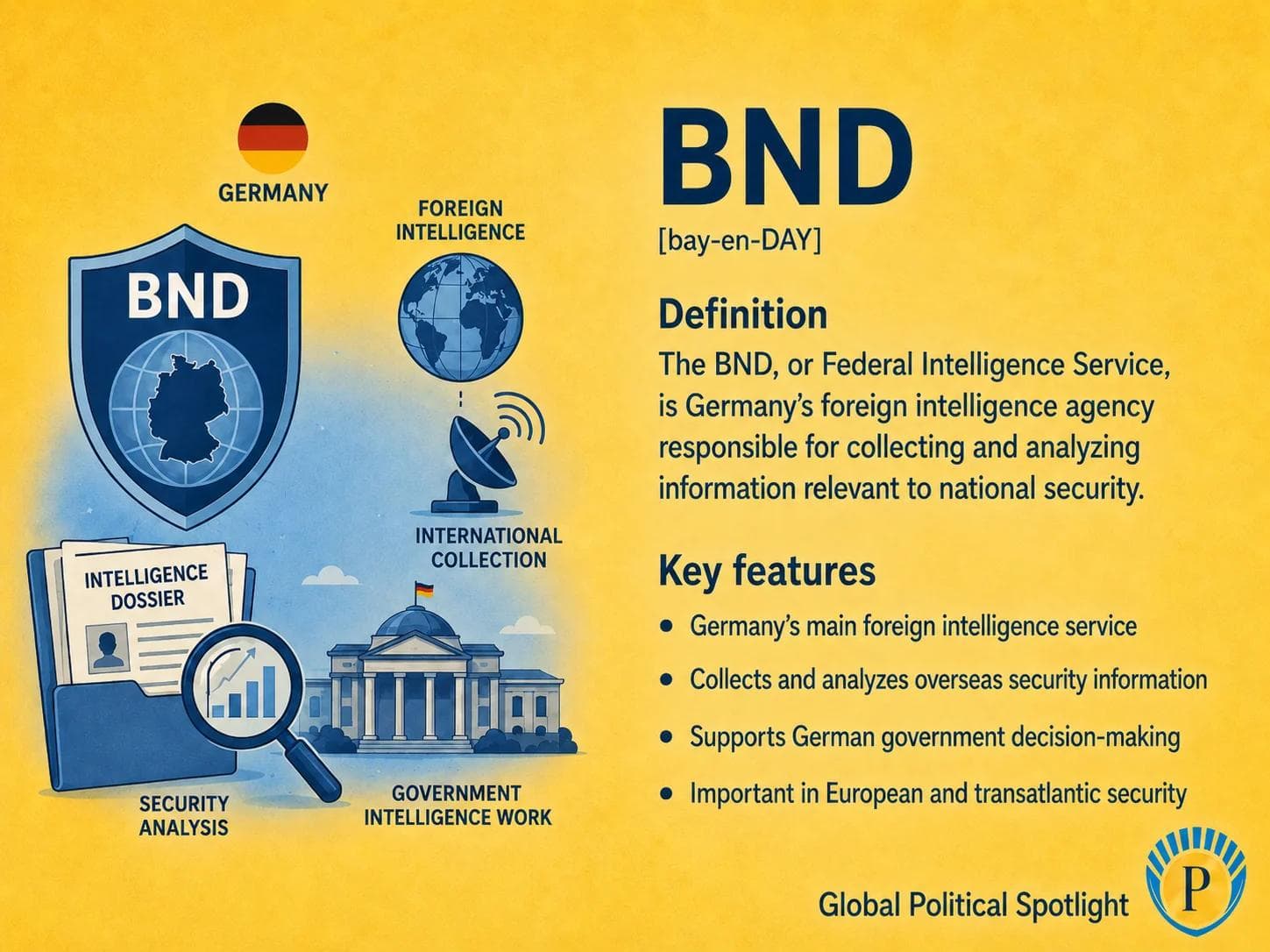
The BND is Germany’s foreign intelligence service, responsible for collecting and analyzing overseas security information to support German national security, foreign policy, crisis warning, and European security cooperation.
Definition
The Bundesnachrichtendienst, usually abbreviated BND and translated as the Federal Intelligence Service, is Germany’s foreign intelligence agency. It collects and analyzes information from abroad to support the German federal government on foreign policy, security policy, crisis warning, defense, terrorism, proliferation, cyber threats, and other external risks.
The BND is part of Germany’s wider intelligence and security system. It is distinct from the Federal Office for the Protection of the Constitution, which focuses on domestic threats to the constitutional order, and from the Military Counterintelligence Service, which focuses on security threats within the Bundeswehr.
Because foreign intelligence activity is classified, public information about BND operations is limited. Responsible analysis should distinguish official descriptions and oversight reports from historical cases, media reporting, allegations, and claims that cannot be independently verified.
Why It Matters
The BND matters because Germany is Europe’s largest economy, a NATO member, a major European Union actor, and a central state in European security policy. Foreign intelligence helps German decision-makers assess threats beyond Germany’s borders before they affect national security, diplomacy, defense planning, supply chains, or crisis response.
The service is geopolitically relevant because Germany’s security environment includes Russia-related threats, war in Europe, terrorism, migration pressures, cyber and hybrid activity, energy and infrastructure vulnerabilities, proliferation risks, and instability in neighboring regions such as the Middle East and Africa.
The BND is also important for understanding Germany’s approach to intelligence oversight. German intelligence is shaped by legal constraints, parliamentary scrutiny, constitutional rights, historical sensitivities around state surveillance, and cooperation with European, NATO, and transatlantic partners.
The BND should be tracked as Germany’s main foreign intelligence actor within European and transatlantic security. GPS should watch how its priorities relate to Russia, Ukraine, China, terrorism, cyber and hybrid threats, migration and crisis warning, energy and infrastructure security, NATO intelligence cooperation, EU security coordination, and German parliamentary oversight debates.
Key Facts
- Full German name
- Bundesnachrichtendienst
- English name
- Federal Intelligence Service
- Type
- Foreign intelligence service
- Country
- Germany
- Established
- 1956, during the Cold War
- Headquarters
- Berlin, Germany
- Primary role
- Collecting and analyzing foreign intelligence to support German national security, foreign policy, crisis warning, and defense policy
- Institutional distinction
- The BND handles foreign intelligence, the BfV handles domestic constitutional protection, and MAD handles military counterintelligence
FAQ
What is the BND?
The BND is Germany’s Federal Intelligence Service. It is responsible for collecting and analyzing foreign intelligence to support the German government on national security, foreign policy, crisis warning, defense, terrorism, cyber threats, and external risks.
What does BND stand for?
BND stands for Bundesnachrichtendienst, which is commonly translated into English as the Federal Intelligence Service.
Is the BND Germany’s domestic intelligence agency?
No. The BND is Germany’s foreign intelligence agency. Domestic threats to Germany’s constitutional order are primarily handled by the Federal Office for the Protection of the Constitution, known as the BfV.
Why does the BND matter geopolitically?
The BND matters because Germany is a major European power, NATO ally, and global economic actor. Its foreign intelligence assessments can shape German policy on Russia, Ukraine, China, terrorism, cyber threats, migration, energy security, and international crises.
How is the BND overseen?
The BND operates under German law and is subject to government, parliamentary, judicial, and independent oversight mechanisms. Oversight reflects Germany’s effort to balance intelligence secrecy, operational effectiveness, constitutional rights, and democratic accountability.
How is the BND different from GCHQ, MI6, or the CIA?
The BND is Germany’s foreign intelligence service. MI6 is the United Kingdom’s foreign human intelligence service, GCHQ focuses on UK signals intelligence and cyber security, and the CIA is a U.S. foreign intelligence agency. Their missions overlap in foreign intelligence but differ by country, legal framework, and capabilities.
Sources6 references
- Bundesnachrichtendienst
Official public website for Germany’s Federal Intelligence Service, including mission, history, structure, and public-facing institutional information.
- German Federal Intelligence Service Act
Official German legal source for the statutory framework governing the BND.
- Parliamentary Control Panel of the Bundestag
Official Bundestag source explaining parliamentary oversight of Germany’s intelligence services.
- Federal Office for the Protection of the Constitution
Official source for Germany’s domestic intelligence agency, useful for distinguishing the BND’s foreign intelligence role from domestic constitutional protection.
- Germany Federal Ministry of Defence
Official defense source for Germany’s security policy environment, NATO role, and defense context.
- Encyclopaedia Britannica
Reference overview of the BND’s history, institutional role, and foreign intelligence function.

GPSNews App
Read GPSNews on iPhone
Daily geopolitical briefings, government updates, and prediction signals in one focused app.
Newsletter
Stay Ahead Of The Next Signal
Get briefings in your inbox when new analysis and reports are published.