
X-37B Space Plane
A reusable uncrewed U.S. space plane used for long-duration orbital testing and military space experiments
The X-37B is a reusable robotic U.S. space plane operated by the U.S. Space Force for long-duration orbital missions, technology demonstrations, and experiments related to military and civil space capabilities.
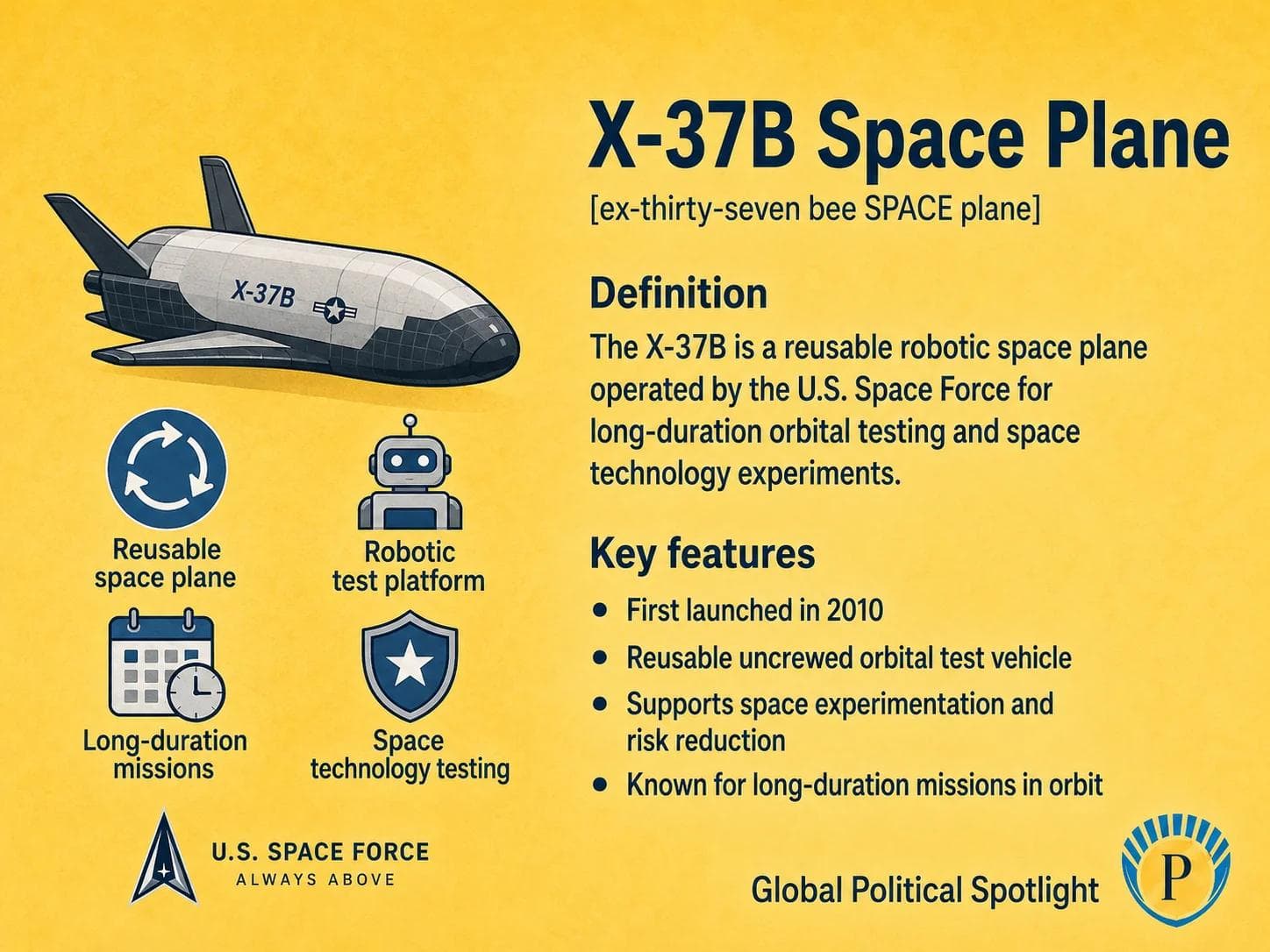
Definition
The X-37B is a reusable, uncrewed U.S. orbital test vehicle that resembles a small space shuttle. It is launched into space on a rocket, operates in orbit for extended periods, and returns to Earth by landing on a runway.
The program is operated by the U.S. Space Force and is used as a test platform for space technologies, experiments, and long-duration operations. Publicly described missions have included technology demonstrations, space environment research, and payload testing.
Because many mission details are not publicly disclosed, the X-37B is often discussed in the context of military space secrecy and strategic competition. Its verified significance lies in its reusable design, long orbital endurance, and role as a flexible experimentation platform.
Why It Matters
The X-37B matters because space systems are increasingly central to military power, including communications, navigation, surveillance, missile warning, and command networks. A reusable orbital test platform allows the United States to experiment with technologies in the space environment and bring some payloads back for analysis.
It also matters geopolitically because long-duration, partially classified space missions can influence how rivals interpret U.S. capabilities and intentions. The program sits at the intersection of reusable spaceflight, military space technology, counterspace concerns, and great-power competition in orbit.
GPS should monitor the X-37B as a reference case for reusable military space experimentation and the growing strategic value of orbital platforms. Key watch areas include mission duration, launch providers, payload disclosures, U.S. Space Force doctrine, reusable spacecraft technology, space-domain awareness, and how China, Russia, and other space powers respond to U.S. orbital test capabilities.
Key Facts
- Type
- Reusable uncrewed orbital test vehicle
- Operator
- U.S. Space Force
- Manufacturer
- Boeing
- Mission profile
- Rocket launch, long-duration orbital operations, and autonomous runway landing
- Primary role
- Testing reusable space technologies, experimental payloads, and long-duration orbital operations
- Crew status
- Uncrewed and remotely operated or autonomous during flight phases
- Strategic relevance
- Supports U.S. military space experimentation and signals the importance of reusable orbital capabilities
- Transparency limit
- Many payload details and mission objectives are not publicly disclosed
FAQ
What is the X-37B space plane?
The X-37B is a reusable uncrewed U.S. orbital test vehicle. It launches on a rocket, operates in space for long periods, and returns to Earth by landing on a runway.
Who operates the X-37B?
The X-37B is operated by the U.S. Space Force. Boeing built the vehicle, and missions have used commercial launch providers including United Launch Alliance and SpaceX.
What is the X-37B used for?
Public descriptions identify the X-37B as a test platform for space technologies, experiments, and long-duration orbital operations. Specific payloads and mission objectives are often only partly disclosed.
Is the X-37B crewed?
No. The X-37B is uncrewed. It operates as a robotic space plane and lands autonomously after completing its orbital mission.
Why is the X-37B geopolitically important?
It is important because it demonstrates reusable military space experimentation, long-duration orbital operations, and the growing strategic role of space technology in great-power competition.
Is the X-37B a weapon?
Public U.S. descriptions present the X-37B as an orbital test vehicle for experiments and technology demonstrations. Because many mission details are classified or undisclosed, analysts debate its wider strategic implications, but public evidence should not be overstated.
Recent Developments
X-37B completed its sixth mission after 908 days in orbit
The X-37B Orbital Test Vehicle completed its sixth mission after spending 908 days in orbit, underscoring the platform's long-duration endurance and its value for sustained orbital experimentation.
U.S. Space ForceSeventh X-37B mission launched on a Falcon Heavy rocket
The seventh X-37B mission launched using a SpaceX Falcon Heavy, expanding public attention on the program's use of commercial launch providers and its continuing role in U.S. military space experimentation.
U.S. Space ForceSources6 references
- U.S. Space Force - X-37B Mission Six Completion
Official U.S. Space Force release on the sixth X-37B mission and its 908-day orbital duration.
- U.S. Space Force
Official source for U.S. Space Force information, releases, and space operations context.
- Boeing - X-37B Orbital Test Vehicle
Manufacturer reference on the X-37B's design, reusable nature, and orbital test vehicle role.
- NASA - X-37 Technology Demonstrator Background
Institutional source for background on early reusable space technology and orbital test vehicle development.
- Secure World Foundation
Reference organization for space security, space sustainability, and military space governance context.
- Center for Strategic and International Studies - Aerospace Security
Think tank source for analysis of space security, counterspace capabilities, and great-power competition in orbit.

GPSNews App
Read GPSNews on iPhone
Daily geopolitical briefings, government updates, and prediction signals in one focused app.
Newsletter
Stay Ahead Of The Next Signal
Get briefings in your inbox when new analysis and reports are published.