
B-2 Spirit vs. B-21 Raider
A comparison of the operational B-2 stealth bomber and the next-generation B-21 Raider
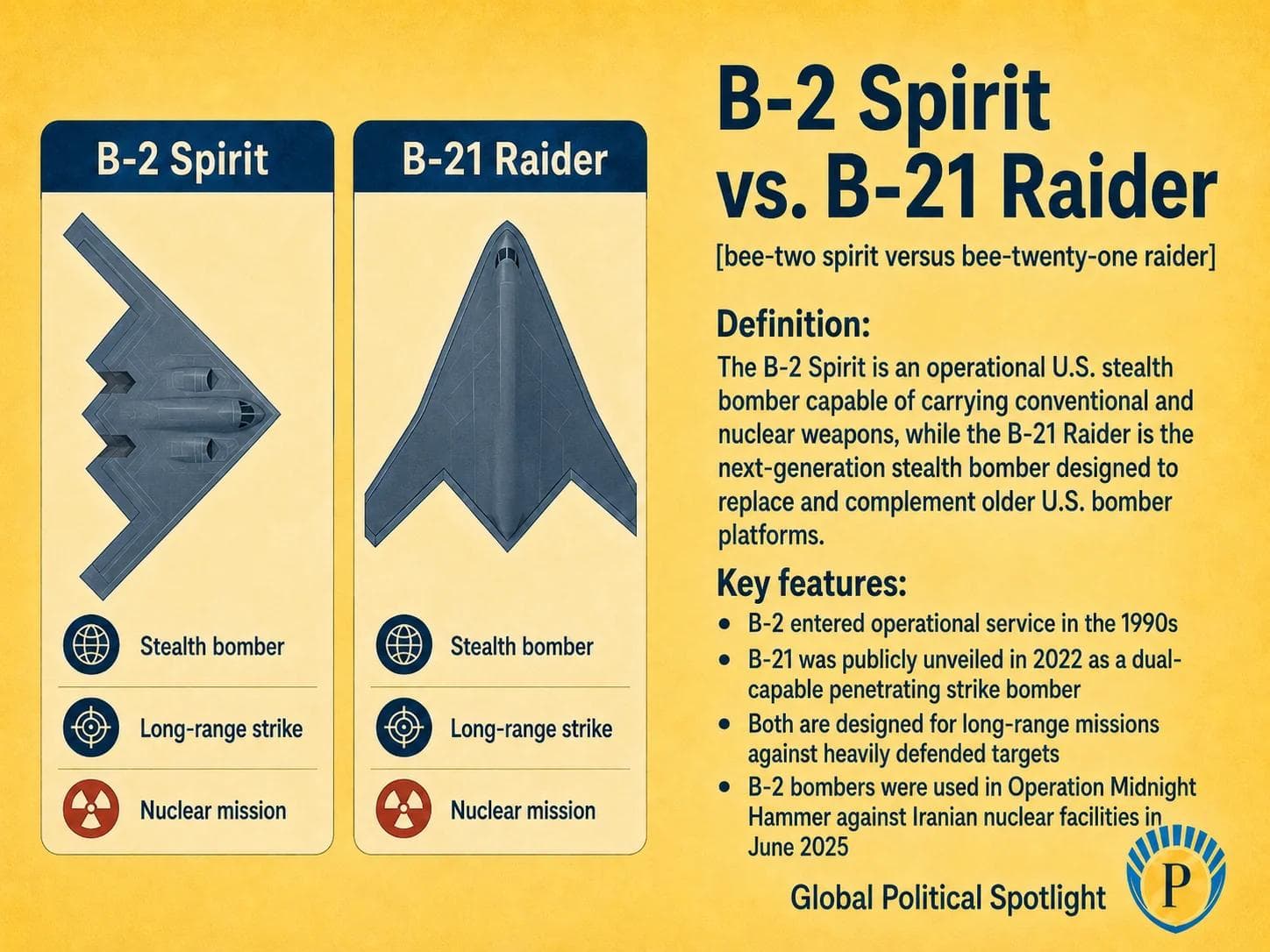
The B-2 Spirit and B-21 Raider are U.S. stealth bombers designed for long-range penetrating strike. The B-2 is operational, while the B-21 is the next-generation dual-capable bomber entering testing and production.
Definition
The B-2 Spirit and B-21 Raider are U.S. stealth bombers designed for long-range penetrating strike. The B-2 is an operational multi-role bomber capable of delivering conventional and nuclear munitions, while the B-21 is the next-generation dual-capable penetrating strike bomber intended to become the backbone of the future U.S. bomber force.
Both aircraft use low-observable design concepts to operate in contested airspace, but they belong to different modernization eras. The B-2 represents the late Cold War and post-Cold War stealth bomber fleet, while the B-21 is designed for future high-end threat environments and a force structure centered on B-21s and B-52s.
Why It Matters
This comparison matters because stealth bombers are one of the few tools that can combine long-range reach, conventional precision strike, nuclear deterrence, and visible signaling. They allow the United States to hold distant targets at risk while reassuring allies and complicating adversary defense planning.
The B-21 transition also matters for nuclear modernization. As the B-2 ages, the B-21 is intended to sustain a penetrating bomber leg of the nuclear triad, connect with future weapons and command systems, and operate in air-defense environments shaped by advanced sensors, missiles, and electronic warfare.
GPS should watch the B-2 to B-21 transition as a durable indicator of U.S. long-range strike modernization, nuclear deterrence planning, and competition over air-defense penetration. Key indicators include B-21 testing milestones, production capacity, bomber basing, nuclear certification, B-2 retirement timelines, integration with standoff weapons, and how China and Russia adapt air-defense and counter-stealth systems.
Key Facts
- Comparison type
- Operational stealth bomber versus next-generation stealth bomber
- Primary operator
- United States Air Force
- B-2 role
- Operational multi-role stealth bomber capable of conventional and nuclear missions
- B-21 role
- Next-generation dual-capable penetrating strike stealth bomber designed for future high-end threat environments
- Strategic function
- Supports long-range strike, nuclear deterrence, alliance reassurance, and crisis signaling
- Nuclear triad relevance
- Represents the bomber leg of the U.S. nuclear triad alongside ICBMs and submarine-launched ballistic missiles
- Modernization logic
- The B-21 is intended to replace and modernize capabilities now associated with aging stealth and non-stealth bomber platforms
- Design concept
- Both aircraft use flying-wing stealth concepts to reduce radar detectability and support penetration of defended airspace
FAQ
What is the difference between the B-2 Spirit and the B-21 Raider?
The B-2 Spirit is the current operational U.S. stealth bomber, while the B-21 Raider is the next-generation stealth bomber being developed and tested to modernize the long-range bomber force.
Are the B-2 and B-21 nuclear bombers?
Both are associated with the bomber leg of U.S. nuclear deterrence. The B-2 is capable of delivering conventional and nuclear munitions, and the B-21 is described by the U.S. Air Force as a dual-capable penetrating strike bomber.
Why does the B-21 Raider matter?
The B-21 matters because it is intended to sustain U.S. long-range penetrating strike in future contested environments. It is central to bomber modernization, nuclear deterrence, and the ability to hold distant targets at risk.
Will the B-21 replace the B-2?
The B-21 is intended to modernize the bomber force and eventually take over missions now associated with older platforms, including the B-2. Exact retirement timing depends on testing, production, basing, certification, and operational planning.
What does dual-capable bomber mean?
A dual-capable bomber is designed to deliver both conventional and nuclear munitions. In practice, nuclear use would depend on separate certification, command-and-control procedures, and political authorization.
What are the limits of stealth bombers?
Stealth reduces detectability but does not make an aircraft invisible. Stealth bombers still depend on basing, maintenance, tanker support, mission planning, electronic warfare, weapons integration, crew readiness, and the evolving quality of enemy sensors and air defenses.
Recent Developments
Second B-21 test aircraft arrived at Edwards Air Force Base
The Department of the Air Force announced the arrival of a second B-21 Raider flight-test aircraft at Edwards Air Force Base, expanding the program's capacity for testing and sustainment training.
Air Force Global Strike CommandDepartment of the Air Force expanded B-21 production capacity
The Department of the Air Force announced an agreement with Northrop Grumman to expand B-21 Raider production capacity, framing the move as part of accelerating delivery of long-range strike capability.
U.S. Air ForceSources6 references
- U.S. Air Force: B-2 Spirit Fact Sheet
Official U.S. Air Force reference describing the B-2 Spirit as a multi-role bomber capable of conventional and nuclear missions.
- U.S. Air Force: B-21 Raider Fact Sheet
Official U.S. Air Force reference describing the B-21 Raider as a dual-capable penetrating strike stealth bomber.
- Air Force Global Strike Command: B-21 Test Aircraft
Official Air Force update on the arrival of a second B-21 flight-test aircraft at Edwards Air Force Base.
- U.S. Department of Defense: 2022 Nuclear Posture Review
Official U.S. policy document explaining nuclear deterrence, modernization, and the role of the bomber force.
- Northrop Grumman: B-21 Raider
Prime contractor reference on the B-21 Raider program and long-range strike role.
- National Museum of the U.S. Air Force: B-2 Spirit
Reference background on the B-2 Spirit's flying-wing stealth design and historical development.

GPSNews App
Read GPSNews on iPhone
Daily geopolitical briefings, government updates, and prediction signals in one focused app.
Newsletter
Stay Ahead Of The Next Signal
Get briefings in your inbox when new analysis and reports are published.