
AWACS / E-3 Sentry
An airborne warning and control aircraft that extends air surveillance and command over large battlespaces
AWACS / E-3 Sentry is an airborne warning and control aircraft used by U.S. and NATO forces to detect aircraft, coordinate air-defense operations, and provide command, control, communications, and surveillance from the air.
Definition
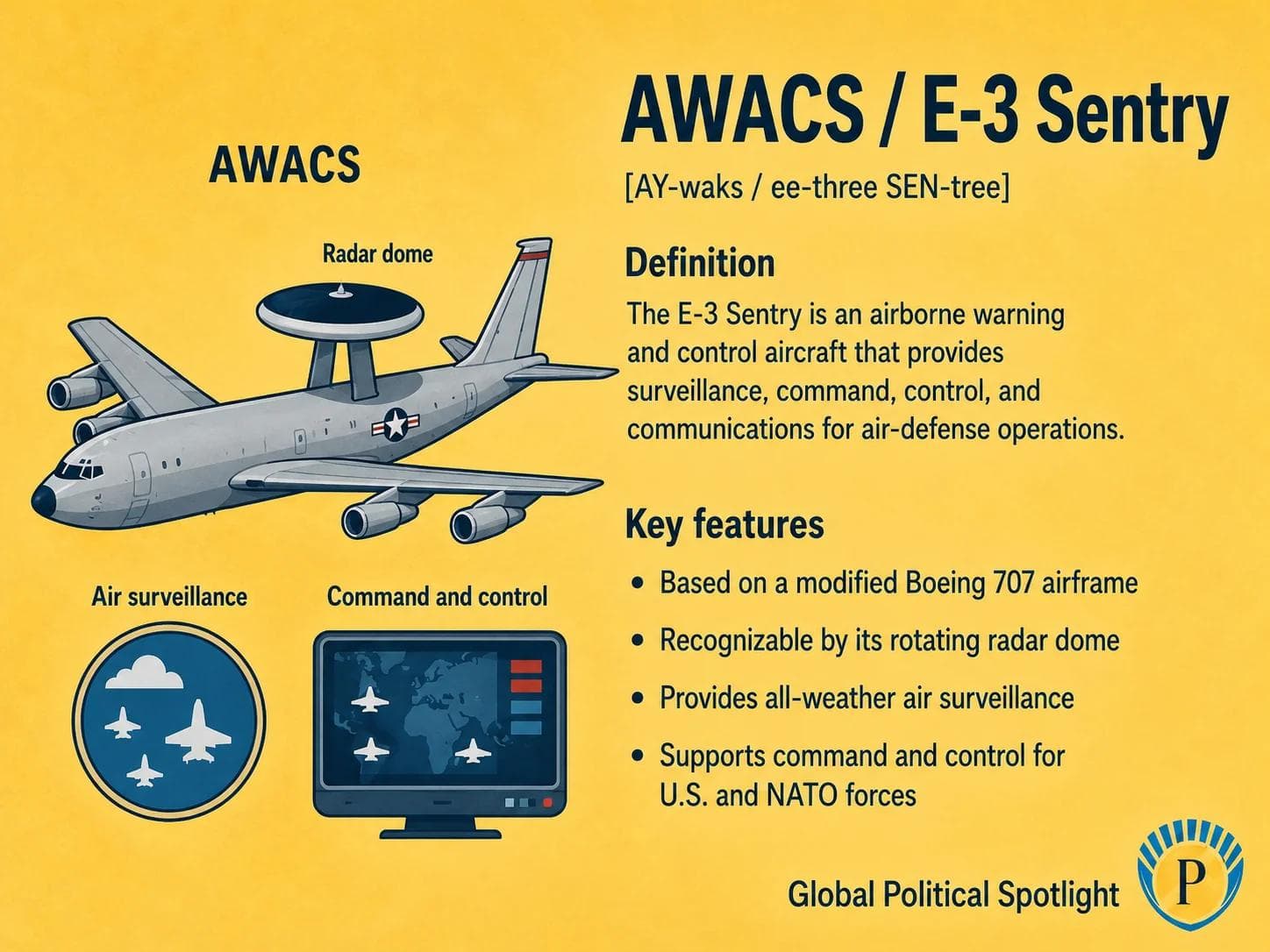
AWACS stands for Airborne Warning and Control System. The E-3 Sentry is a Boeing 707-derived airborne early warning and control aircraft recognizable by its large rotating radar dome, or rotodome, mounted above the fuselage.
The aircraft is designed to detect, track, and identify aircraft and other airborne activity over long distances, then share that information with commanders, fighter aircraft, ground units, naval forces, and air-defense networks.
AWACS platforms are not primarily combat aircraft. Their value comes from extending situational awareness, coordinating air operations, and serving as airborne command-and-control nodes during air-defense, crisis response, and joint military missions.
Why It Matters
AWACS matters because control of the air depends on seeing threats early and coordinating responses quickly. Airborne radar can look beyond some ground-based radar limitations caused by terrain, distance, and the curvature of the Earth.
For NATO and U.S. forces, AWACS aircraft support deterrence, air policing, air-defense coordination, crisis monitoring, and coalition operations. They are especially relevant near contested airspace where aircraft, missiles, drones, and electronic warfare can stress fixed radar and command networks.
GPS should monitor AWACS / E-3 Sentry as a core enabler of air-defense networks, alliance deterrence, and coalition command and control. Key watch areas include NATO eastern-flank surveillance, replacement programs such as E-7 Wedgetail, airborne early warning modernization, drone and missile detection requirements, and the vulnerability of high-value surveillance aircraft in contested environments.
Key Facts
- Type
- Airborne warning and control aircraft
- Known platform
- E-3 Sentry, based on the Boeing 707 airframe
- Distinctive feature
- Large radar dome mounted above the fuselage for wide-area air surveillance
- Primary roles
- Air surveillance, command and control, communications relay, and air-defense coordination
- Major operators
- United States, NATO, and several allied air forces have operated E-3 or AWACS-type aircraft
- Operational value
- Extends situational awareness and helps coordinate fighters, tankers, ground systems, and air-defense assets
- Strategic relevance
- Supports alliance deterrence, air policing, crisis monitoring, and integrated air and missile defense
- Modernization issue
- Aging E-3 fleets are being retired or replaced by newer airborne early warning platforms such as the E-7 Wedgetail
FAQ
What does AWACS mean?
AWACS stands for Airborne Warning and Control System. It refers to aircraft equipped with powerful radar and communications systems that detect airborne activity and help coordinate military operations.
What is the E-3 Sentry?
The E-3 Sentry is an airborne warning and control aircraft based on the Boeing 707 airframe. It is recognizable by its large radar dome and has been used by U.S., NATO, and allied forces for air surveillance and command and control.
Why does the E-3 Sentry have a radar dome?
The radar dome, or rotodome, houses radar equipment that allows the aircraft to monitor large areas of airspace. This helps detect aircraft and other airborne threats and share information with military command networks.
Why is AWACS important for NATO?
AWACS aircraft help NATO monitor airspace, coordinate fighter aircraft, support air policing, and maintain situational awareness during crises. They are especially useful when allied forces need shared air surveillance across borders.
Is AWACS an air-defense weapon?
AWACS is not mainly a weapon platform. Its role is to detect, track, communicate, and coordinate. It helps air-defense forces and fighter aircraft respond more effectively, but it usually does not perform the intercept mission itself.
What will replace the E-3 Sentry?
Several operators are replacing or supplementing older E-3 fleets with newer airborne early warning aircraft. NATO and some allied forces have selected the E-7 Wedgetail as a future replacement platform.
Recent Developments
NATO selected the E-7A Wedgetail as its future AWACS replacement
NATO announced a plan to acquire E-7A Wedgetail aircraft to replace its aging E-3A AWACS fleet, reflecting the continuing importance of airborne early warning and control for alliance surveillance and command-and-control missions.
NATONATO increased surveillance and air policing after Russia's full-scale invasion of Ukraine
After Russia's full-scale invasion of Ukraine, NATO AWACS aircraft became part of enhanced alliance monitoring and air-policing activity along NATO territory, reinforcing their role in eastern-flank situational awareness.
NATOSources6 references
- NATO - AWACS
Official NATO reference on the alliance's AWACS capability, mission, and airborne early warning role.
- NATO - E-7A Wedgetail Replacement Announcement
Official NATO announcement on the future replacement of the E-3A AWACS fleet with E-7A Wedgetail aircraft.
- U.S. Air Force - E-3 Sentry Fact Sheet
Official U.S. Air Force reference on the E-3 Sentry's mission, airframe, radar, and command-and-control role.
- Boeing - E-3 AWACS
Manufacturer reference for the E-3 AWACS aircraft and airborne warning and control mission.
- Royal Air Force - E-7 Wedgetail
Official allied reference for the newer airborne early warning platform replacing older AWACS capabilities in some fleets.
- Congressional Research Service
Institutional source for U.S. defense aviation modernization, air and missile defense, and command-and-control context.

GPSNews App
Read GPSNews on iPhone
Daily geopolitical briefings, government updates, and prediction signals in one focused app.
Newsletter
Stay Ahead Of The Next Signal
Get briefings in your inbox when new analysis and reports are published.