
Avangard Hypersonic Glide Vehicle
A Russian strategic glide vehicle designed to maneuver after ballistic-missile boost
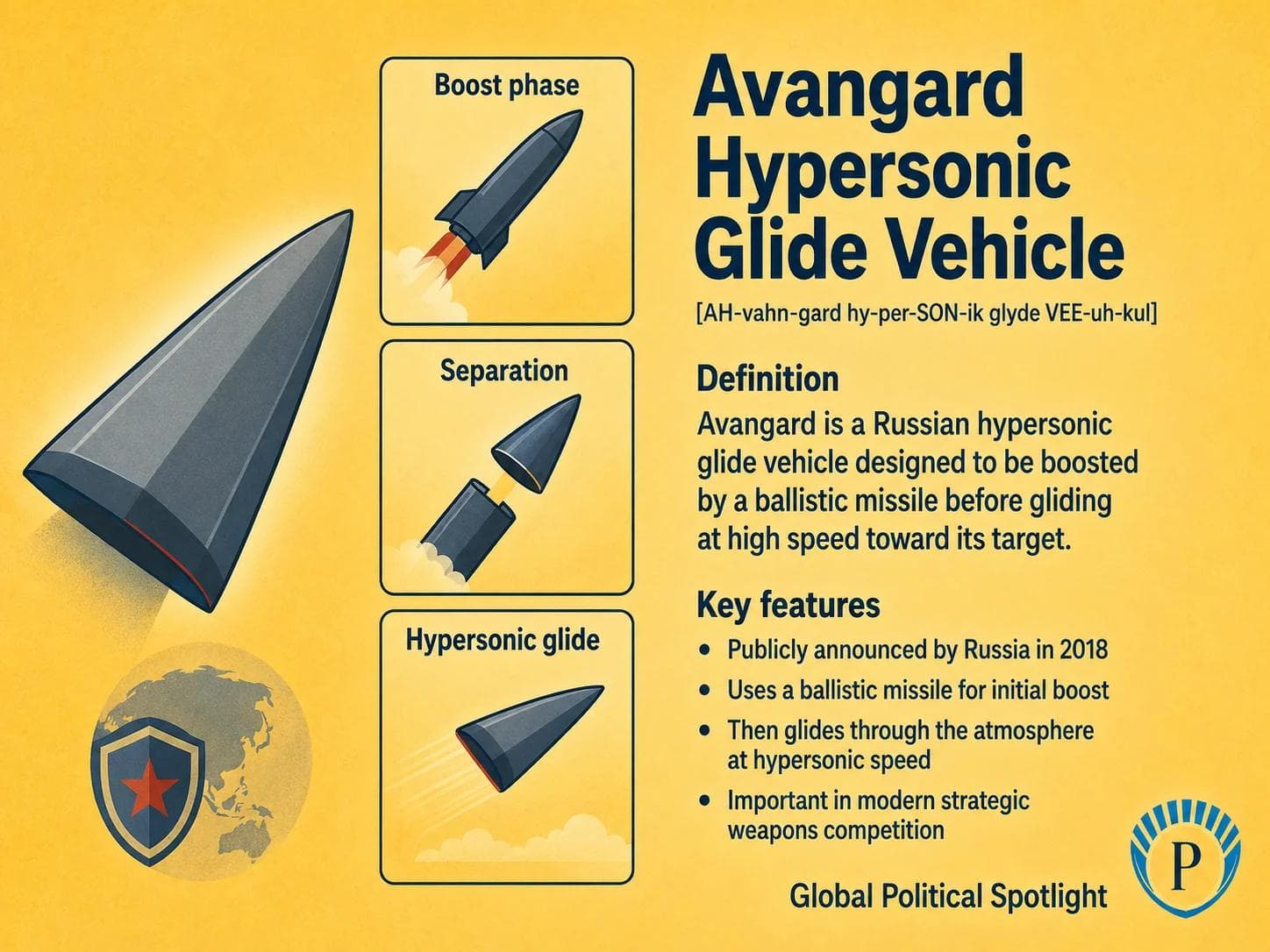
Avangard is a Russian hypersonic glide vehicle designed to be boosted by a ballistic missile, separate in flight, and glide at very high speed toward a target, complicating missile-defense planning.
Definition
Avangard is a Russian hypersonic glide vehicle designed to be carried upward by a ballistic missile booster and then separate from that booster before gliding through the atmosphere at very high speed. Unlike a conventional ballistic reentry vehicle, a hypersonic glide vehicle can follow a flatter and more maneuverable trajectory after separation.
The system is associated with Russia's strategic nuclear forces and is often discussed as part of wider competition over missile defenses, long-range strike capabilities, and advanced delivery systems. Public claims about exact performance should be treated cautiously, but the basic concept is that speed, maneuverability, and nontraditional flight paths make tracking and interception more difficult.
Why It Matters
Avangard matters because it illustrates how major powers are trying to preserve strategic deterrence in an environment shaped by missile-defense systems, precision strike, and advanced sensors. Its purpose is not only physical delivery but also political signaling: it demonstrates that Russia seeks ways to penetrate or complicate defenses.
The system also matters for arms-control and crisis-stability debates. Hypersonic glide vehicles can compress decision time, blur distinctions between conventional and nuclear delivery systems, and complicate verification because they combine ballistic-missile launch infrastructure with maneuvering payloads.
GPS should watch Avangard as a reference point for strategic weapons competition, missile-defense countermeasures, and the modernization of nuclear delivery systems. Long-term indicators include Russia's deployment claims, arms-control treatment of hypersonic systems, U.S. and allied missile-defense adaptation, and whether other powers accelerate similar glide-vehicle programs.
Key Facts
- Type
- Hypersonic glide vehicle
- Primary state actor
- Russia
- Launch concept
- Boosted by a ballistic missile before separating into a glide phase
- Flight profile
- Designed to glide through the atmosphere at hypersonic speed while maneuvering
- Strategic role
- Intended to strengthen strategic deterrence and complicate missile-defense planning
- Military domain
- Long-range strategic strike and nuclear delivery systems
- Defense challenge
- Maneuvering glide paths can make prediction, tracking, and interception harder than for simpler ballistic trajectories
- Arms-control relevance
- Raises verification and classification questions for future strategic arms-control frameworks
FAQ
What is the Avangard hypersonic glide vehicle?
Avangard is a Russian hypersonic glide vehicle designed to be boosted by a ballistic missile, separate during flight, and glide at very high speed toward a target while maneuvering.
How is Avangard different from a normal ballistic missile warhead?
A traditional ballistic reentry vehicle largely follows a predictable ballistic path after launch. A hypersonic glide vehicle like Avangard is designed to separate from its booster and glide through the atmosphere on a flatter, more maneuverable trajectory.
Why does Avangard matter for missile defense?
Avangard matters because maneuverability and unusual flight paths can make it harder for missile-defense systems to predict where the vehicle will go, track it continuously, and calculate an interception point.
Is Avangard a nuclear weapon?
Avangard is a delivery vehicle associated with Russia's strategic forces and is generally discussed in a nuclear-deterrence context. The vehicle itself is part of a wider weapon system that includes a booster, payload, command systems, and political authorization.
What are the limits of hypersonic glide vehicles?
Hypersonic glide vehicles still depend on launch platforms, command-and-control systems, targeting information, heat-resistant materials, testing, maintenance, and political decision-making. Their public performance claims are often difficult to verify independently.
How does Avangard affect arms control?
Avangard complicates arms-control discussions because it combines ballistic-missile launch infrastructure with a maneuvering payload. Future agreements may need to address how such systems are counted, verified, and distinguished from other long-range strike weapons.
Recent Developments
Russia announced Avangard had entered combat duty
Russian officials stated that the first Avangard-equipped missile regiment had entered combat duty, making the system a prominent symbol of Russia's strategic weapons modernization.
President of RussiaRussia suspended participation in New START implementation
Russia announced it would suspend participation in implementation of the New START treaty, adding uncertainty to the broader arms-control environment in which systems such as Avangard are discussed.
President of RussiaSources5 references
- President of Russia
Official Russian statement on Avangard entering combat duty.
- U.S. Congressional Research Service
Reference report on hypersonic weapons, including strategic context and missile-defense implications.
- Center for Strategic and International Studies Missile Defense Project
Reference profile of the Avangard hypersonic glide vehicle and its strategic context.
- U.S. Department of Defense: 2022 Missile Defense Review
Official U.S. policy document addressing missile-defense challenges and advanced missile threats.
- SIPRI
Institutional reference source for strategic weapons, arms-control trends, and nuclear-force modernization.

GPSNews App
Read GPSNews on iPhone
Daily geopolitical briefings, government updates, and prediction signals in one focused app.
Newsletter
Stay Ahead Of The Next Signal
Get briefings in your inbox when new analysis and reports are published.