
MQ-9 Reaper
A remotely piloted aircraft used for surveillance, reconnaissance, and precision strike
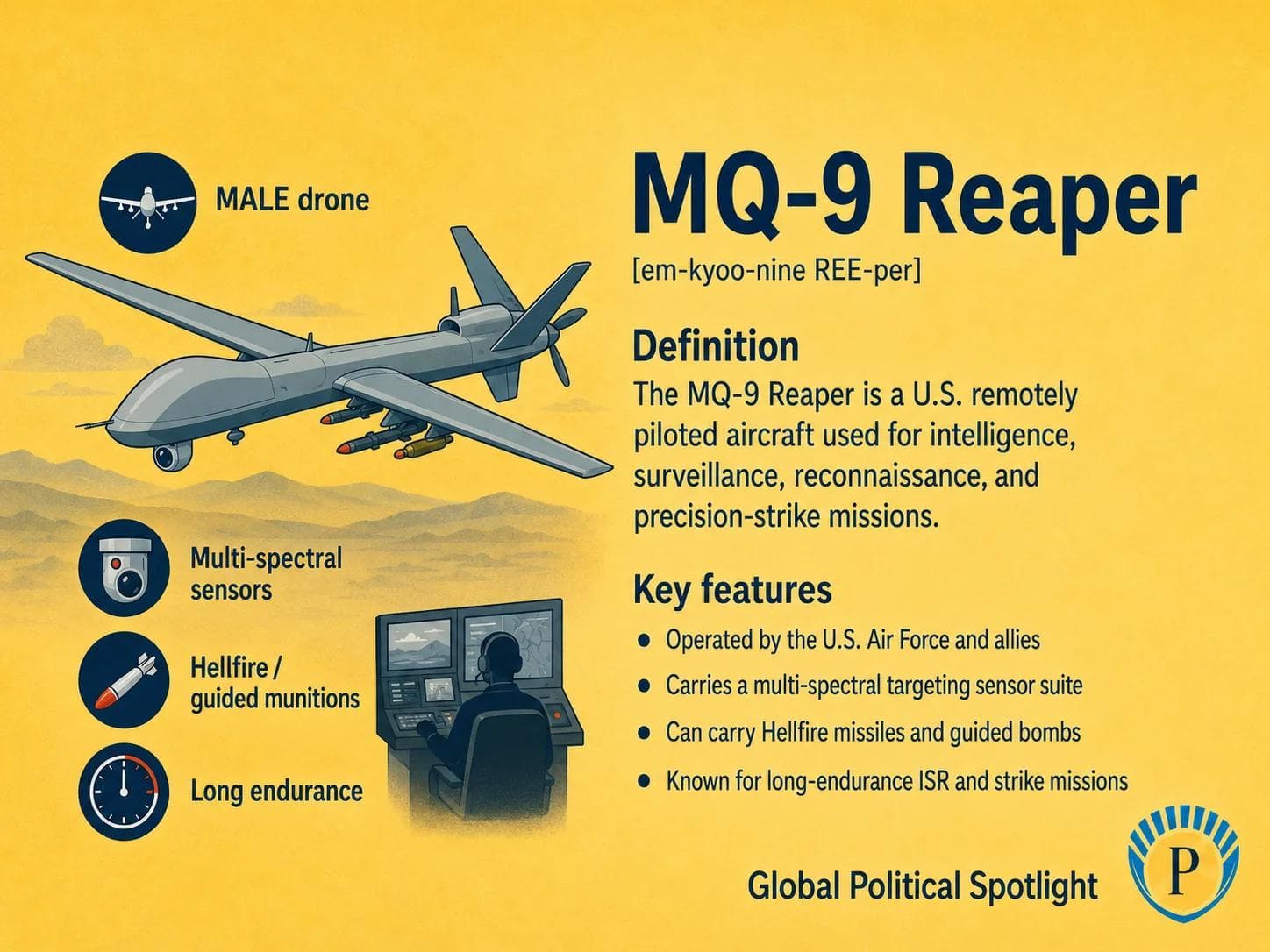
The MQ-9 Reaper is a U.S. remotely piloted aircraft used for intelligence, surveillance, reconnaissance, and precision-strike missions, combining long endurance, sensors, and guided munitions.
Definition
The MQ-9 Reaper is a U.S. remotely piloted aircraft designed for intelligence, surveillance, reconnaissance, and precision-strike missions. It belongs to the medium-altitude, long-endurance category of unmanned aircraft, often described as MALE drones.
The aircraft is operated by crews on the ground and can carry multi-spectral sensors, communications systems, and guided weapons such as Hellfire missiles and precision-guided bombs. Its role is not only to strike targets but also to monitor areas, track movements, support commanders, and provide persistent situational awareness.
Why It Matters
The MQ-9 Reaper matters because it became one of the most recognizable platforms of modern remotely piloted warfare. Its long endurance allows militaries to watch an area for extended periods, gather intelligence, and strike selected targets without placing an aircrew directly over the battlefield.
It also matters for geopolitics because the Reaper sits at the center of debates over drone exports, counterterrorism, civilian harm, airspace sovereignty, escalation management, and the vulnerability of slower drones in contested air-defense environments.
GPS should watch the MQ-9 Reaper as a reference point for remotely piloted airpower, persistent ISR, precision strike, and the evolution of drone warfare. Long-term indicators include allied procurement, export approvals, loss rates in contested airspace, sensor upgrades, munitions integration, autonomy debates, and the balance between persistent surveillance value and vulnerability to advanced air defenses.
Key Facts
- Type
- Medium-altitude long-endurance remotely piloted aircraft
- Primary operator
- United States Air Force, with use by several U.S. allies and partners
- Core missions
- Intelligence, surveillance, reconnaissance, target tracking, and precision strike
- Sensor role
- Uses multi-spectral sensors to support persistent observation and target identification
- Weapons role
- Can carry guided munitions such as Hellfire missiles and precision-guided bombs
- Control concept
- Flown by ground-based crews through remote-control and communications links
- Operational advantage
- Long endurance allows it to monitor areas for extended periods before, during, and after operations
- Main constraint
- More vulnerable in heavily defended airspace than stealth aircraft, fast jets, or stand-off weapons
FAQ
What is the MQ-9 Reaper?
The MQ-9 Reaper is a remotely piloted aircraft used for intelligence, surveillance, reconnaissance, and precision-strike missions. It is operated by ground crews and can carry sensors and guided weapons.
Is the MQ-9 Reaper a drone?
Yes. The MQ-9 Reaper is commonly called a drone, though the U.S. military often describes it as a remotely piloted aircraft because trained crews operate it from ground control stations.
What weapons can the MQ-9 Reaper carry?
The MQ-9 can carry guided munitions, including Hellfire missiles and precision-guided bombs. The exact loadout depends on mission requirements, operator configuration, and policy restrictions.
Why does the MQ-9 Reaper matter?
It matters because it combines long-endurance surveillance with precision-strike capability. This allows militaries to monitor target areas for long periods and conduct strikes without placing a pilot inside the aircraft.
Who uses the MQ-9 Reaper?
The United States is the primary operator, and several allied or partner militaries have acquired or operated MQ-9 variants. Its export and basing arrangements make it relevant to alliance operations and regional security.
What are the limits of the MQ-9 Reaper?
The MQ-9 is effective for persistence and strike in permissive or lightly defended airspace, but it is vulnerable to advanced air defenses, fighter aircraft, electronic warfare, communications disruption, and weather or basing constraints.
Recent Developments
U.S. MQ-9 was downed after encounter with Russian aircraft over the Black Sea
The U.S. Department of Defense said an MQ-9 Reaper was forced down after a Russian Su-27 aircraft struck its propeller over the Black Sea, highlighting the platform's role in surveillance missions and the escalation risks around contested airspace.
U.S. Department of DefenseU.S. planning continued to assess remotely piloted aircraft in contested environments
U.S. force-planning discussions continued to emphasize the need to adapt remotely piloted aircraft, sensors, and communications links for environments where drones face stronger air defenses and electronic warfare.
U.S. Department of DefenseSources6 references
- U.S. Air Force: MQ-9 Reaper Fact Sheet
Official U.S. Air Force reference describing the MQ-9 Reaper's mission, sensors, weapons, and operational role.
- General Atomics Aeronautical Systems
Manufacturer reference on the MQ-9A remotely piloted aircraft and its capabilities.
- U.S. Department of Defense
Official U.S. account of the March 2023 MQ-9 incident over the Black Sea.
- NATO
Institutional background on alliance adaptation, surveillance, and modern uncrewed systems.
- U.S. Congressional Research Service
Reference source for unmanned aircraft, arms transfers, and policy debates around remotely piloted systems.
- RAND Corporation
Research background on unmanned aerial vehicles and their military and policy implications.

GPSNews App
Read GPSNews on iPhone
Daily geopolitical briefings, government updates, and prediction signals in one focused app.
Newsletter
Stay Ahead Of The Next Signal
Get briefings in your inbox when new analysis and reports are published.