
Anti-Satellite Weapons
Counterspace systems designed to disrupt, disable, or destroy satellites
Anti-satellite weapons are counterspace systems designed to disrupt, disable, degrade, or destroy satellites, threatening communications, navigation, missile warning, weather monitoring, and Earth observation from orbit.
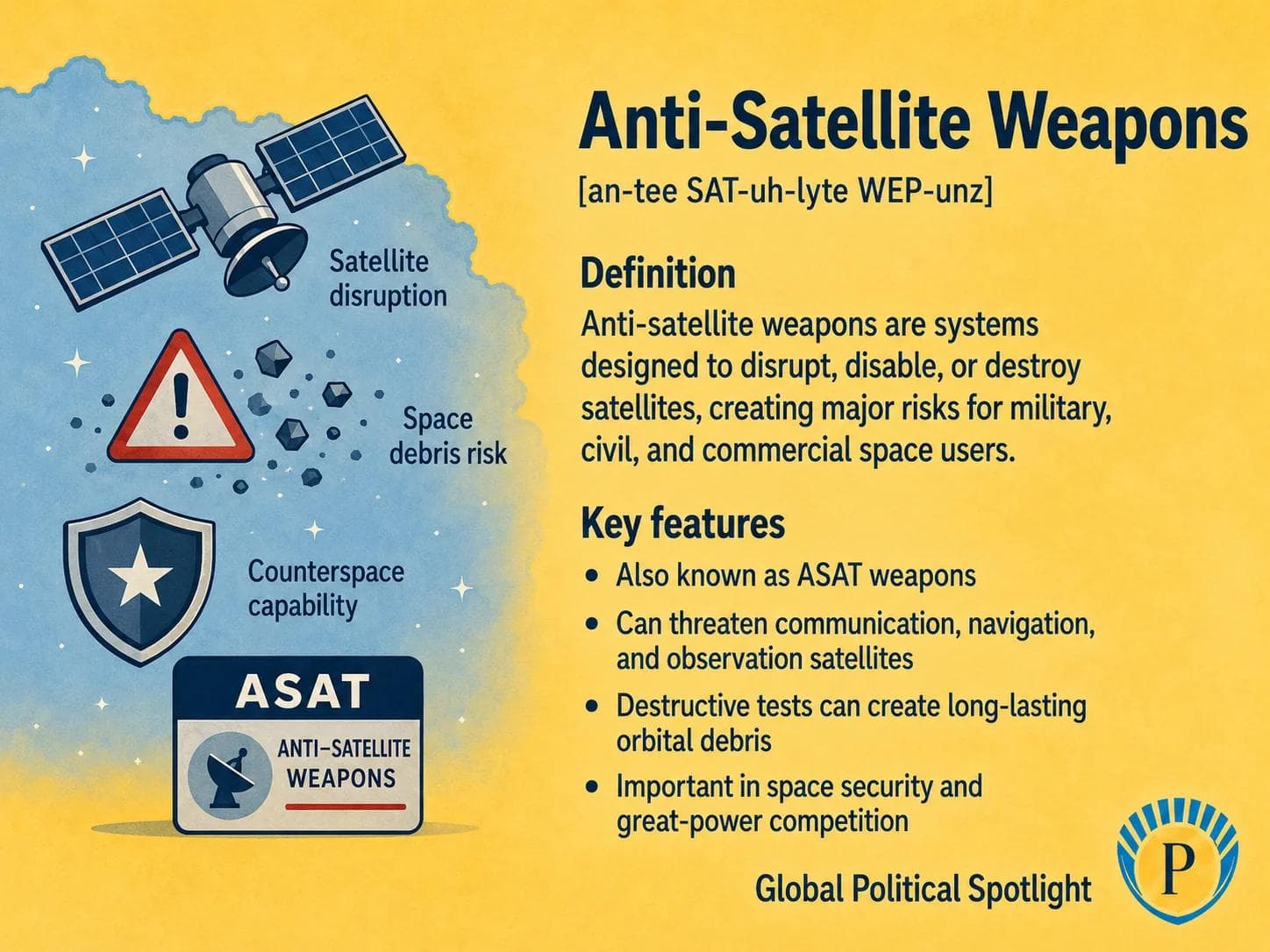
Definition
Anti-satellite weapons, often abbreviated ASAT weapons, are systems designed to disrupt, disable, degrade, or destroy satellites. They are part of the broader category of counterspace capabilities, which includes both destructive and non-destructive methods of interfering with space systems.
ASAT capabilities can include direct-ascent missiles launched from Earth, co-orbital systems that approach satellites in space, electronic warfare against satellite links, cyber operations against ground or network infrastructure, lasers or dazzlers, and other techniques that affect satellite performance.
The strategic importance of ASAT weapons comes from modern dependence on satellites for communications, navigation, intelligence, surveillance, reconnaissance, weather forecasting, missile warning, financial timing, and military command networks.
Why It Matters
Anti-satellite weapons matter because satellites are now part of the basic infrastructure of military power and civilian life. Disrupting them can affect battlefield awareness, precision navigation, global communications, disaster response, shipping, aviation, banking systems, and emergency services.
Destructive ASAT tests are especially controversial because they can create orbital debris that threatens other satellites for years. This makes anti-satellite weapons not only a military issue, but also a space governance, crisis stability, and global infrastructure problem.
GPS should monitor anti-satellite weapons as a core issue in great-power space security and military deterrence. Key watch areas include destructive ASAT testing, orbital debris norms, U.S., Chinese, Russian, and Indian counterspace capabilities, satellite resilience, commercial space vulnerability, and efforts to establish rules against debris-generating attacks in orbit.
Key Facts
- Type
- Counterspace capability
- Main purpose
- Disrupt, disable, degrade, or destroy satellites and related space infrastructure
- Common forms
- Direct-ascent missiles, co-orbital systems, electronic warfare, cyber operations, directed-energy systems, and signal interference
- Affected satellites
- Communications, navigation, Earth observation, missile warning, weather, intelligence, and military command satellites
- Major risk
- Destructive attacks can create orbital debris that threatens other satellites and spacecraft
- Strategic actors
- The United States, Russia, China, India, and other space-capable states are central to counterspace debates
- Civilian relevance
- Satellite disruption can affect GPS, banking timing, aviation, shipping, weather forecasts, communications, and emergency response
- Governance issue
- International debates focus on responsible behavior in space, debris mitigation, crisis stability, and restrictions on destructive ASAT testing
FAQ
What are anti-satellite weapons?
Anti-satellite weapons are systems designed to disrupt, disable, degrade, or destroy satellites. They can include missiles, co-orbital systems, electronic jamming, cyber operations, directed energy, and other counterspace methods.
Why are anti-satellite weapons important?
They are important because satellites support communications, GPS navigation, military targeting, intelligence collection, missile warning, weather forecasting, and financial timing. Disrupting satellites can affect both military operations and civilian infrastructure.
What is a direct-ascent ASAT weapon?
A direct-ascent ASAT weapon is launched from Earth to intercept a satellite in orbit. If it physically destroys the satellite, it can create debris that may threaten other spacecraft and satellites.
Do anti-satellite weapons always destroy satellites?
No. Some counterspace tools are non-kinetic and may jam signals, blind sensors, interfere with communications, or compromise networks without physically destroying a satellite. The effects can be temporary, reversible, or difficult to attribute.
Why is orbital debris a major concern?
Orbital debris travels at very high speeds and can damage or destroy other satellites. Debris from destructive ASAT tests can remain in orbit and create risks for civilian, commercial, and military space systems.
Are anti-satellite weapons illegal under international law?
International law regulates activities in outer space, but there is no universal treaty that bans all anti-satellite weapons. However, destructive debris-generating tests face growing diplomatic opposition and are central to debates over responsible behavior in space.
Recent Developments
Russia conducted a destructive direct-ascent anti-satellite test
Russia destroyed one of its own satellites in a direct-ascent ASAT test, generating orbital debris and intensifying international concern over destructive counterspace testing and long-term space safety.
U.S. Space CommandUnited Nations General Assembly supported a moratorium on destructive ASAT missile tests
The UN General Assembly adopted a resolution calling on states not to conduct destructive direct-ascent anti-satellite missile tests, reflecting growing diplomatic pressure to reduce debris-generating risks in space.
United Nations Digital LibrarySources6 references
- U.S. Space Command - Russian ASAT Test
Official U.S. Space Command statement on Russia's 2021 destructive direct-ascent anti-satellite test and debris risk.
- United Nations Office for Outer Space Affairs
Institutional source for outer space law, space sustainability, and international space governance.
- United Nations Digital Library - Destructive ASAT Test Resolution
UN General Assembly resolution on reducing space threats through norms against destructive direct-ascent anti-satellite missile testing.
- Secure World Foundation - Global Counterspace Capabilities
Reference research on global counterspace capabilities, including ASAT systems and space security trends.
- Center for Strategic and International Studies - Space Threat Assessment
Think tank reference for space threats, counterspace capabilities, and great-power competition in orbit.
- NASA - Orbital Debris Program Office
Official reference on orbital debris, collision risk, and debris mitigation concerns.

GPSNews App
Read GPSNews on iPhone
Daily geopolitical briefings, government updates, and prediction signals in one focused app.
Newsletter
Stay Ahead Of The Next Signal
Get briefings in your inbox when new analysis and reports are published.