
NORAD
The U.S.-Canada command for aerospace warning, air defense, and North American homeland security
NORAD is a binational U.S.-Canada command responsible for aerospace warning, airspace monitoring, missile warning, and aerospace control for the defense of North America.
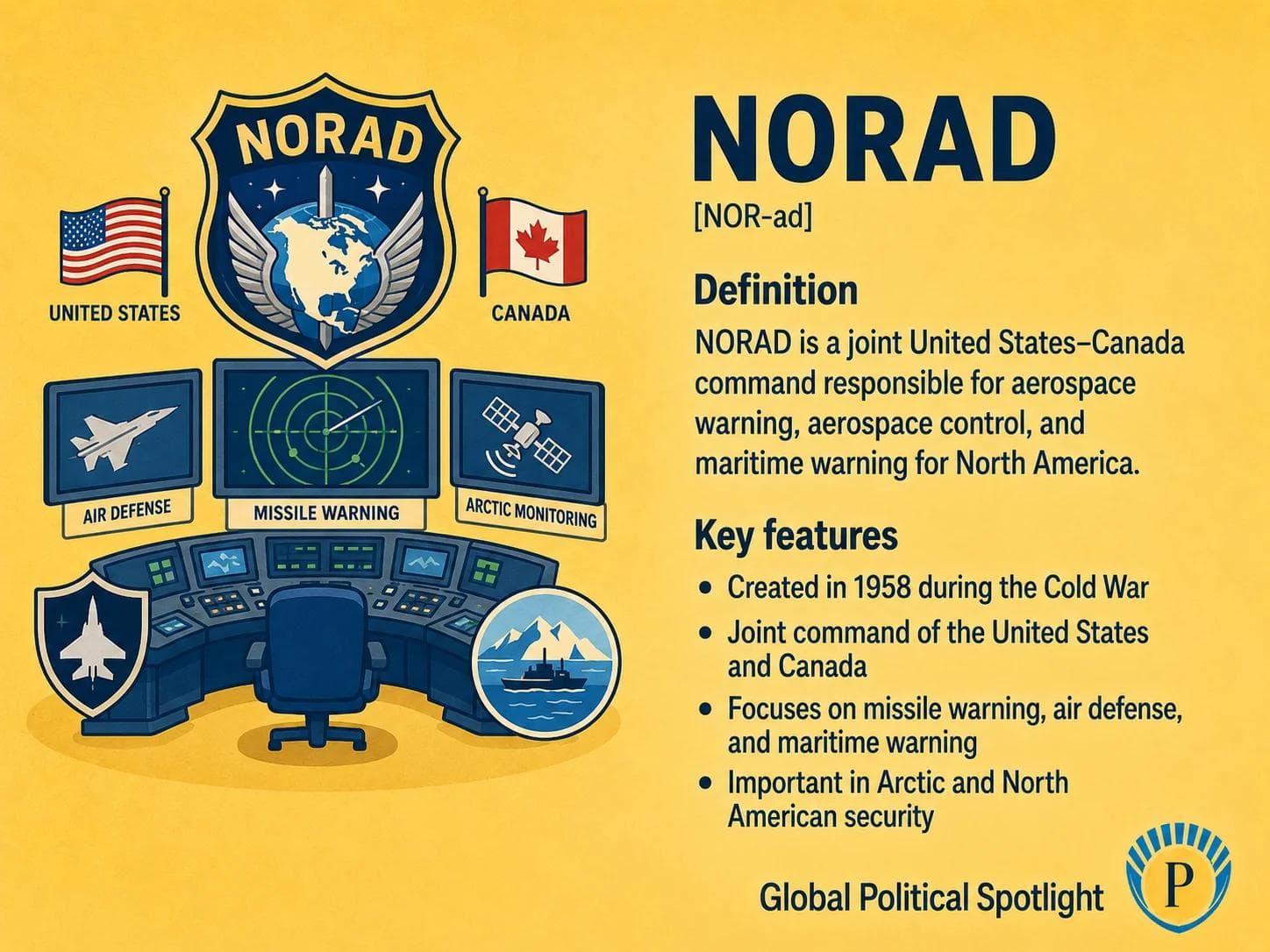
Definition
The North American Aerospace Defense Command, known as NORAD, is a binational command operated by the United States and Canada. It is responsible for aerospace warning, aerospace control, and maritime warning in defense of North America.
NORAD monitors North American airspace through radar, satellites, command-and-control systems, and coordination with U.S. and Canadian military forces. Its mission includes detecting and tracking aircraft, missiles, and other aerospace threats, then coordinating defensive responses when required.
The command is especially associated with Arctic approaches to North America, where geography, long distances, missile trajectories, bomber routes, and emerging hypersonic and cruise missile risks make early warning and surveillance strategically important.
Why It Matters
NORAD matters because North American defense depends on detecting threats before they reach U.S. or Canadian territory. Warning time, radar coverage, air defense readiness, and command coordination are central to deterrence, crisis management, and homeland security.
The command is geopolitically important because Russia’s long-range aviation, missile capabilities, Arctic military posture, and new delivery systems keep the northern approaches strategically relevant. NORAD also supports responses to unusual airspace incidents, including unidentified aerial objects, unauthorized aircraft, and potential missile threats.
NORAD is also a pillar of U.S.-Canada defense cooperation. It links sovereignty, alliance politics, Arctic security, missile warning, radar modernization, and defense spending debates in a single binational command structure.
NORAD should be watched as a core institution of North American homeland defense and U.S.-Canada military integration. GPS should track radar modernization, Arctic surveillance, missile warning upgrades, hypersonic and cruise missile threats, Russian long-range aviation activity, air defense readiness, Canada-U.S. burden-sharing debates, and how NORAD adapts to new aerospace and maritime warning requirements.
Key Facts
- Full name
- North American Aerospace Defense Command
- Type
- Binational aerospace warning and defense command
- Countries
- United States and Canada
- Established
- 1958, during the Cold War
- Headquarters
- Peterson Space Force Base, Colorado, with major command facilities linked to Cheyenne Mountain
- Core missions
- Aerospace warning, aerospace control, and maritime warning for North America
- Strategic geography
- Arctic approaches are central because many long-range air and missile pathways to North America pass over or near northern regions
- Modernization challenge
- NORAD must adapt legacy radar and command systems to cruise missiles, hypersonic systems, drones, cyber risks, and wider Arctic activity
FAQ
What is NORAD?
NORAD is the North American Aerospace Defense Command, a binational U.S.-Canada command responsible for aerospace warning, aerospace control, and maritime warning for the defense of North America.
Which countries run NORAD?
NORAD is jointly operated by the United States and Canada. It is a binational command, meaning both countries participate in its mission, leadership structure, and defense cooperation.
Why does NORAD matter?
NORAD matters because it provides early warning and defense coordination against air and missile threats to North America. Its work supports deterrence, crisis response, homeland security, and U.S.-Canada defense cooperation.
Does NORAD only watch the Arctic?
No. NORAD monitors threats to North America across multiple approaches, but the Arctic is especially important because of geography, long-range aviation routes, missile trajectories, and the difficulty of operating sensors and infrastructure in northern regions.
What is the difference between NORAD and NATO?
NORAD is a U.S.-Canada binational command focused on North American aerospace warning and defense. NATO is a wider military alliance of many countries. The United States and Canada are both NATO members, but NORAD is a separate command structure.
What are the limits of NORAD?
NORAD depends on sensors, warning time, command systems, interceptor readiness, and political authorization. Its modernization challenge is to detect and track newer threats such as low-flying cruise missiles, hypersonic systems, drones, and activity across the Arctic.
Recent Developments
Canada announced major NORAD modernization funding
Canada announced a long-term investment plan to modernize NORAD capabilities, including surveillance systems, command and control, infrastructure, and Arctic-focused defenses, reinforcing the command’s continuing relevance to North American aerospace warning.
Government of CanadaNORAD publicly highlighted airspace monitoring after high-altitude object incidents
The U.S. and Canada relied on NORAD tracking and aerospace control processes during a series of high-altitude object incidents, illustrating the command’s role in airspace monitoring, threat assessment, and homeland defense coordination.
NORADSources6 references
- NORAD Official Website
Official public source for NORAD’s mission, structure, history, and public statements.
- NORAD Mission
Official NORAD overview of its aerospace warning, aerospace control, and maritime warning responsibilities.
- U.S. Northern Command
Official U.S. command source relevant to homeland defense and NORAD’s operational environment.
- Government of Canada NORAD Modernization
Official Canadian source on NORAD modernization, Arctic surveillance, infrastructure, and defense investments.
- Canadian Armed Forces NORAD
Official Canadian source explaining Canada’s role in NORAD and North American aerospace defense.
- Encyclopaedia Britannica
Reference overview of NORAD’s history, Cold War origins, and institutional role.

GPSNews App
Read GPSNews on iPhone
Daily geopolitical briefings, government updates, and prediction signals in one focused app.
Newsletter
Stay Ahead Of The Next Signal
Get briefings in your inbox when new analysis and reports are published.