
Drone Dome
An Israeli counter-UAS system for detecting, tracking, identifying, and disrupting unauthorized drones
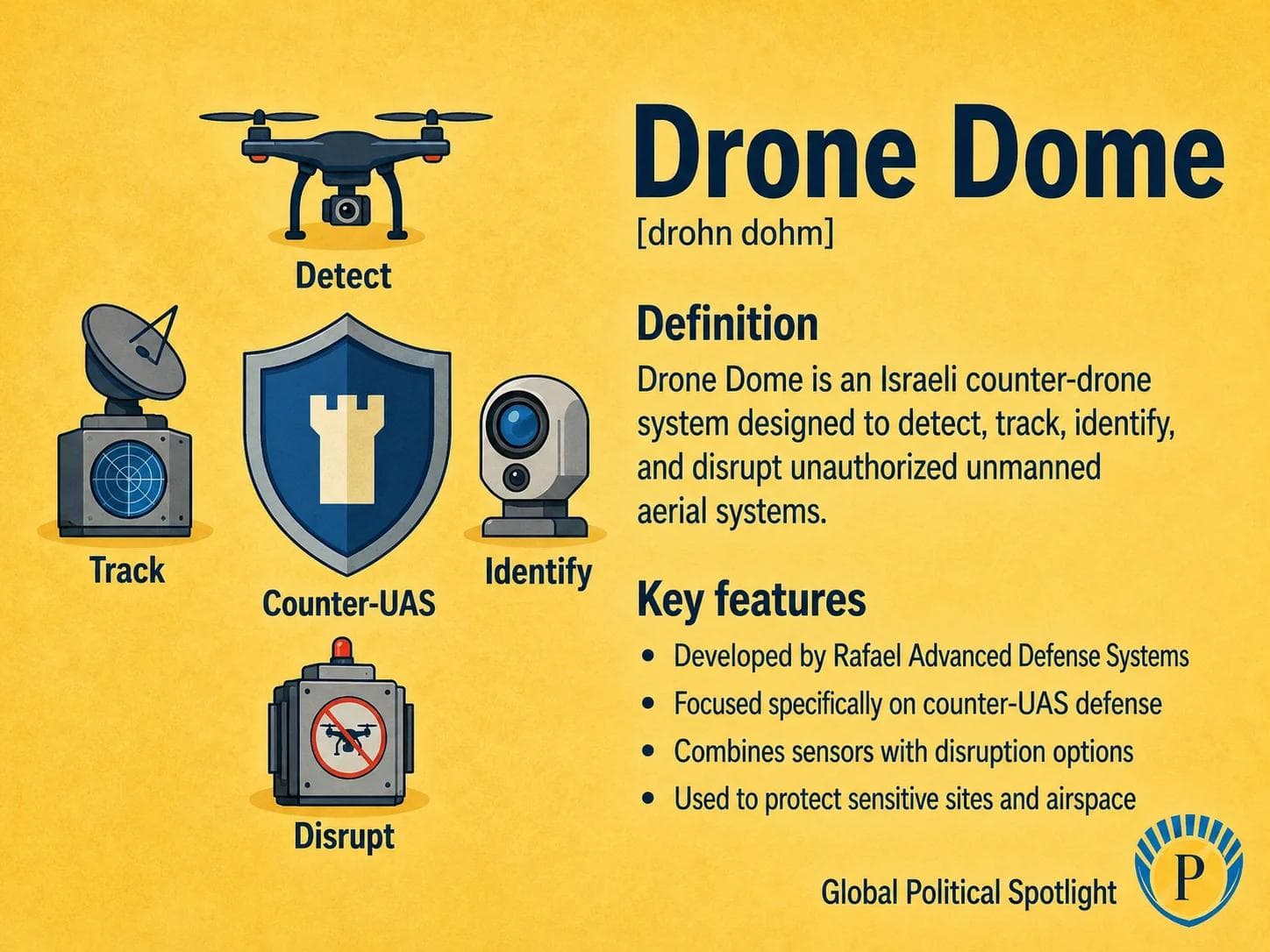
Drone Dome is an Israeli counter-drone system designed to detect, track, identify, and disrupt unauthorized unmanned aerial systems around sensitive sites, borders, military assets, and critical infrastructure.
Definition
Drone Dome is a counter-unmanned aerial system developed by Rafael Advanced Defense Systems to protect sensitive sites, military forces, borders, airports, and critical infrastructure from unauthorized drones. It combines sensors, tracking systems, command-and-control tools, and disruption methods into an integrated counter-UAS architecture.
The system is designed to detect and track small unmanned aerial systems, help operators identify whether a drone is a threat, and then use soft-kill measures such as electronic disruption to interfere with the drone's control, navigation, or communication links. Some configurations may also be paired with additional defeat mechanisms depending on mission requirements.
Drone Dome is part of a wider shift in airspace security: drones are no longer only military tools, but also low-cost systems that can threaten civilian infrastructure, public events, borders, and military bases. Counter-UAS systems therefore sit between traditional air defense, electronic warfare, site security, and homeland protection.
Why It Matters
Drone Dome matters because small drones can be inexpensive, widely available, difficult to detect, and useful for surveillance, smuggling, harassment, or attack. Protecting sensitive airspace increasingly requires systems that can detect small aerial objects before they create operational, political, or public-safety consequences.
The system also illustrates a major doctrinal change in modern defense: not every aerial threat is best handled by a missile interceptor or aircraft. Counter-UAS defense often depends on layered sensors, electronic warfare, rapid identification, legal authorization, and proportional disruption tools.
For governments and militaries, counter-drone systems raise strategic and regulatory questions about airspace control, civil aviation safety, critical infrastructure protection, border security, and the balance between disabling a drone and avoiding collateral effects from jamming or physical interception.
Drone Dome is a useful reference point for tracking the global expansion of counter-UAS doctrine, especially where states face cheap drones near borders, bases, airports, public events, energy infrastructure, and military assets. GPS should watch how counter-drone systems integrate radar, optical sensors, electronic warfare, artificial intelligence, and hard-kill options, as well as how governments regulate disruption tools in civilian airspace.
Key Facts
- Type
- Counter-unmanned aerial system
- Developer
- Rafael Advanced Defense Systems
- Primary role
- Detects, tracks, identifies, and disrupts unauthorized drones
- Threat focus
- Small unmanned aerial systems used for surveillance, disruption, smuggling, or attack
- Core components
- Radar, electro-optical sensors, command-and-control systems, and electronic disruption tools
- Defense method
- Primarily soft-kill disruption of drone control, navigation, or communication links
- Protected sites
- Military bases, borders, airports, public events, critical infrastructure, and sensitive facilities
- Key limitation
- Effectiveness depends on detection conditions, rules of engagement, signal environment, drone autonomy, and legal limits on jamming
FAQ
What is Drone Dome?
Drone Dome is an Israeli counter-UAS system developed by Rafael Advanced Defense Systems. It is designed to detect, track, identify, and disrupt unauthorized drones around sensitive sites, military assets, borders, airports, and critical infrastructure.
How does Drone Dome work?
Drone Dome uses sensors such as radar and electro-optical systems to detect and track drones. Operators can then identify the drone and, when authorized, use disruption methods such as jamming to interfere with its control, navigation, or communications.
Is Drone Dome the same as Iron Dome?
No. Iron Dome is a short-range missile-defense system mainly associated with intercepting rockets, mortars, artillery shells, and some aerial threats. Drone Dome is a counter-drone system focused on detecting, identifying, tracking, and disrupting unmanned aerial systems.
Why are counter-drone systems important?
Counter-drone systems are important because small drones are cheap, accessible, and capable of surveillance, smuggling, disruption, or attack. Sensitive sites need tools that can detect small aerial threats early and respond without necessarily using expensive missile interceptors.
What are the limits of Drone Dome?
Like other counter-UAS systems, Drone Dome can be affected by terrain, cluttered signal environments, drone autonomy, legal restrictions on jamming, sensor range, weather, and rules of engagement. A drone that does not rely on external control signals may be harder to disrupt with soft-kill methods.
Where would a system like Drone Dome be used?
Systems like Drone Dome may be used around military bases, borders, airports, public events, energy infrastructure, government buildings, ports, and other sensitive facilities where unauthorized drones create security, safety, or intelligence risks.
Recent Developments
Sources6 references
- Rafael Advanced Defense Systems
Official Rafael overview of Drone Dome's counter-UAS detection, tracking, identification, and disruption role.
- Rafael Advanced Defense Systems
Official Rafael background on counter-UAS capabilities and system architecture.
- NATO
Institutional background on unmanned aircraft systems and the growing security relevance of drone threats.
- U.S. Federal Aviation Administration
Official reference on unmanned aircraft systems and airspace safety considerations.
- Congressional Research Service
Institutional overview of counter-drone systems, policy challenges, and U.S. counter-UAS considerations.
- European Union Aviation Safety Agency
European institutional reference on drone regulation and airspace safety.

GPSNews App
Read GPSNews on iPhone
Daily geopolitical briefings, government updates, and prediction signals in one focused app.
Newsletter
Stay Ahead Of The Next Signal
Get briefings in your inbox when new analysis and reports are published.