
Iron Dome
Israel's short-range air-defense system for intercepting rockets, mortars, artillery shells, and some unmanned aerial threats
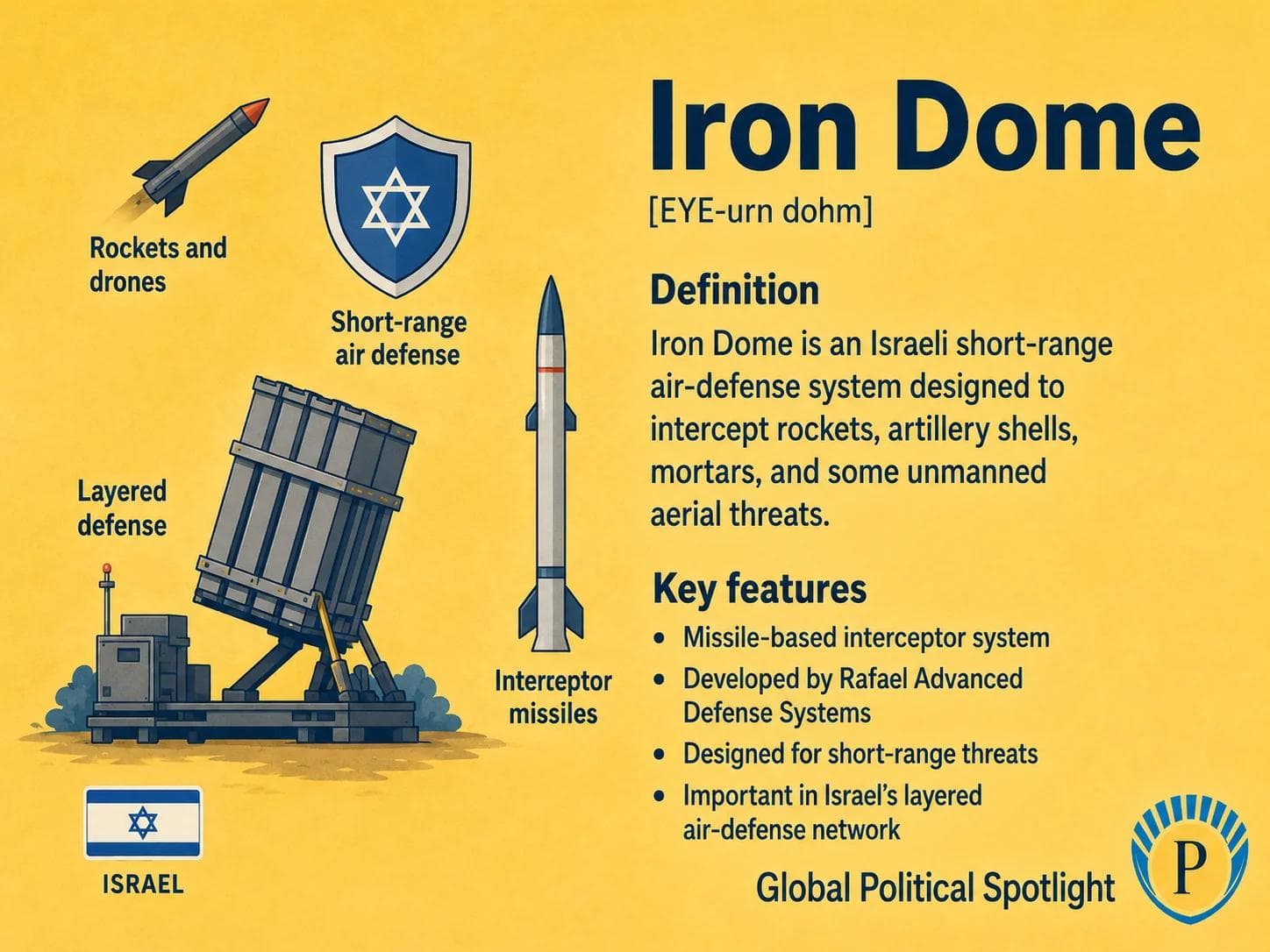
Iron Dome is an Israeli short-range air-defense system designed to detect, track, and intercept incoming rockets, artillery shells, mortars, and some unmanned aerial threats before they reach populated or protected areas.
Definition
Iron Dome is a mobile short-range air-defense system developed by Rafael Advanced Defense Systems with Israeli defense partners and U.S. support. It is designed to detect incoming rockets, artillery shells, mortars, and some unmanned aerial threats, calculate whether they are likely to hit a protected area, and launch interceptor missiles only against threats assessed as dangerous.
The system is commonly described as part of Israel's layered air and missile defense architecture, alongside other systems intended for longer-range ballistic missile, cruise missile, and aircraft threats. Its core components include detection and tracking radar, a battle management and weapon control unit, and launchers carrying Tamir interceptor missiles.
Why It Matters
Iron Dome matters because it changes the strategic and political effects of short-range rocket fire. By reducing casualties and damage from many incoming projectiles, it can give decision-makers more time and flexibility during crises, while also shaping deterrence, escalation risks, and public expectations of homeland defense.
The system also highlights the growing importance of counter-rocket, counter-artillery, counter-mortar, and counter-drone defense in modern warfare. Its role is not absolute protection; saturation attacks, cost asymmetries, drone adaptation, and ammunition supply all remain important operational constraints.
Iron Dome is a durable reference point for understanding Israeli homeland security, counter-rocket defense, U.S.-Israel defense cooperation, and the wider shift toward layered air defense against rockets, drones, and mixed aerial threats. GPS should watch interceptor supply, system upgrades, export interest, adversary saturation tactics, and how the system affects escalation calculations during regional crises.
Key Facts
- Type
- Short-range air-defense and counter-rocket system
- Primary operator
- Israel
- Developer
- Rafael Advanced Defense Systems, with Israeli defense partners
- Main interceptor
- Tamir interceptor missile
- Threat focus
- Rockets, artillery shells, mortars, and some unmanned aerial threats
- Defense role
- Protects populated areas and strategic sites from short-range aerial threats
- Strategic context
- Part of Israel's broader layered air and missile defense architecture
- Key limitation
- Can be pressured by saturation attacks, interceptor supply limits, and evolving drone or rocket tactics
FAQ
What is Iron Dome?
Iron Dome is an Israeli short-range air-defense system designed to intercept rockets, artillery shells, mortars, and some unmanned aerial threats. It uses radar and battle-management software to decide which incoming projectiles threaten protected areas before launching interceptor missiles.
How does Iron Dome work?
Iron Dome detects an incoming threat with radar, tracks its trajectory, estimates where it is likely to land, and launches a Tamir interceptor if the projectile is assessed to threaten a populated area or protected site. This selective firing approach helps conserve interceptors.
Why does Iron Dome matter geopolitically?
Iron Dome matters because it affects Israel's homeland security, crisis management, deterrence, and escalation dynamics. By reducing the impact of many short-range attacks, it can alter the political cost of rocket fire and the timing of military responses.
Can Iron Dome stop all rockets and drones?
No. Iron Dome is an important defensive system, but it is not a perfect shield. Large salvos, saturation tactics, interceptor shortages, complex drone attacks, and threats outside its intended engagement envelope can reduce its effectiveness.
Who makes Iron Dome?
Iron Dome was developed by Rafael Advanced Defense Systems with Israeli defense partners. The United States has also provided significant support for procurement, co-production, and related Israeli air-defense funding.
Is Iron Dome part of a larger defense network?
Yes. Iron Dome is generally understood as the short-range layer in Israel's broader air and missile defense architecture, which also includes systems intended for longer-range rockets, ballistic missiles, cruise missiles, aircraft, and other aerial threats.
Recent Developments
Layered air defense remained central during regional missile and drone attacks
Iran's large-scale missile and drone attack on Israel in April 2024 reinforced the strategic importance of layered air defense, including systems designed for different ranges and threat types. Iron Dome is one component of that wider defensive architecture.
Israel Ministry of Foreign AffairsU.S. legislation continued support for Israeli air-defense systems
U.S. supplemental security legislation in 2024 included funding associated with Israeli air and missile defense, reflecting the long-running role of U.S.-Israel defense cooperation in sustaining systems such as Iron Dome.
U.S. CongressSources5 references
- Rafael Advanced Defense Systems
Official Rafael overview of Iron Dome's purpose, components, and air-defense role.
- Israel Ministry of Defense
Official Israeli defense background on Iron Dome and its role in Israeli air defense.
- Congressional Research Service
Institutional reference on U.S. foreign aid and defense support to Israel, including missile defense cooperation.
- U.S. Missile Defense Agency
U.S. government reference page on Iron Dome and missile defense cooperation.
- Center for Strategic and International Studies Missile Defense Project
Reference background on Iron Dome's development, role, and technical context.

GPSNews App
Read GPSNews on iPhone
Daily geopolitical briefings, government updates, and prediction signals in one focused app.
Newsletter
Stay Ahead Of The Next Signal
Get briefings in your inbox when new analysis and reports are published.