
Iron Beam
Israel's high-energy laser air-defense system for countering drones, rockets, mortars, and other short-range aerial threats
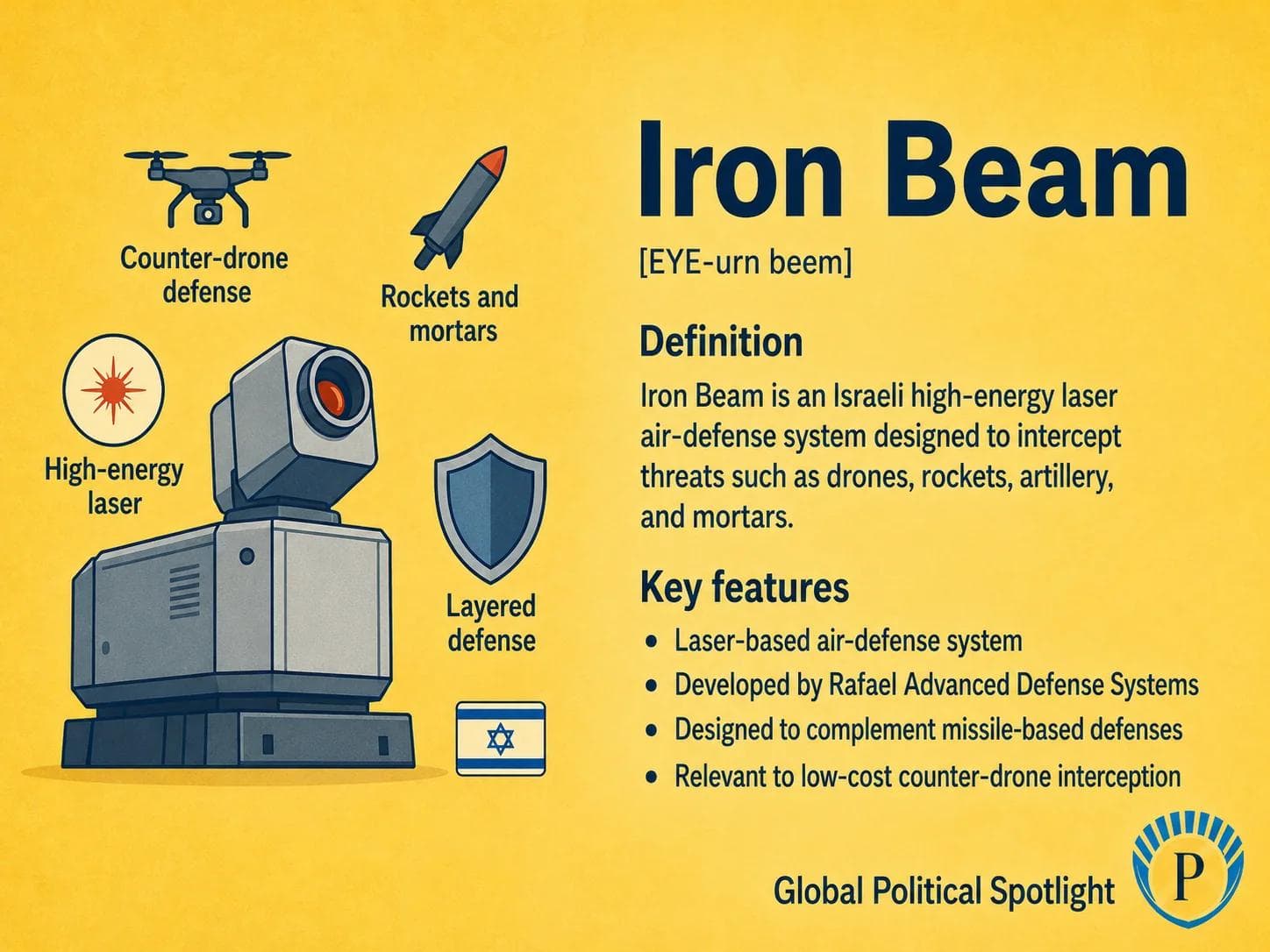
Iron Beam is an Israeli high-energy laser air-defense system designed to intercept short-range aerial threats such as drones, rockets, artillery shells, and mortars, complementing missile-based systems in layered defense.
Definition
Iron Beam is an Israeli high-energy laser weapon system developed by Rafael Advanced Defense Systems, with Israeli defense partners and defense-ministry backing. It is designed to use directed energy to neutralize short-range aerial threats such as drones, rockets, artillery shells, and mortars.
Unlike missile-based interceptors, Iron Beam engages threats with a laser beam rather than a kinetic missile. Its strategic purpose is to complement systems such as Iron Dome, David's Sling, and Arrow by adding a lower-cost interception layer for suitable short-range targets.
The system's effectiveness depends on factors common to directed-energy weapons, including target exposure time, atmospheric conditions, power generation, beam control, and line of sight. It is therefore best understood as an additional defensive layer, not a universal replacement for missile interceptors.
Why It Matters
Iron Beam matters because modern air defense increasingly faces cheap, numerous, and adaptable threats such as drones, rockets, and mortars. A laser interceptor can shift the cost equation by reducing reliance on expensive missiles for every suitable incoming target.
For Israel, Iron Beam strengthens the logic of layered homeland defense: different systems cover different threat types, ranges, and engagement conditions. For other militaries, it is a closely watched example of how directed-energy systems may enter operational air-defense doctrine.
The geopolitical significance is not only technical. If laser defenses become reliable at scale, they could influence escalation dynamics, procurement priorities, defense-industrial partnerships, and the balance between low-cost attack systems and expensive defensive interceptors.
Iron Beam is a key reference point for the transition from purely missile-based interception toward mixed air-defense architectures that combine kinetic interceptors, sensors, command systems, and directed-energy weapons. GPS should watch operational integration with Iron Dome, weather and line-of-sight limitations, counter-drone performance, U.S.-Israel technology cooperation, export interest, and whether low-cost laser engagement changes the economics of rocket and drone warfare.
Key Facts
- Type
- High-energy laser air-defense system
- Primary operator
- Israel
- Developer
- Rafael Advanced Defense Systems, with Israeli defense partners
- Defense role
- Short-range interception layer for drones, rockets, artillery, and mortars
- Interception method
- Directed-energy laser engagement rather than a kinetic missile interceptor
- Strategic logic
- Adds a lower-cost defensive layer to complement missile systems such as Iron Dome
- Operational constraints
- Performance can depend on weather, atmosphere, target visibility, power supply, and line of sight
- Wider significance
- Part of the global move toward counter-drone and directed-energy air defense
FAQ
What is Iron Beam?
Iron Beam is an Israeli high-energy laser air-defense system designed to intercept short-range aerial threats such as drones, rockets, artillery shells, and mortars. It is intended to complement, not replace, missile-based air-defense systems.
How does Iron Beam work?
Iron Beam uses directed energy to focus a laser on a target long enough to damage or neutralize it. The system depends on detection, tracking, beam control, power generation, and a clear line of sight to the threat.
Why is Iron Beam considered low cost?
Laser systems can have much lower marginal firing costs than missile interceptors because each engagement uses electrical energy rather than a separate interceptor missile. However, the full system still requires sensors, power, maintenance, operators, and integration with wider defense networks.
Does Iron Beam replace Iron Dome?
No. Iron Beam is designed to complement Iron Dome and other systems in a layered defense architecture. Missile interceptors remain important for threats, ranges, weather conditions, and tactical situations where a laser may not be the best engagement option.
What are Iron Beam's limitations?
Directed-energy systems can be affected by weather, dust, smoke, atmospheric distortion, target movement, target hardness, and line-of-sight constraints. They also require sufficient power and time on target, which makes integration with other air-defense layers essential.
Why does Iron Beam matter for counter-drone defense?
Drones can be cheap, numerous, and difficult to counter economically with expensive missiles. Iron Beam is geopolitically important because it points toward a defensive model where lasers help reduce the cost imbalance between low-cost drones and high-cost interceptors.
Recent Developments
Israel announced Iron Beam had completed operational testing
Israel's Ministry of Defense said Iron Beam completed successful trials and was expected to become operational, framing the system as a laser-based addition to Israel's multi-layered air-defense architecture.
Israel Ministry of DefenseIsrael delivered the first operational Iron Beam system to the IDF
Israel's Ministry of Defense and Rafael announced delivery of the first operational high-power laser Iron Beam system to the Israel Defense Forces, presenting it as an additional layer in Israel's air-defense network.
Israel Ministry of DefenseSources6 references
- Rafael Advanced Defense Systems
Official Rafael overview of Iron Beam's high-energy laser role, threat set, and low-cost interception logic.
- Israel Ministry of Defense
Official Israeli announcement on delivery of the first operational Iron Beam system to the IDF.
- Israel Ministry of Defense
Official Israeli announcement on operational testing and integration plans for Iron Beam.
- Lockheed Martin
Company announcement on Lockheed Martin and Rafael collaboration on high-energy laser defense.
- Congress.gov
U.S. legislative reference for 2024 supplemental security funding connected to Israeli defense support.
- Center for Strategic and International Studies Missile Defense Project
Reference background on Iron Beam, directed-energy air defense, and Israel's layered defense architecture.

GPSNews App
Read GPSNews on iPhone
Daily geopolitical briefings, government updates, and prediction signals in one focused app.
Newsletter
Stay Ahead Of The Next Signal
Get briefings in your inbox when new analysis and reports are published.