
Jamming vs. Kinetic Intercept
A comparison of soft-kill and hard-kill counter-drone methods
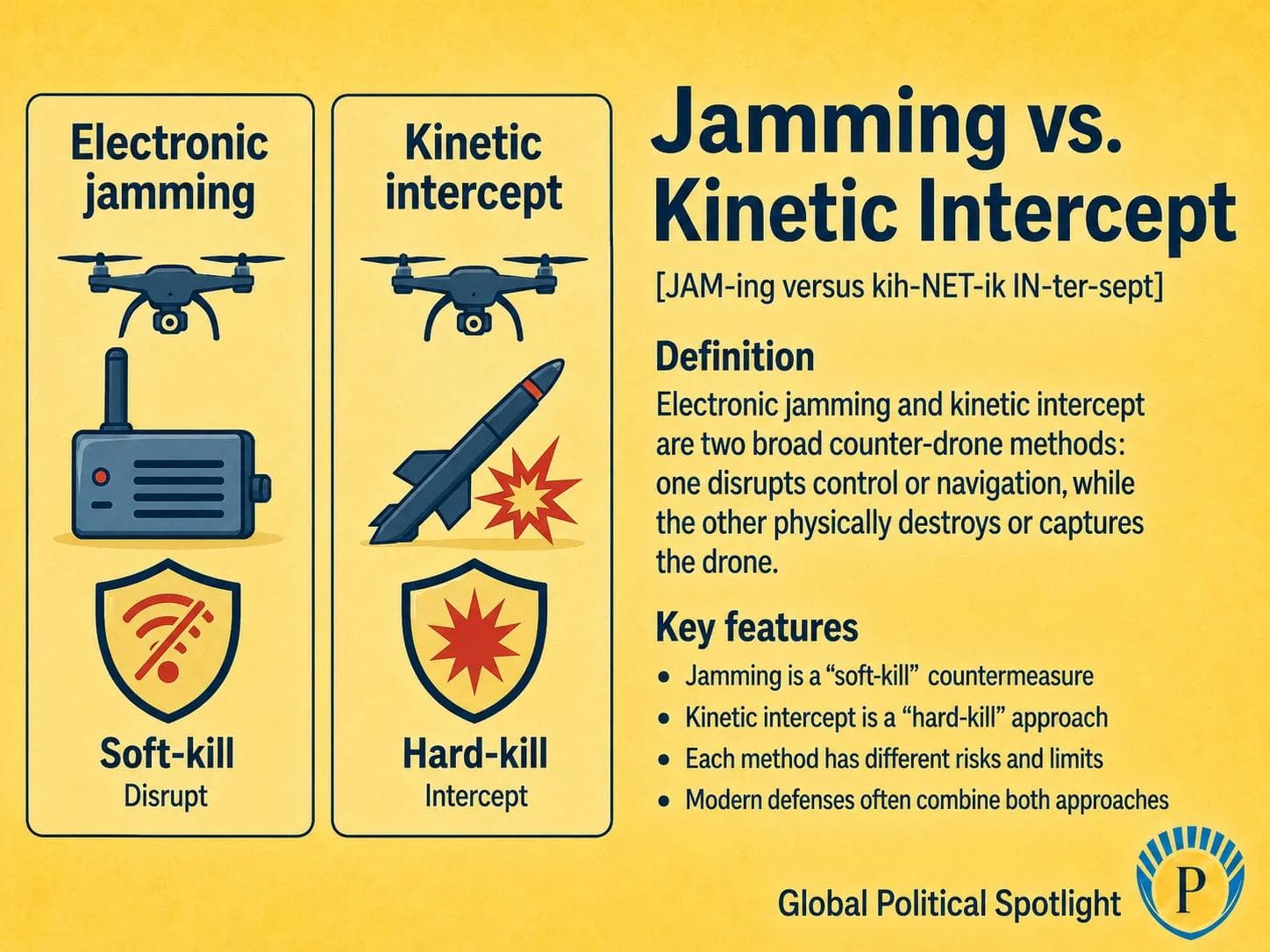
Jamming and kinetic intercept are two counter-drone methods: jamming disrupts control or navigation signals as a soft-kill approach, while kinetic intercept physically destroys, disables, or captures the drone.
Definition
Jamming and kinetic intercept are two broad approaches to countering drones and other uncrewed aerial systems. Jamming is a soft-kill method that uses electronic interference to disrupt a drone's control link, navigation signal, data transmission, or sensor operation.
Kinetic intercept is a hard-kill method that physically defeats the drone through destruction, collision, capture, or disabling force. Examples can include gunfire, missiles, interceptor drones, nets, or other systems designed to stop the aircraft by physical contact or explosive effect.
Why It Matters
The comparison matters because drones create different risks depending on their size, speed, payload, autonomy, target, and operating environment. A cheap quadcopter near a base, a loitering munition near artillery, and a long-range one-way attack drone may require different combinations of detection, jamming, interception, and command decisions.
Jamming can reduce collateral damage by avoiding an explosion or debris field, but it may fail against autonomous drones, hardened links, or pre-programmed navigation. Kinetic intercept can provide a clearer physical defeat, but it may be more expensive, create falling debris, consume ammunition, and pose risks in populated or sensitive areas.
Modern counter-UAS doctrine therefore tends to emphasize layered defense: detect, track, identify, decide, and defeat using a mix of soft-kill and hard-kill tools. The challenge is matching the response to the threat while managing cost, legal constraints, escalation risk, and collateral effects.
GPS should watch jamming versus kinetic intercept as a core counter-UAS framework shaping modern force protection, air defense, base security, and urban defense planning. Long-term indicators include electronic-warfare adaptation, drone autonomy, interceptor-drone development, cost-per-shot economics, civilian airspace rules, and how militaries build layered defenses against both cheap commercial drones and military-grade loitering munitions.
Key Facts
- Concept type
- Counter-drone defeat methods
- Jamming category
- Soft-kill countermeasure using electronic disruption rather than physical destruction
- Kinetic category
- Hard-kill countermeasure using physical destruction, disabling, collision, or capture
- Jamming target
- Control links, navigation signals, data links, telemetry, or some sensor functions
- Kinetic target
- The drone airframe, propulsion, payload, or flight path through physical interception
- Doctrine role
- Often used together in layered counter-UAS defense rather than as mutually exclusive options
- Key tradeoff
- Jamming may reduce debris and cost but can fail against autonomous or hardened systems; kinetic intercept can be decisive but may create debris and higher cost
- Strategic relevance
- Central to military, infrastructure, border, event-security, and urban counter-drone planning
FAQ
What is the difference between jamming and kinetic intercept?
Jamming is a soft-kill method that disrupts a drone's control, navigation, or communications signals. Kinetic intercept is a hard-kill method that physically destroys, disables, collides with, or captures the drone.
What does soft kill mean in counter-drone defense?
Soft kill means defeating or disrupting a drone without physically destroying it. Electronic jamming, spoofing, or cyber effects are common soft-kill examples, though effectiveness depends on the drone's design and autonomy.
What does hard kill mean in counter-drone defense?
Hard kill means physically defeating the drone. This can involve bullets, missiles, interceptor drones, nets, directed projectiles, or other methods that damage, capture, or destroy the aircraft.
Why does jamming not always stop a drone?
Jamming may fail if the drone uses autonomous navigation, inertial guidance, jam-resistant communications, pre-programmed routes, or hardened satellite-navigation alternatives. It can also be limited by range, terrain, legal restrictions, and interference with friendly systems.
Why use kinetic intercept if jamming is available?
Kinetic intercept may be needed when a drone is autonomous, close to impact, carrying a dangerous payload, or resistant to electronic disruption. It can provide a more certain physical defeat, although it may create debris and cost more per engagement.
Why do militaries use layered counter-UAS defense?
Layered defense combines detection, identification, electronic warfare, kinetic intercept, command decisions, and physical protection. No single method works against every drone, so layered systems reduce the chance that one failure leads to a successful attack.
Recent Developments
U.S. Department of Defense emphasized attritable autonomous systems
The U.S. Department of Defense announced the Replicator initiative, reflecting the growing importance of large numbers of lower-cost autonomous systems and the corresponding need for scalable counter-drone defenses.
U.S. Department of DefenseNATO continued to highlight drone and counter-drone lessons from Ukraine
NATO public analysis continued to emphasize uncrewed systems, electronic warfare, and counter-drone adaptation as major lessons from the war in Ukraine, where both jamming and physical interception became central to battlefield defense.
NATOSources6 references
- U.S. Joint Counter-small Unmanned Aircraft Systems Office
Official U.S. Army-hosted resource for joint counter-small UAS coordination and doctrine development.
- NATO
Institutional background on alliance adaptation and lessons from modern conflict, including uncrewed systems and counter-drone challenges.
- U.S. Department of Defense
Official remarks on the Replicator initiative and the growing importance of scalable autonomous systems.
- Congressional Research Service
Reference background on counter-drone policy, technology, and legal considerations.
- SIPRI
Institutional research on emerging military technologies, uncrewed systems, autonomy, and arms-control implications.
- RAND Corporation
Research background on unmanned aerial vehicles and their military and policy implications.

GPSNews App
Read GPSNews on iPhone
Daily geopolitical briefings, government updates, and prediction signals in one focused app.
Newsletter
Stay Ahead Of The Next Signal
Get briefings in your inbox when new analysis and reports are published.