
Harop
An Israeli loitering munition designed for surveillance, loitering, and precision strike
Harop is an Israeli loitering munition made by Israel Aerospace Industries, designed to search, loiter, and strike targets, including radar emitters and air-defense systems.
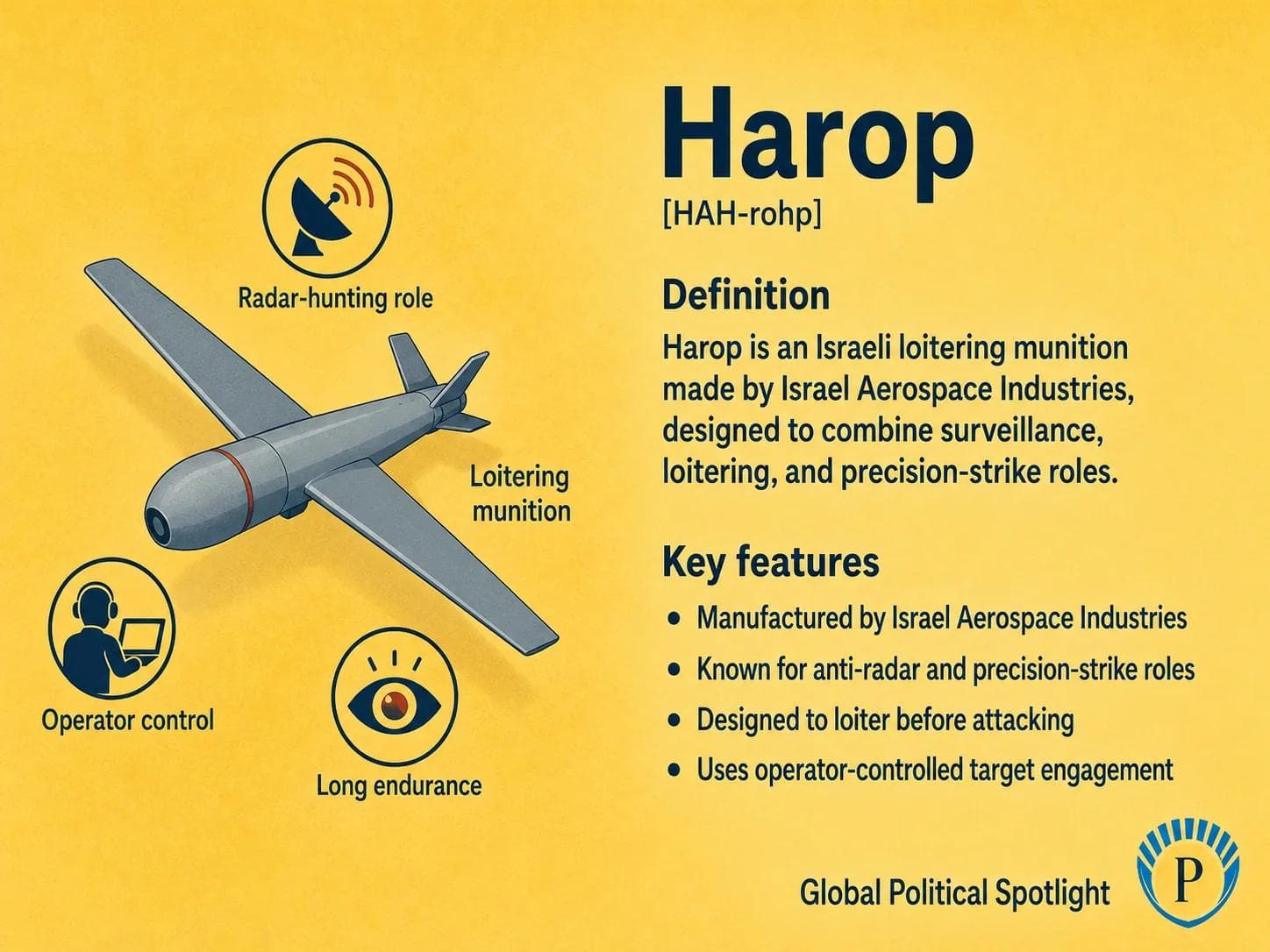
Definition
Harop is an Israeli loitering munition developed by Israel Aerospace Industries. It is designed to fly to a target area, search or wait, and then strike by destroying itself, placing it between a drone, a missile, and a precision-guided munition.
The system is especially associated with anti-radar and suppression of enemy air defense missions. It can be used against emitting radar systems and other high-value targets, while operator control allows human decision-making during the search, identification, and attack process.
Why It Matters
Harop matters because it illustrates how loitering munitions can change air-defense and battlefield dynamics. A system that can wait, observe, and strike radar or command targets can pressure defenders to switch off sensors, relocate systems, or spend resources on counter-drone protection.
It also matters as an exportable model of modern precision strike. Harop shows how middle powers and smaller militaries can gain access to long-endurance strike options without relying only on crewed aircraft or large missile inventories.
GPS should watch Harop as a reference point for loitering munitions, anti-radar warfare, and the diffusion of precision strike. Long-term indicators include export patterns, battlefield use against air defenses, counter-drone adaptation, electronic warfare, operator-control rules, and the role of loitering munitions in smaller states' deterrence strategies.
Key Facts
- Type
- Loitering munition
- Manufacturer
- Israel Aerospace Industries
- Country of origin
- Israel
- Core role
- Search, loiter, identify, and conduct one-way precision strike
- Mission association
- Often linked to anti-radar and suppression of enemy air defense missions
- Control concept
- Designed to support operator control during target search and engagement
- Operational advantage
- Can loiter before attack rather than requiring a fixed target at launch
- Strategic relevance
- Represents the spread of precision strike and drone warfare capabilities beyond major powers
FAQ
What is Harop?
Harop is an Israeli loitering munition made by Israel Aerospace Industries. It is designed to search, loiter, and conduct a one-way precision strike against selected targets.
Is Harop a drone or a missile?
Harop combines features of both. It flies like an uncrewed aircraft and can loiter over a target area, but it functions as an expendable munition because it destroys itself during the strike.
Why is Harop associated with radar-hunting?
Harop is commonly associated with anti-radar missions because loitering munitions can search for or respond to radar emissions and strike air-defense systems, radar sites, or related high-value targets.
Why does Harop matter in modern warfare?
Harop matters because it shows how loitering munitions can combine surveillance, persistence, and precision attack. This can force defenders to protect radars, command posts, vehicles, and other exposed targets from persistent aerial threats.
What are the limits of Harop?
Like other loitering munitions, Harop can be affected by air defenses, electronic warfare, jamming, weather, target deception, communications limits, and the quality of operator training and intelligence support.
How is Harop different from a conventional missile?
A conventional missile usually flies toward a preselected target after launch. Harop can remain airborne, search or wait, and then be directed toward a target, giving it more flexibility against time-sensitive targets.
Sources5 references
- Israel Aerospace Industries
Manufacturer reference page for Harop and its loitering munition role.
- U.S. Congressional Research Service
Reference background on loitering munitions and policy considerations.
- Center for Strategic and International Studies
Analytical background on loitering munitions and their military significance.
- SIPRI
Institutional research on emerging military technologies, autonomy, and arms-control implications.
- International Committee of the Red Cross
Institutional background on legal and humanitarian questions around autonomy in weapon systems.

GPSNews App
Read GPSNews on iPhone
Daily geopolitical briefings, government updates, and prediction signals in one focused app.
Newsletter
Stay Ahead Of The Next Signal
Get briefings in your inbox when new analysis and reports are published.