
RS-28 Sarmat
A heavy Russian intercontinental ballistic missile tied to strategic nuclear deterrence
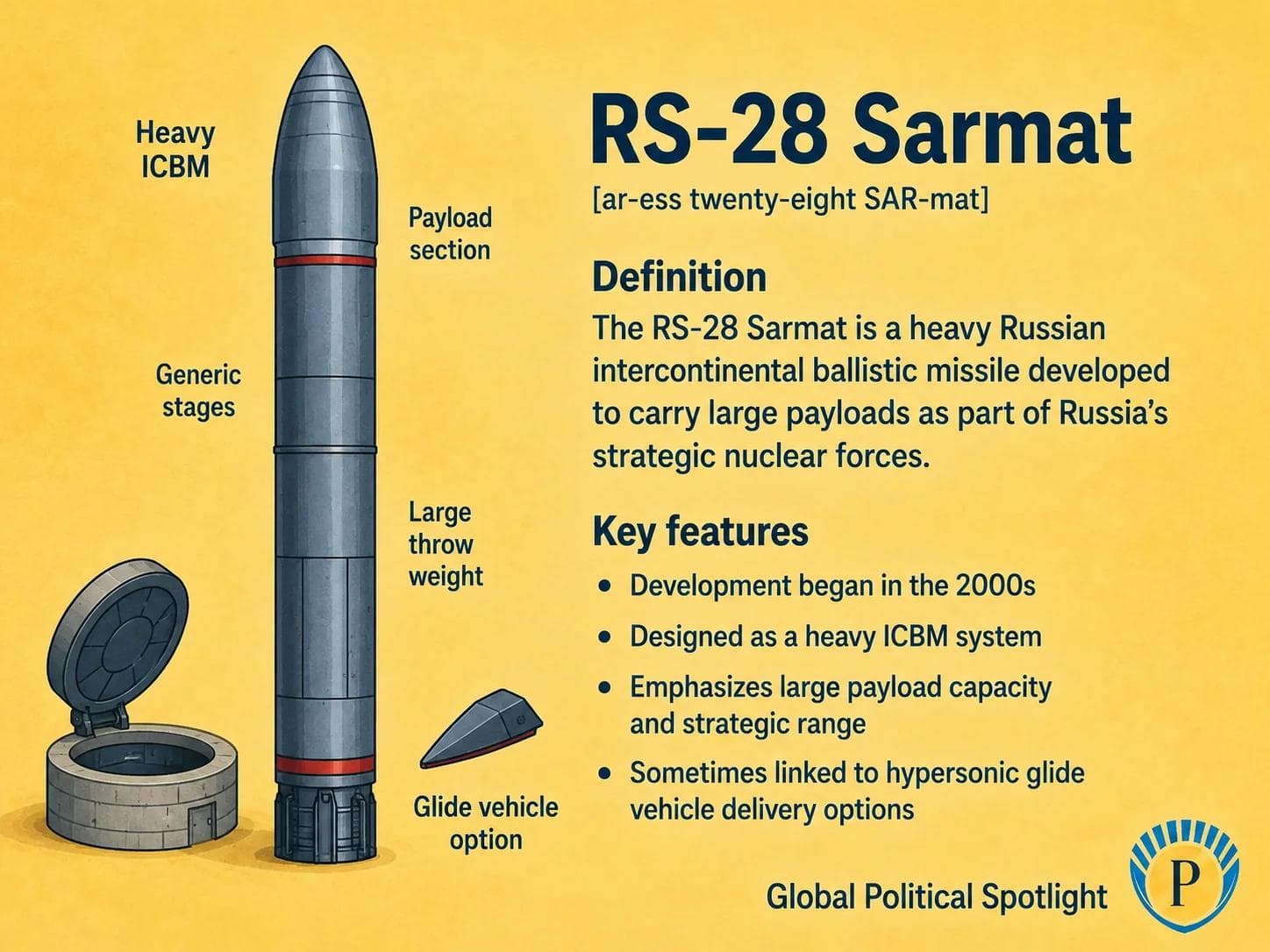
The RS-28 Sarmat is a heavy Russian intercontinental ballistic missile associated with silo basing, large payload capacity, strategic nuclear deterrence, and potential carriage of multiple warheads or hypersonic glide vehicles.
Definition
The RS-28 Sarmat is a heavy Russian intercontinental ballistic missile intended to replace older Soviet-era heavy ICBMs in Russia's strategic nuclear forces. It is associated with silo basing, long-range strategic deterrence, and a large payload capacity.
In broad terms, Sarmat is described as a multi-stage missile with a payload section capable of carrying different strategic payload configurations. Russian officials have linked the system to multiple warhead options and possible compatibility with the Avangard hypersonic glide vehicle.
For geopolitical analysis, the RS-28 Sarmat is best understood as part of Russia's strategic nuclear modernization and deterrence signaling. Public performance claims should be treated cautiously because exact capabilities, deployment status, and operational details are sensitive and often politically framed.
Why It Matters
The RS-28 Sarmat matters because heavy ICBMs are designed to support strategic nuclear deterrence by threatening retaliation over intercontinental distances. Their payload capacity and basing in hardened silos make them central to debates over survivability, arms control, and nuclear force structure.
The missile also matters because Russia uses strategic nuclear modernization as a signal of military power and deterrent credibility. Systems such as Sarmat influence NATO planning, U.S.-Russia arms-control debates, missile-defense discussions, and assessments of crisis stability between nuclear-armed states.
GPS should monitor the RS-28 Sarmat as a key reference point for Russian strategic nuclear modernization and deterrence signaling. Key watch areas include confirmed deployment status, replacement of older heavy ICBMs, arms-control implications, links to Avangard glide vehicles, test-launch narratives, and how the United States, NATO, and other nuclear-armed states assess Russia's strategic posture.
Key Facts
- Type
- Heavy intercontinental ballistic missile
- Country
- Russia
- Deployment mode
- Silo-based strategic missile system
- Strategic role
- Part of Russia's land-based strategic nuclear deterrent
- Replacement role
- Intended to replace older Soviet-era heavy ICBMs such as the R-36M family
- Payload relevance
- Associated with large throw weight and multiple possible strategic payload configurations
- Glide vehicle option
- Russian officials have linked the system to potential carriage of the Avangard hypersonic glide vehicle
- Assessment limit
- Exact performance, deployment readiness, and operational configuration are difficult to verify from open sources
FAQ
What is the RS-28 Sarmat?
The RS-28 Sarmat is a heavy Russian intercontinental ballistic missile associated with silo basing, large payload capacity, and Russia's strategic nuclear deterrent.
Why is the RS-28 Sarmat important?
It is important because it represents Russian strategic nuclear modernization and is intended to replace older heavy ICBMs. Its role is tied to deterrence, arms-control debates, missile defense, and great-power nuclear signaling.
What does heavy ICBM mean?
A heavy ICBM generally refers to an intercontinental ballistic missile with a large payload capacity, often described in terms of throw weight. This can allow different payload configurations, though exact operational details are usually sensitive.
Is the RS-28 Sarmat silo-based?
Yes. The RS-28 Sarmat is generally described as a silo-based strategic missile system, meaning it is intended to launch from hardened underground missile silos rather than from mobile launchers or submarines.
Can Sarmat carry hypersonic glide vehicles?
Russian officials have linked Sarmat to the potential carriage of the Avangard hypersonic glide vehicle. Open-source analysis should treat exact payload configurations cautiously because operational details are not fully public.
How does Sarmat affect arms control?
Sarmat affects arms-control debates because it is a strategic nuclear delivery system. Its deployment, payload capacity, and replacement of older heavy ICBMs are relevant to counting rules, transparency, crisis stability, and future U.S.-Russia nuclear limits.
Recent Developments
Russia announced a Sarmat flight test
Russia announced a flight test of the RS-28 Sarmat, presenting the system as part of the modernization of its strategic nuclear forces and wider deterrence posture.
Russian Ministry of DefenceRussian officials stated Sarmat had entered combat duty
Russian officials stated that the Sarmat system had entered combat duty, though outside assessments have continued to treat precise deployment status and operational readiness cautiously because public information remains limited.
TASSSources6 references
- Russian Ministry of Defence
Official Russian defense source for public statements on strategic missile testing and military modernization.
- U.S. Department of Defense - Nuclear Posture Review
Official U.S. policy source for nuclear deterrence, Russian nuclear forces, and strategic stability context.
- Congressional Research Service
Institutional source for U.S.-Russia nuclear arms control, strategic forces, and nuclear modernization analysis.
- Federation of American Scientists - Nuclear Notebook
Reference source for public analysis of nuclear forces, strategic delivery systems, and modernization trends.
- International Institute for Strategic Studies
Reference source for military balance assessments, strategic forces, and Russian military capability analysis.
- SIPRI - Nuclear Forces
Institutional source for global nuclear force trends, arms control, and strategic weapons context.

GPSNews App
Read GPSNews on iPhone
Daily geopolitical briefings, government updates, and prediction signals in one focused app.
Newsletter
Stay Ahead Of The Next Signal
Get briefings in your inbox when new analysis and reports are published.