
Gulf Cooperation Council
A regional organization of Gulf monarchies focused on security, energy, economics, and diplomacy
The Gulf Cooperation Council is a regional organization of six Gulf monarchies that coordinates on security, economic policy, energy interests, regional diplomacy, and shared concerns about instability and Iran.
Definition
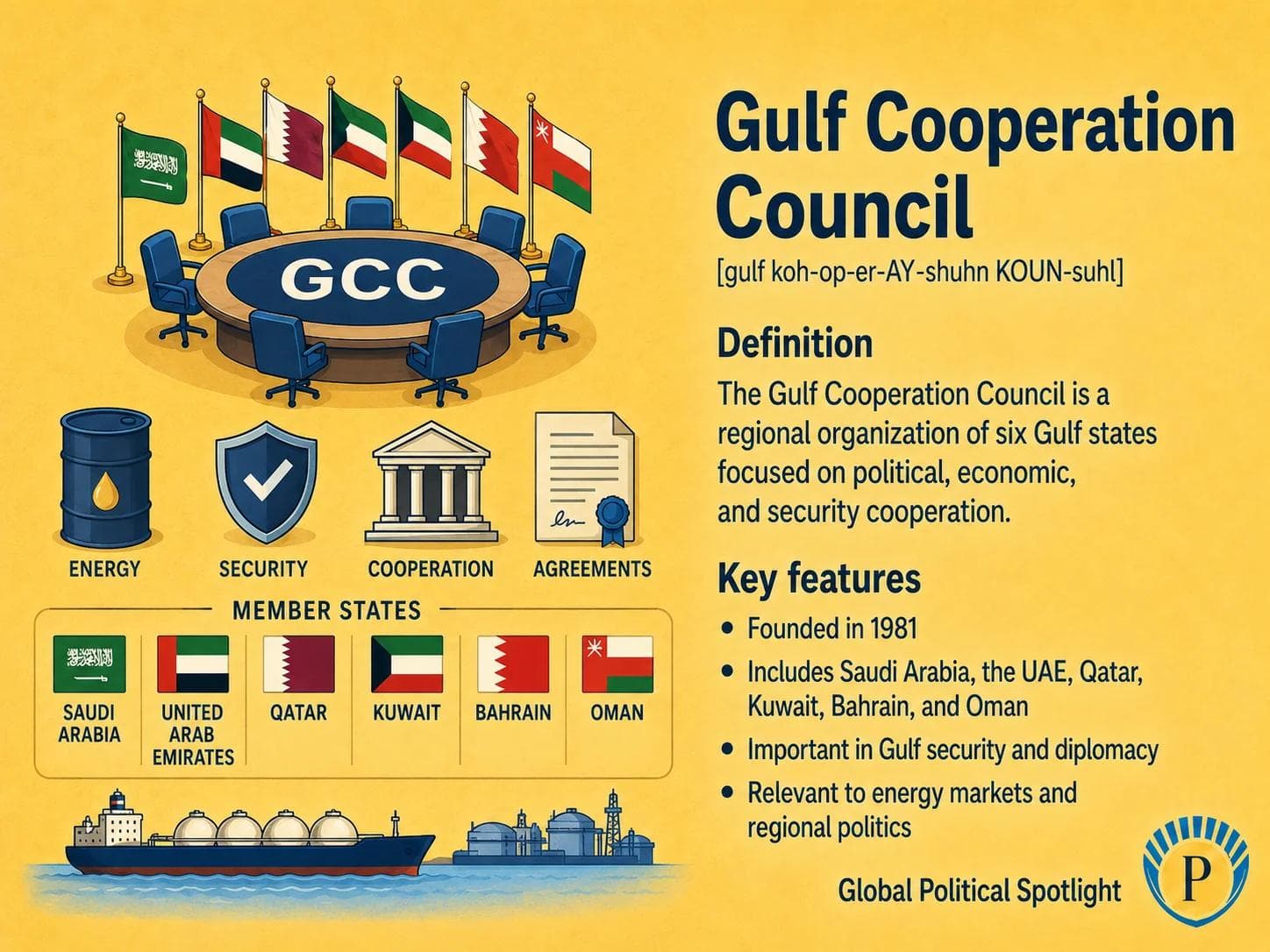
The Gulf Cooperation Council, or GCC, is a regional organization of six Arab Gulf monarchies: Saudi Arabia, the United Arab Emirates, Qatar, Kuwait, Bahrain, and Oman. It was founded in 1981 to coordinate political, economic, security, and social cooperation among states that share geographic proximity, monarchical systems, energy-exporting economies, and regional security concerns.
The GCC is not a single state or military alliance with NATO-style automatic defense guarantees. It functions as a platform for summit diplomacy, economic integration, security coordination, defense planning, customs and market initiatives, and collective messaging on regional issues such as Iran, Yemen, Palestine, maritime security, and energy-market stability.
Why It Matters
The GCC matters because its members sit at the center of global oil and gas markets, Gulf maritime routes, sovereign wealth investment, and Middle East security. Coordination or disagreement among Saudi Arabia, the UAE, Qatar, Kuwait, Bahrain, and Oman can affect energy prices, regional diplomacy, financial flows, and security partnerships with the United States, Europe, and Asia.
Its internal politics also matter. The GCC projects a shared Gulf identity and common security concerns, but member states often differ over relations with Iran, political Islam, media influence, defense priorities, economic competition, and foreign-policy alignments. The 2017-2021 Qatar crisis showed that intra-Gulf disputes can significantly weaken regional coordination.
GPS should track the Gulf Cooperation Council as a core Gulf regional institution where energy markets, Iran-related security concerns, U.S. security partnerships, intra-Gulf rivalries, economic diversification, sovereign wealth, maritime security, and Middle East diplomacy intersect. Key watchpoints include GCC summit language, Saudi-UAE-Qatar relations, Oman and Kuwait mediation roles, defense integration, Iran-Gulf de-escalation efforts, energy policy coordination, Yemen diplomacy, and competition over ports, finance, aviation, and technology.
Key Facts
- Type
- Regional organization of Gulf monarchies
- Founded
- 1981, through the GCC Charter signed in Abu Dhabi
- Headquarters
- Riyadh, Saudi Arabia
- Members
- Saudi Arabia, United Arab Emirates, Qatar, Kuwait, Bahrain, and Oman
- Core focus
- Security coordination, economic integration, energy interests, regional diplomacy, and shared Gulf policy positions
- Energy relevance
- GCC members include major oil and gas exporters with significant influence on energy markets, investment, and supply security
- Security relevance
- Iran-related concerns, maritime security, missile and drone threats, U.S. defense partnerships, and Gulf air and naval security
- Institutional limit
- Consensus politics and divergent national interests can limit common action, especially during intra-Gulf disputes
FAQ
What is the Gulf Cooperation Council?
The Gulf Cooperation Council is a regional organization of six Gulf monarchies: Saudi Arabia, the United Arab Emirates, Qatar, Kuwait, Bahrain, and Oman. It coordinates on politics, economics, security, energy, and regional diplomacy.
Which countries are in the GCC?
The GCC members are Saudi Arabia, the United Arab Emirates, Qatar, Kuwait, Bahrain, and Oman. All six are monarchies located on or near the Arabian Peninsula and the Persian Gulf.
Why does the GCC matter for energy markets?
The GCC matters for energy markets because several members are major oil and gas exporters. Their production policies, investment strategies, shipping routes, and energy diplomacy affect global supply security, prices, and long-term energy-transition debates.
Is the GCC a military alliance?
The GCC has defense cooperation mechanisms and a shared security agenda, but it is not a NATO-style alliance with the same level of integrated command or automatic collective-defense credibility. Members also maintain separate bilateral defense ties, especially with the United States.
Why is Iran important to the GCC?
Iran is important to the GCC because Gulf monarchies view Iranian regional influence, missiles, drones, maritime activity, and proxy networks as major security concerns. At the same time, some GCC members also pursue dialogue and de-escalation with Tehran.
What caused intra-Gulf tensions?
Intra-Gulf tensions have come from disagreements over Qatar's foreign policy, relations with Iran, support for political Islamist movements, media influence, regional competition, economic rivalry, and differing approaches to conflicts such as Libya, Yemen, and Syria.
Recent Developments
The Al-Ula summit ended the Qatar rift
GCC leaders signed the Al-Ula Declaration, formally ending the 2017-2021 dispute in which Saudi Arabia, the UAE, Bahrain, and Egypt had severed ties with Qatar. The episode remains a key example of both intra-Gulf rivalry and the GCC's ability to restore formal unity.
Gulf Cooperation CouncilSaudi-Iran normalization affected Gulf security diplomacy
Saudi Arabia and Iran agreed to restore diplomatic relations in a China-brokered announcement, influencing the wider GCC security environment and highlighting how Gulf states balance deterrence, de-escalation, and regional diplomacy toward Iran.
Saudi Press AgencySources6 references
- Gulf Cooperation Council
Official GCC Secretariat website with institutional information, statements, summit materials, and member-state coordination updates.
- GCC Charter
Official GCC legal and institutional framework outlining the organization's objectives and structure.
- International Energy Agency
Reference source for global energy-market data and analysis relevant to Gulf oil and gas exporters.
- U.S. Energy Information Administration
Reference source for international energy data, including Gulf oil and gas production and exports.
- International Monetary Fund
IMF regional source for economic analysis on Gulf and Middle East economies, fiscal policy, and diversification.
- Encyclopaedia Britannica
Reference overview of the GCC's founding, membership, and regional role.

GPSNews App
Read GPSNews on iPhone
Daily geopolitical briefings, government updates, and prediction signals in one focused app.
Newsletter
Stay Ahead Of The Next Signal
Get briefings in your inbox when new analysis and reports are published.