
ECOWAS
West Africa’s regional bloc for economic integration, free movement, crisis diplomacy, and security cooperation
ECOWAS is a West African regional organization focused on economic integration, free movement, trade, crisis diplomacy, peacekeeping, democracy enforcement, and regional security cooperation.
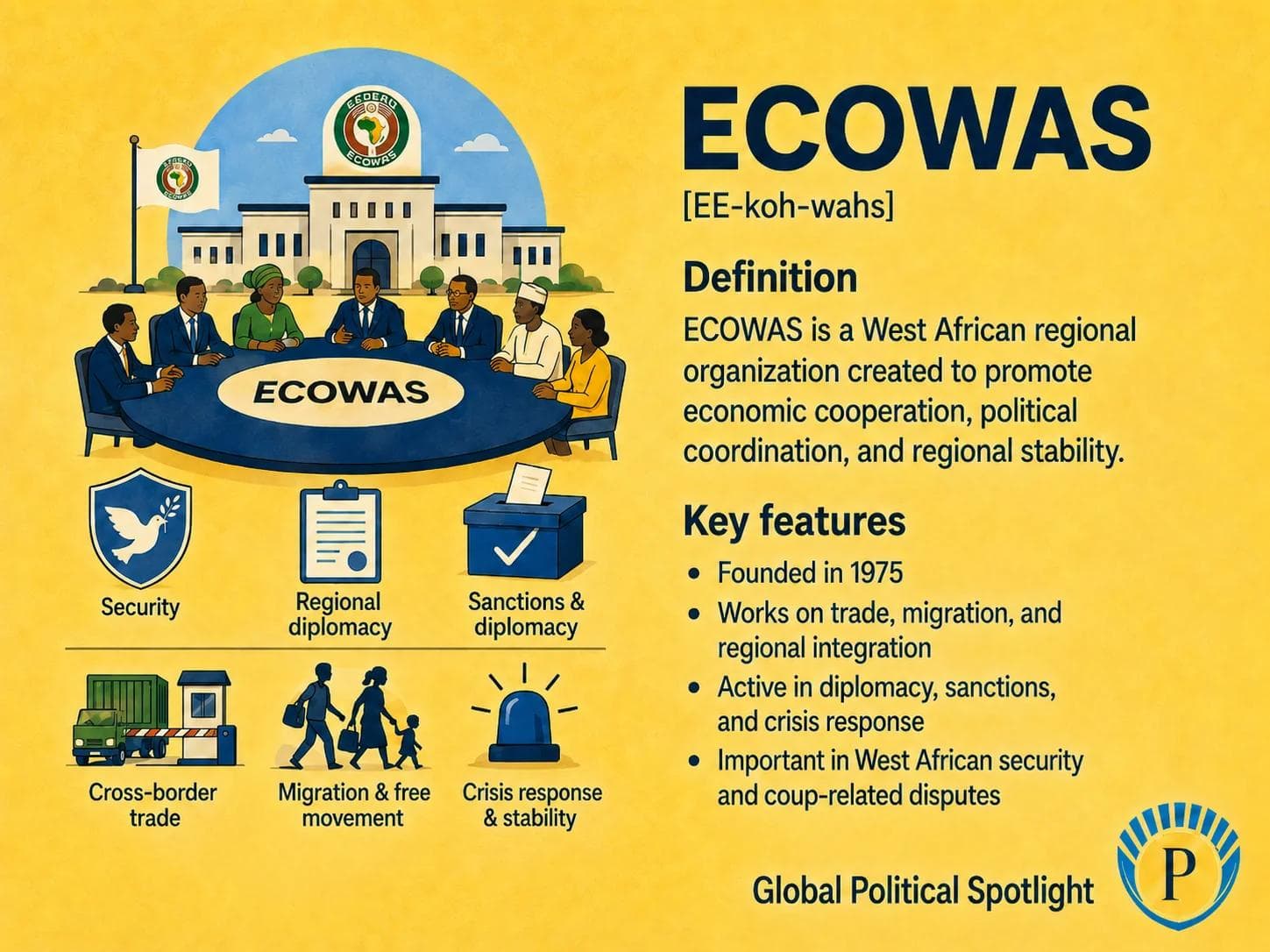
Definition
The Economic Community of West African States, usually known as ECOWAS, is a regional intergovernmental organization founded in 1975 to promote economic integration and cooperation in West Africa. Its secretariat, formally the ECOWAS Commission, is based in Abuja, Nigeria.
ECOWAS has developed beyond trade cooperation into a wider regional governance and security organization. It is associated with free movement rules, trade liberalization, regional infrastructure, crisis diplomacy, election support, sanctions, conflict prevention, peace operations, and norms against unconstitutional changes of government.
The bloc’s political importance increased as West Africa faced repeated coups, jihadist insurgencies, maritime insecurity, migration pressures, and debates over foreign military influence. The formal withdrawal of Burkina Faso, Mali, and Niger in January 2025 created one of the most serious institutional challenges in ECOWAS history.
Why It Matters
ECOWAS matters because it links West African economies through a regional market, free movement arrangements, ports, energy systems, migration networks, and cross-border trade. Its policies affect how people, goods, services, capital, and informal commerce move across a region with deep social and economic interdependence.
The organization is also a major security and governance actor. ECOWAS has used mediation, sanctions, election diplomacy, and regional military deployments to respond to civil wars, coups, constitutional crises, and instability. Its approach is often debated because democracy enforcement can collide with sovereignty claims, humanitarian costs, and the risk of escalation.
Nigeria’s role gives ECOWAS strategic weight. As West Africa’s largest economy and most populous state, Nigeria heavily influences the bloc’s diplomacy, military credibility, financial capacity, and regional agenda, while smaller states use ECOWAS to coordinate bargaining power and stabilize regional rules.
ECOWAS should be watched as a key test of regional governance in West Africa. Important signals include Nigeria’s willingness and capacity to lead, the bloc’s handling of coup-led governments and sanctions, relations with Burkina Faso, Mali, and Niger after their withdrawal, security spillovers from the Sahel, the credibility of election observation and democracy rules, and whether free movement and trade integration remain resilient despite political fragmentation.
Key Facts
- Full name
- Economic Community of West African States
- Type
- Regional intergovernmental organization
- Founded
- 1975, through the Treaty of Lagos
- Headquarters
- Abuja, Nigeria
- Members
- 12 member states after the 2025 withdrawal of Burkina Faso, Mali, and Niger
- Core agenda
- Economic integration, free movement, trade liberalization, infrastructure, peace and security, and political cooperation
- Security role
- ECOWAS has used mediation, sanctions, and regional deployments to respond to conflicts, coups, and constitutional crises
- Main constraint
- Regional unity is constrained by coups, sovereignty disputes, sanctions fatigue, Sahel insecurity, resource limits, and divergent foreign partnerships
FAQ
What is ECOWAS?
ECOWAS is the Economic Community of West African States, a regional organization created to promote economic integration, free movement, trade, development, political cooperation, peace and security, and crisis diplomacy in West Africa.
Which countries are members of ECOWAS?
After the withdrawal of Burkina Faso, Mali, and Niger became effective in January 2025, ECOWAS has 12 members: Benin, Cabo Verde, Cote d'Ivoire, The Gambia, Ghana, Guinea, Guinea-Bissau, Liberia, Nigeria, Senegal, Sierra Leone, and Togo.
Why does ECOWAS matter geopolitically?
ECOWAS matters because it is both an economic integration project and a regional security actor. It shapes trade, migration, sanctions, election diplomacy, coup responses, peace operations, and regional bargaining in a part of Africa affected by rapid demographic growth, Sahel insecurity, and major political transitions.
What role does Nigeria play in ECOWAS?
Nigeria is ECOWAS’s largest member by population and economic weight, and it has historically played a central role in funding, diplomacy, and regional security initiatives. Its domestic politics, fiscal capacity, and foreign policy priorities strongly influence what ECOWAS can do.
Does ECOWAS allow free movement?
ECOWAS has protocols on free movement, residence, and establishment that allow citizens of member states to travel and reside across the region under agreed rules. Implementation varies, and border controls, security concerns, documentation rules, and political disputes can still limit movement in practice.
What are the limits of ECOWAS power?
ECOWAS depends on member-state consent, funding, political unity, and enforcement capacity. It can impose sanctions and support mediation or deployments, but its leverage is limited when governments reject its authority, when regional consensus breaks down, or when security crises exceed available resources.
Recent Developments
Burkina Faso, Mali, and Niger formally withdrew from ECOWAS
ECOWAS announced that the withdrawal of Burkina Faso, Mali, and Niger had become effective, while asking member states to keep channels open and continue practical arrangements related to movement, trade, and regional cooperation where possible.
ECOWASECOWAS debated intervention after the Niger coup
After the July 2023 coup in Niger, ECOWAS imposed sanctions and debated possible military intervention, highlighting the bloc’s democracy enforcement role as well as the political, legal, and operational risks of regional intervention.
ECOWASSources6 references
- ECOWAS Commission
Official institutional source for ECOWAS membership, policy areas, governance structures, and public statements.
- ECOWAS Revised Treaty
Foundational legal framework for ECOWAS objectives, institutions, economic integration, and cooperation mechanisms.
- ECOWAS Press Statement on Burkina Faso, Mali, and Niger Withdrawal
Official ECOWAS statement confirming the effective withdrawal of Burkina Faso, Mali, and Niger on 29 January 2025.
- African Union Regional Economic Communities: ECOWAS
African Union reference page describing ECOWAS as one of Africa’s regional economic communities.
- UN Africa Renewal
United Nations publication summarizing ECOWAS achievements and challenges in regional integration and free movement.
- World Bank West and Central Africa
Institutional source for development, growth, poverty, infrastructure, and resilience context in West and Central Africa.

GPSNews App
Read GPSNews on iPhone
Daily geopolitical briefings, government updates, and prediction signals in one focused app.
Newsletter
Stay Ahead Of The Next Signal
Get briefings in your inbox when new analysis and reports are published.