
Arab League
A regional organization of Arab states focused on diplomacy, coordination, and regional political issues
The Arab League is a regional organization of Arab states headquartered in Cairo that coordinates diplomacy on regional issues, including Palestine, conflicts, development, and inter-Arab political relations.
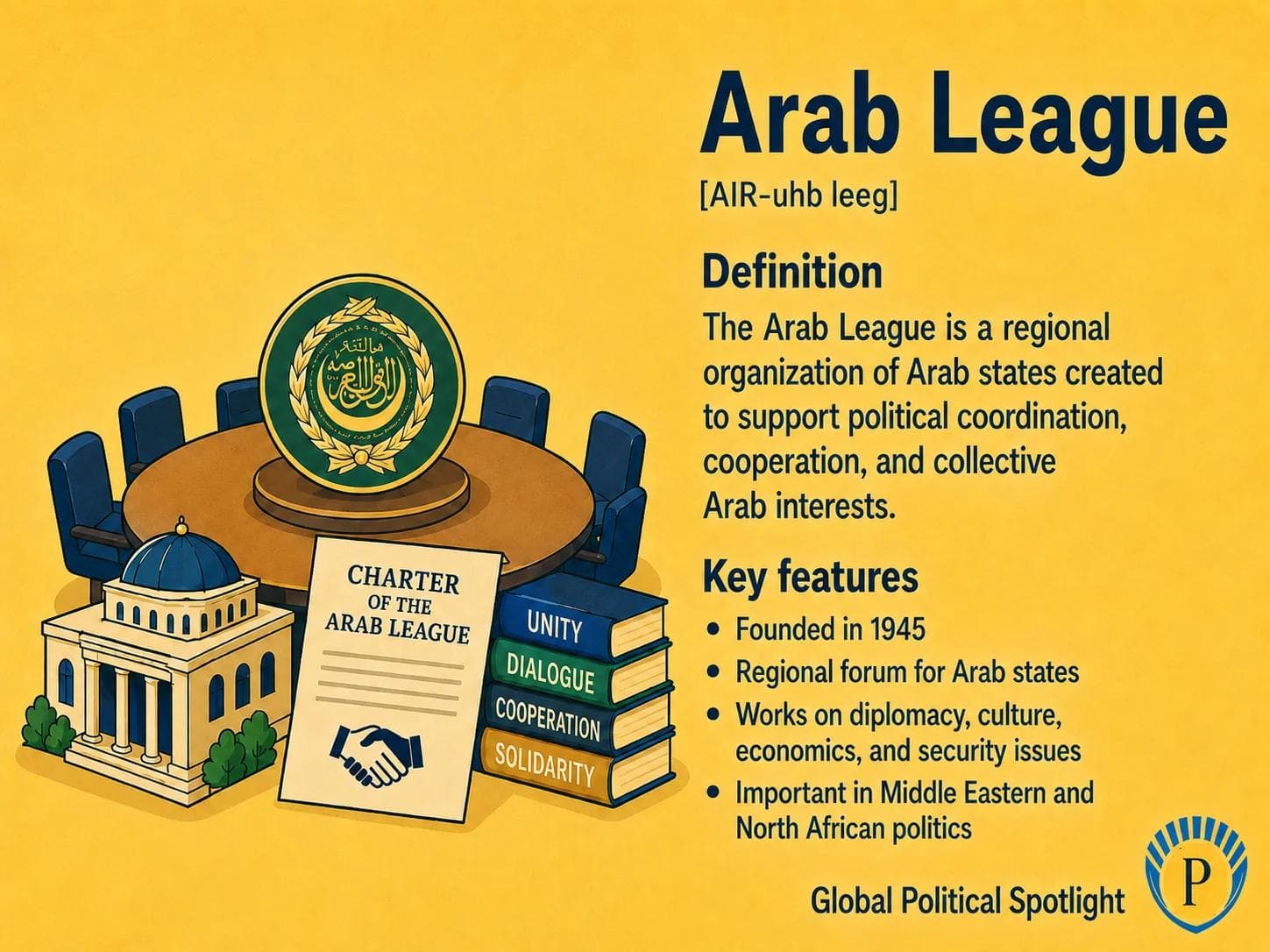
Definition
The Arab League, formally the League of Arab States, is a regional organization founded in 1945 to coordinate political, diplomatic, economic, cultural, and security-related cooperation among Arab states. Its headquarters are in Cairo, Egypt, and its members span North Africa, the Levant, the Gulf, and parts of the Horn of Africa.
The League is often most visible during regional crises, summits, and debates over Palestine, wars, normalization, sanctions, and diplomatic recognition. Its influence depends heavily on member-state consensus, meaning it can provide political legitimacy and collective messaging but often struggles to enforce decisions when major Arab governments disagree.
Why It Matters
The Arab League matters because it is the main institutional forum for collective Arab diplomacy. Its statements and summits can shape regional narratives, signal diplomatic alignments, coordinate responses to crises, and frame Arab positions on issues such as Palestine, Syria, Libya, Sudan, Lebanon, and regional security.
Its limits are equally important. The League reflects the tension between symbolic Arab unity and the divergent interests of monarchies, republics, energy exporters, conflict-affected states, and rival regional blocs. This makes it a useful indicator of consensus, division, and diplomatic feasibility in the Arab world.
GPS should track the Arab League as a regional diplomatic institution where Palestine policy, inter-Arab legitimacy, crisis mediation, state recognition, sanctions, normalization, and regional bloc politics intersect. Key watchpoints include summit communiques, member suspensions or readmissions, Arab positions on Palestine and Israel, conflict mediation attempts in Sudan, Syria, Libya, Yemen, and Lebanon, and gaps between collective statements and individual state policy.
Key Facts
- Type
- Regional intergovernmental organization
- Formal name
- League of Arab States
- Founded
- 1945, under the Pact of the League of Arab States
- Headquarters
- Cairo, Egypt
- Membership
- Arab states across North Africa, the Levant, the Gulf, and parts of the Horn of Africa
- Core issue
- The Palestinian question has been one of the League's most persistent diplomatic priorities
- Decision-making constraint
- Consensus politics and divergent national interests often limit enforcement and mediation capacity
- Strategic relevance
- Regional diplomacy, conflict mediation, summit politics, recognition disputes, and Arab positions on major Middle East crises
FAQ
What is the Arab League?
The Arab League is a regional organization of Arab states founded in 1945. It coordinates diplomacy and political positions on regional issues, including Palestine, conflicts, development, and inter-Arab relations.
Where is the Arab League headquartered?
The Arab League is headquartered in Cairo, Egypt. Cairo has long been the organization's main institutional center and a major hub of Arab diplomacy.
What does the Arab League do?
The Arab League holds summits, issues collective statements, coordinates diplomacy, supports political initiatives, and sometimes mediates regional disputes. It also works through councils and specialized bodies on economic, social, cultural, and security-related issues.
Why is Palestine important to the Arab League?
Palestine has been one of the League's central issues since its founding era. Arab League summits and communiques frequently address Palestinian statehood, Jerusalem, Israeli-Palestinian diplomacy, humanitarian conditions, and Arab positions on recognition and normalization.
Why is the Arab League sometimes seen as limited?
The League's power is limited because member states often have different interests, alliances, threat perceptions, and domestic priorities. Consensus-based diplomacy can produce symbolic unity, but enforcement is difficult when major members disagree.
How does the Arab League affect regional conflicts?
The League can provide diplomatic legitimacy, convene states, endorse peace initiatives, suspend or readmit members, and shape collective messaging. However, conflict outcomes usually depend on member-state power, external actors, local armed groups, and wider geopolitical conditions.
Recent Developments
The Arab League readmitted Syria after a long suspension
Arab foreign ministers agreed to restore Syria's participation in Arab League meetings after Syria had been suspended in 2011. The decision illustrated the League's role as a forum for regional legitimacy and shifting Arab diplomatic positions.
League of Arab StatesThe Arab League summit emphasized Palestine and regional crises
The 2024 Arab League summit in Bahrain placed Palestine and regional conflict diplomacy at the center of the League's agenda, reflecting the organization's recurring role in collective Arab political messaging during crises.
League of Arab StatesSources6 references
- League of Arab States
Official Arab League website for institutional information, summit materials, and regional statements.
- United Nations Peacemaker
UN-hosted text of the Pact of the League of Arab States, the founding treaty framework.
- United Nations
UN statement to the 33rd Arab League Summit, reflecting the League's role in regional diplomacy.
- Encyclopaedia Britannica
Reference overview of the Arab League's founding, membership, institutional role, and political history.
- Council on Foreign Relations
Reference background on the Arab League's political role, limitations, and regional diplomacy.
- Arab League Educational, Cultural and Scientific Organization
Specialized Arab League organization illustrating the League's broader cultural and educational cooperation agenda.

GPSNews App
Read GPSNews on iPhone
Daily geopolitical briefings, government updates, and prediction signals in one focused app.
Newsletter
Stay Ahead Of The Next Signal
Get briefings in your inbox when new analysis and reports are published.