
SAARC
South Asia’s regional organization for cooperation, development, and limited economic integration
SAARC is a South Asian regional organization created to promote cooperation on development, trade, poverty reduction, connectivity, and people-to-people ties, but its integration agenda has been constrained by political tensions, especially India-Pakistan rivalry.
Definition
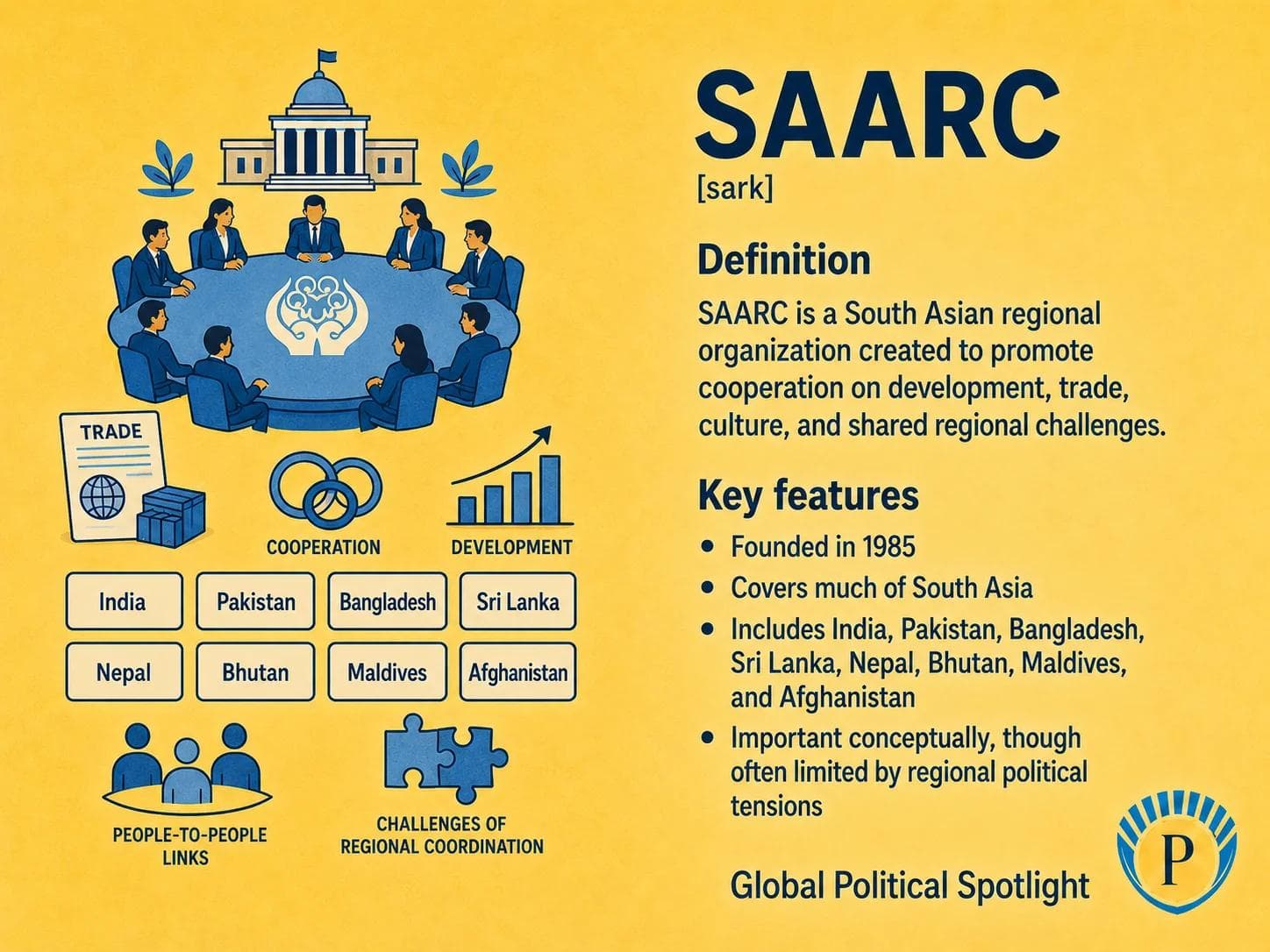
The South Asian Association for Regional Cooperation, usually known as SAARC, is a regional intergovernmental organization founded in 1985 to promote cooperation among South Asian countries. Its members are Afghanistan, Bangladesh, Bhutan, India, Maldives, Nepal, Pakistan, and Sri Lanka, although Afghanistan’s representation has been politically complicated since the Taliban takeover in 2021.
SAARC was designed to support cooperation in areas such as agriculture, rural development, health, education, science and technology, culture, climate resilience, poverty reduction, and regional trade. Its secretariat is located in Kathmandu, Nepal.
Despite South Asia’s large population and economic potential, SAARC has struggled to become a strong integration project because decisions require consensus and regional politics are deeply shaped by India-Pakistan rivalry, border disputes, security concerns, and uneven economic size among members.
Why It Matters
SAARC matters because South Asia contains a large share of the world’s population, major development challenges, important maritime routes, nuclear-armed rivals, and fast-growing economies. A more functional regional framework could improve trade, infrastructure, energy connectivity, disaster response, education, health cooperation, and climate adaptation.
The organization is also geopolitically important because its weakness reveals why South Asia remains under-integrated compared with many other regions. Political distrust, unresolved conflicts, protectionist barriers, visa limits, and security tensions reduce the ability of neighboring states to turn geographic proximity into shared economic gains.
For GPS, SAARC is a useful lens for tracking regional cooperation, India’s neighborhood diplomacy, Pakistan-India tensions, Chinese influence in South Asia, climate vulnerability, cross-border migration, and the gap between regional trade potential and actual integration.
SAARC should be watched as an indicator of South Asian regional integration and political paralysis. Key signals include whether India and Pakistan allow summit diplomacy to resume, whether smaller South Asian states use SAARC or alternative forums for development cooperation, how regional trade barriers evolve, and whether climate, health, migration, or disaster response pressures create practical incentives for renewed cooperation.
Key Facts
- Full name
- South Asian Association for Regional Cooperation
- Type
- Regional intergovernmental organization
- Founded
- 1985, with the first SAARC summit held in Dhaka
- Headquarters
- Kathmandu, Nepal
- Members
- Afghanistan, Bangladesh, Bhutan, India, Maldives, Nepal, Pakistan, and Sri Lanka
- Core purpose
- Regional cooperation on development, trade, poverty reduction, social progress, and people-to-people links
- Trade framework
- The South Asian Free Trade Area agreement was intended to reduce trade barriers among SAARC members
- Main constraint
- Consensus-based diplomacy and India-Pakistan rivalry have limited summit activity and deeper regional integration
FAQ
What is SAARC?
SAARC is the South Asian Association for Regional Cooperation, a regional organization created in 1985 to promote cooperation among South Asian states in development, trade, poverty reduction, education, health, culture, and social progress.
Which countries are members of SAARC?
SAARC’s members are Afghanistan, Bangladesh, Bhutan, India, Maldives, Nepal, Pakistan, and Sri Lanka. Afghanistan’s participation has been politically complicated since the Taliban takeover in 2021.
Why has SAARC been less effective than other regional organizations?
SAARC has been limited by consensus rules, weak implementation capacity, protectionist trade barriers, security concerns, and especially India-Pakistan rivalry. These tensions have made it difficult to hold regular high-level summits or advance ambitious integration projects.
Why does South Asian regional trade remain limited?
South Asian trade remains constrained by tariffs, non-tariff barriers, poor cross-border connectivity, visa restrictions, political mistrust, weak logistics, and the fact that India-Pakistan trade has often been restricted by security and diplomatic tensions.
What is the difference between SAARC and BIMSTEC?
SAARC covers South Asia and includes both India and Pakistan, while BIMSTEC links parts of South Asia and Southeast Asia around the Bay of Bengal and excludes Pakistan. India and some partners have increasingly used BIMSTEC and other forums when SAARC diplomacy is stalled.
Does SAARC still matter?
Yes, but mostly as an underused framework. SAARC still matters because it covers a region with major development, climate, trade, migration, and security challenges, but its influence depends on whether member states can separate practical cooperation from bilateral political disputes.
Recent Developments
Afghanistan’s political status complicated SAARC representation
The Taliban takeover of Afghanistan created continuing uncertainty over Afghanistan’s representation in regional and international forums, adding another institutional complication for SAARC alongside the organization’s already limited summit diplomacy.
United NationsWorld Bank continued to highlight South Asia’s growth potential and structural constraints
World Bank regional updates have repeatedly identified South Asia as a high-growth region while also emphasizing constraints linked to employment, productivity, resilience, and structural reform, reinforcing why regional cooperation remains economically significant even when SAARC diplomacy is weak.
World BankSources6 references
- SAARC Secretariat
Official institutional source for SAARC background, membership, charter information, and cooperation areas.
- SAARC Charter
Official charter setting out SAARC’s objectives, principles, and institutional framework.
- World Bank South Asia
Regional economic and development context for South Asia, including growth, poverty, employment, and resilience themes.
- Asian Development Bank South Asia
Institutional development source covering infrastructure, connectivity, climate resilience, and economic cooperation in South Asia.
- World Trade Organization Regional Trade Agreements Database
Reference source for trade agreements, including regional trade frameworks relevant to South Asia.
- Encyclopaedia Britannica
Reference overview of SAARC’s history, membership, and institutional background.

GPSNews App
Read GPSNews on iPhone
Daily geopolitical briefings, government updates, and prediction signals in one focused app.
Newsletter
Stay Ahead Of The Next Signal
Get briefings in your inbox when new analysis and reports are published.