
Nord Stream Pipeline Routes
Baltic Sea gas pipelines linking Russia directly to Germany
The Nord Stream pipeline routes are undersea natural gas pipelines in the Baltic Sea built to connect Russia directly with Germany, bypassing several Eastern European transit states.
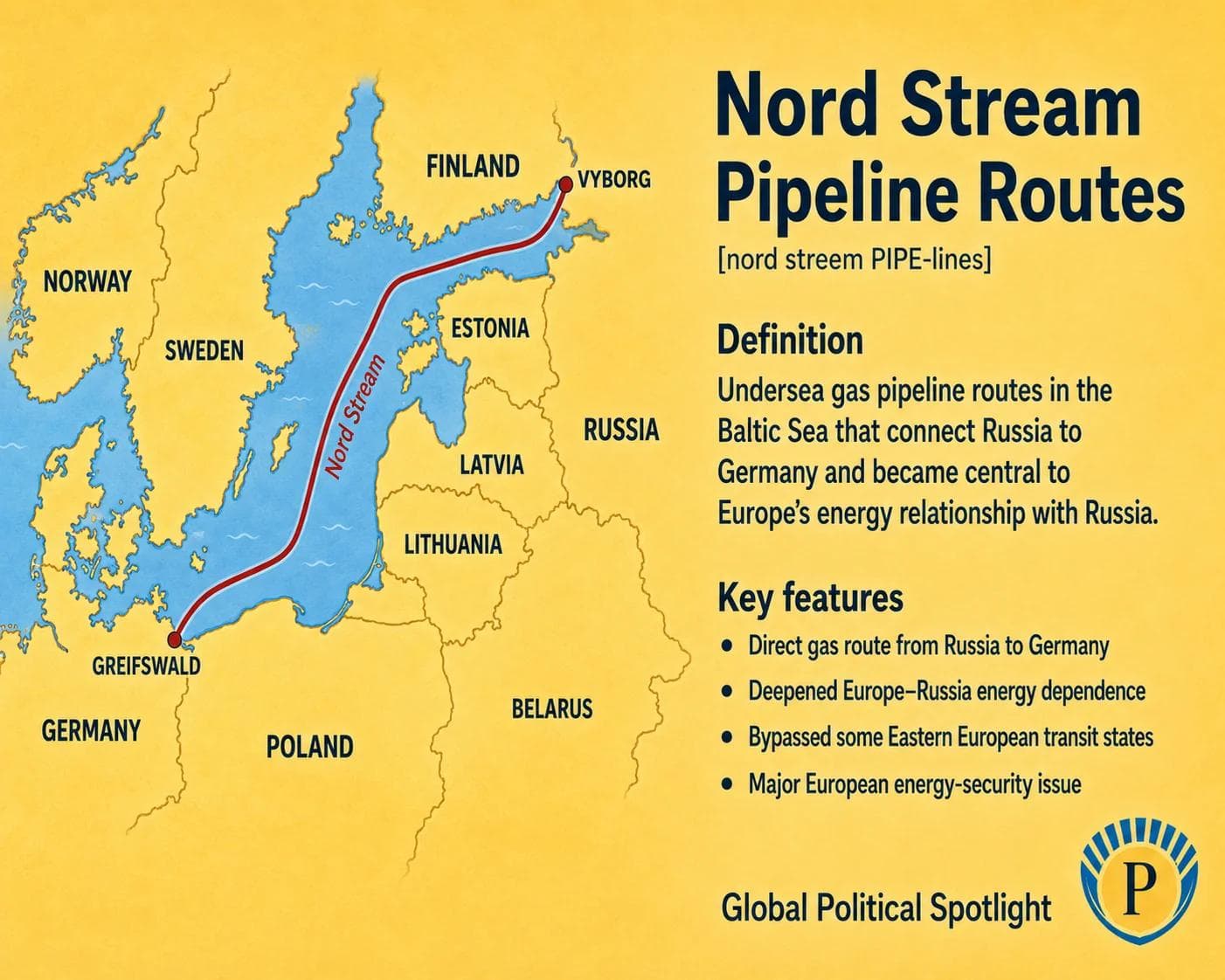
Definition
The Nord Stream pipeline routes are undersea natural gas pipeline systems running across the Baltic Sea between Russia and Germany. Nord Stream 1 entered service in the early 2010s, while Nord Stream 2 was completed but did not enter commercial operation.
The routes were designed to move Russian gas directly to Germany, reducing reliance on overland transit through countries such as Ukraine and Poland. This made them economically significant and politically controversial long before the 2022 Russia-Ukraine war.
Why It Matters
Nord Stream matters because it became a symbol of Europe's exposure to Russian energy supplies. The pipelines deepened debate over whether commercial gas infrastructure could create strategic dependence and political leverage.
The routes also mattered because they bypassed some Eastern European transit states, changing the distribution of transit revenue, bargaining power, and energy-security risk across Europe.
After the 2022 pipeline explosions, Nord Stream also became a major case study in undersea infrastructure vulnerability, Baltic Sea security, and the protection of critical energy systems.
GPS should watch Nord Stream as a durable example of energy interdependence, infrastructure vulnerability, sanctions politics, and the strategic consequences of bypassing transit states. The routes remain relevant to European energy diversification, Russia-Europe relations, Baltic Sea security, and debates over critical undersea infrastructure.
Key Facts
- Type
- Undersea natural gas pipeline routes
- Location
- Baltic Sea, between Russia and Germany
- Connects
- Russian gas export infrastructure with Germany's Baltic coast
- Main systems
- Nord Stream 1 and Nord Stream 2
- Strategic role
- Direct Russia-Germany gas route bypassing several Eastern European transit states
- Primary actors
- Russia, Germany, European Union, Ukraine, Poland, Baltic Sea states, and energy companies
- Energy-security issue
- Associated with European dependence on Russian gas and debates over supply diversification
- Core vulnerability
- Exposure to sanctions, geopolitical coercion, sabotage, undersea infrastructure risks, and regulatory restrictions
FAQ
What are the Nord Stream pipeline routes?
The Nord Stream pipeline routes are undersea natural gas pipelines in the Baltic Sea designed to carry Russian gas directly to Germany.
Why are the Nord Stream pipelines important?
They are important because they linked Russian gas supplies directly to Germany, shaped Europe's energy dependence on Russia, and became central to debates over energy security and geopolitical leverage.
Which countries did Nord Stream bypass?
The pipeline routes bypassed several traditional Eastern European gas transit states, especially Ukraine and Poland, reducing their role in some Russia-Europe gas flows.
What is the difference between Nord Stream 1 and Nord Stream 2?
Nord Stream 1 entered service and transported gas from Russia to Germany. Nord Stream 2 was completed but did not enter commercial operation after Germany halted certification in 2022.
Why did Nord Stream become controversial?
Nord Stream became controversial because critics argued it increased Europe's dependence on Russian gas, weakened Ukrainian and Polish transit leverage, and exposed Europe to political and supply risks.
What do the Nord Stream explosions show about energy security?
The explosions showed that undersea energy infrastructure can be physically vulnerable, making pipeline security, seabed monitoring, and critical infrastructure protection major European security concerns.
Recent Developments
Germany halted Nord Stream 2 certification
Germany suspended the certification process for Nord Stream 2 after Russia recognized separatist-controlled areas of eastern Ukraine, preventing the pipeline from entering commercial operation.
German Federal Ministry for Economic Affairs and Climate ActionExplosions damaged Nord Stream pipelines in the Baltic Sea
Explosions and gas leaks damaged Nord Stream infrastructure in the Baltic Sea, turning the pipelines into a prominent example of critical undersea infrastructure vulnerability in Europe.
NATOSources6 references
- European Commission - REPowerEU
Institutional context on the EU's effort to reduce dependence on Russian fossil fuels and strengthen energy security.
- International Energy Agency - Germany
Energy profile and context for Germany's energy system, gas use, and diversification challenges.
- U.S. Energy Information Administration - Europe
Reference energy analysis on European energy markets and regional energy security.
- German Federal Ministry for Economic Affairs and Climate Action
Official German statement on the suspension of Nord Stream 2 certification.
- NATO
Official NATO statement on the Nord Stream pipeline damage and critical infrastructure concerns.
- European Council - EU sanctions against Russia
Institutional context on EU sanctions policy and the wider Russia-Europe geopolitical environment.

GPSNews App
Read GPSNews on iPhone
Daily geopolitical briefings, government updates, and prediction signals in one focused app.
Newsletter
Stay Ahead Of The Next Signal
Get briefings in your inbox when new analysis and reports are published.