
Druzhba Pipeline
A major Russia-Europe oil pipeline network supplying parts of Central and Eastern Europe
The Druzhba Pipeline is a major oil pipeline network that carries Russian crude westward through Belarus and Ukraine toward several Central and Eastern European markets.
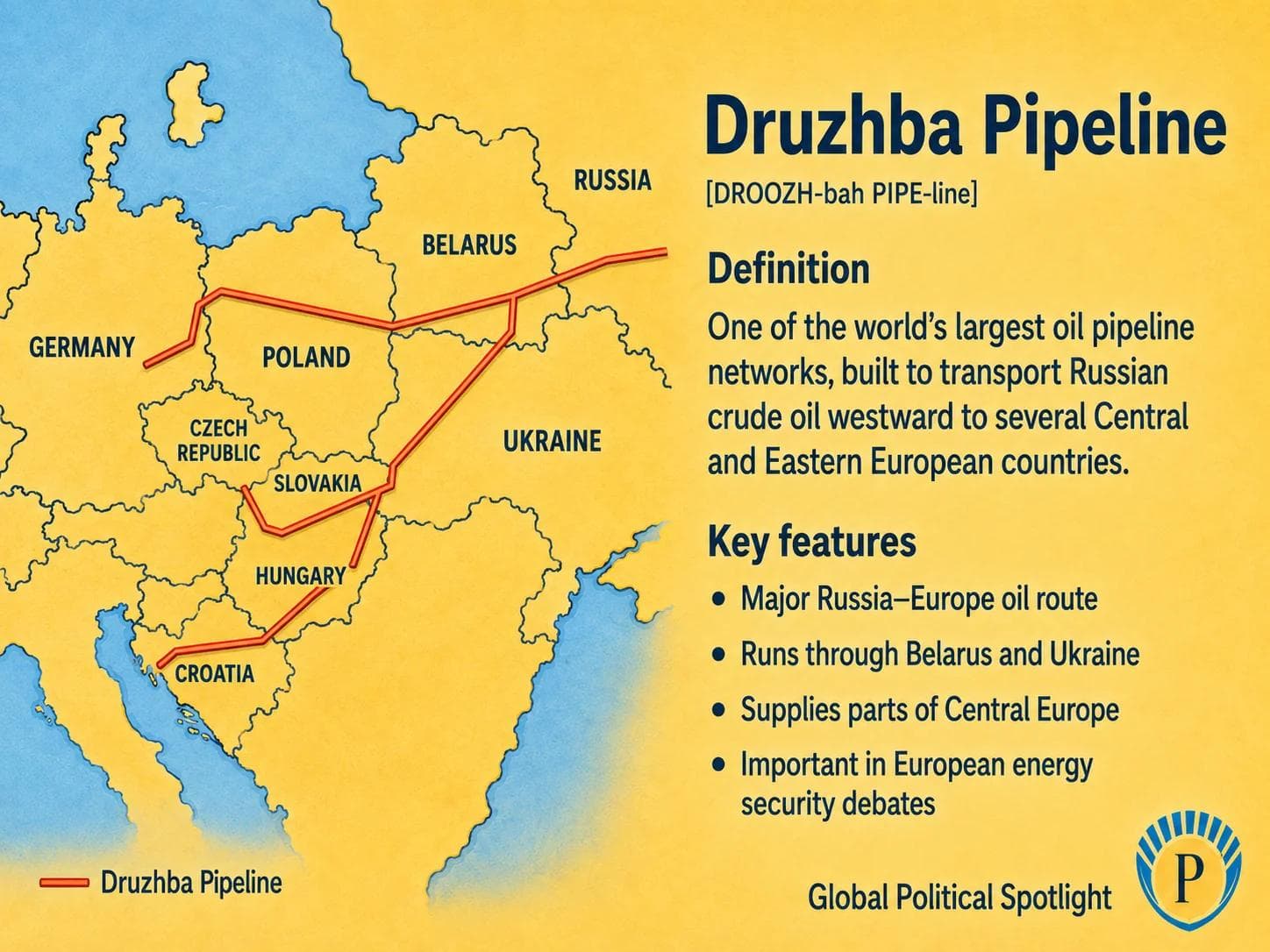
Definition
The Druzhba Pipeline is a large crude oil pipeline network built during the Soviet era to transport oil from Russia westward to European customers. The name means friendship in Russian, reflecting its original role in linking Soviet energy supplies with allied states in Eastern Europe.
The network passes through Belarus and Ukraine before branching toward several Central and Eastern European countries. Because it connects physical infrastructure, oil supply contracts, transit states, and European energy policy, it remains an important reference point in debates over Russia-Europe energy dependence.
Why It Matters
The Druzhba Pipeline matters because it has historically been one of the main overland routes for Russian crude oil into Europe. Countries connected to the system have had to balance refinery needs, supply diversification, sanctions policy, and the practical limits of replacing pipeline crude with seaborne alternatives.
Its geopolitical relevance comes from the interaction between energy infrastructure and state power. Pipeline flows can be affected by sanctions, transit disputes, war risks, maintenance, pricing, and political decisions, making the route a durable symbol of European energy-security challenges.
GPS should watch the Druzhba Pipeline as a long-term indicator of Russia-Europe energy dependence, Central European refinery exposure, sanctions implementation, transit-state leverage, oil supply diversification, and the strategic vulnerability of fixed pipeline infrastructure during geopolitical crises.
Key Facts
- Type
- Crude oil pipeline network
- Primary route
- Transports Russian crude oil westward toward Central and Eastern Europe
- Transit states
- Belarus and Ukraine are key transit countries
- Strategic role
- Historically one of the major overland Russia-Europe oil routes
- Market relevance
- Important for refineries, crude supply planning, and regional oil logistics
- Energy security issue
- Highlights dependence on fixed infrastructure and politically exposed supply routes
- Policy relevance
- Central to European sanctions, diversification, and Russian oil dependency debates
- Name meaning
- Druzhba means friendship in Russian
FAQ
What is the Druzhba Pipeline?
The Druzhba Pipeline is a major crude oil pipeline network that transports Russian oil westward toward parts of Central and Eastern Europe. It is one of the best-known Russia-Europe energy routes.
Why is the Druzhba Pipeline important?
It is important because it connects Russian crude supply to European refineries and markets. Its flows affect energy security, sanctions policy, refinery operations, and debates over European dependence on Russian energy.
Which countries does the Druzhba Pipeline pass through?
The pipeline network carries crude from Russia westward through transit countries including Belarus and Ukraine, then branches toward several Central and Eastern European states.
How does the Druzhba Pipeline affect European energy security?
It affects energy security by tying some refineries and markets to a fixed pipeline route. Disruptions, sanctions, transit disputes, or political decisions can create supply risks for countries that rely on the network.
Can Europe replace oil from the Druzhba Pipeline?
Some replacement is possible through seaborne crude, alternative pipelines, refinery adjustments, and diversification. However, landlocked states and refineries configured for specific crude grades can face higher costs and logistical constraints.
Why is the pipeline called Druzhba?
Druzhba means friendship in Russian. The name reflects the pipeline Soviet-era role in supplying allied socialist states with crude oil.
Recent Developments
EU sanctions included exemptions for some pipeline oil
The European Union sanctions on Russian oil treated pipeline deliveries differently from many seaborne imports, reflecting the practical dependence of some landlocked Central European states on infrastructure such as Druzhba.
Council of the European UnionEU restrictions on Russian petroleum products deepened energy-policy shifts
Further EU measures on Russian oil products reinforced the broader European effort to reduce reliance on Russian energy, keeping pipeline routes, refinery adaptation, and supply diversification high on the policy agenda.
European CommissionSources5 references
- Council of the European Union
Official EU source for sanctions decisions, Russian oil restrictions, and energy-related policy measures.
- European Commission
Official EU source for energy security policy, sanctions implementation, and diversification initiatives.
- International Energy Agency
Institutional source for oil markets, energy security, supply-demand analysis, and European energy transitions.
- U.S. Energy Information Administration
Official energy statistics and analysis source for global oil markets, petroleum flows, and energy infrastructure context.
- European Commission Energy
European institutional source for energy infrastructure, supply security, and energy-system policy context.

GPSNews App
Read GPSNews on iPhone
Daily geopolitical briefings, government updates, and prediction signals in one focused app.
Newsletter
Stay Ahead Of The Next Signal
Get briefings in your inbox when new analysis and reports are published.