What Moved the Market
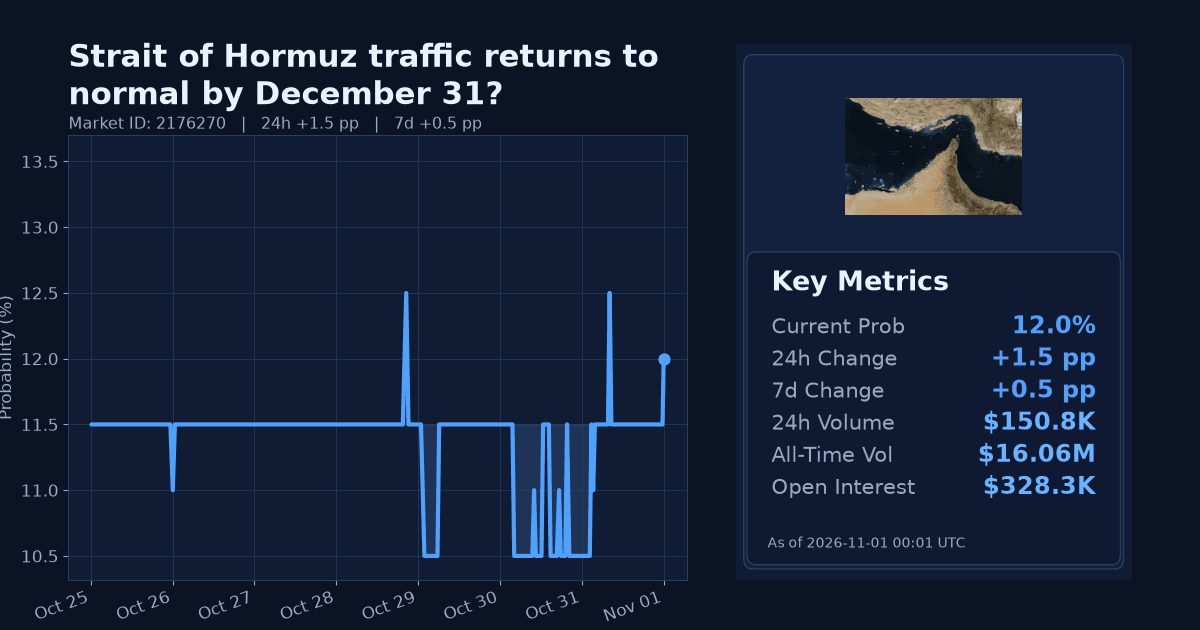
The Polymarket contract asks whether IMF Portwatch will publish a 7-day moving average of at least 60 transit calls for the Strait of Hormuz before the resolution window closes. The market covers data from its creation on May 11, 2026, through December 31, 2026, with the listed market end date on January 1, 2027.
The “Yes” side moved higher over the latest session, indicating a modest increase in market-implied odds that Strait of Hormuz ship traffic returns to the contract’s specified threshold before the deadline. The move was upward but from a low base.
Why It Likely Moved
- The repricing appears driven by renewed attention to energy-security risk around seaborne supply routes, with official European policy discussion explicitly focused on refining, energy security, defence readiness, and industrial competitiveness.
- Markets reacted to a mixed oil signal: Brent remained high at $113.43/bbl as of October 30, but it was down 3.58% on the day and 2.82% over seven days, which may have reduced near-term pricing of acute disruption risk.
- The move also appears linked to ongoing concern about Iran-related supply shocks. A recent report tied elevated oil-company profits and fuel prices to the war in Iran and related global oil-price increases.
- The increase was not broadly confirmed by near-term blockade-announcement markets, suggesting the main contract may be responding more to traffic-normalization and energy-market signals than to a clean diplomatic or blockade-resolution signal.
How Strong the Move Is
The 24-hour move was significant in statistical terms: the market rose 1.5 percentage points over 24 hours, and the supplied 24-hour z-score is 4.0. The provided interpretation classifies that as an extreme upward move relative to this market’s recent trading history.
The broader weekly picture is less forceful. The market is up 0.5 percentage points over seven days, with a 7-day z-score of 0.0 and a supplied interpretation of normal and flat. That makes this look more like a short-term spike than a confirmed trend continuation.
Cross-Market Confirmation
- The related market on a U.S. announcement ending an Iranian blockade by December 31, 2026, diverged over 24 hours, falling 0.8 percentage points, but it remains up 7.55 percentage points over seven days. That weakens immediate confirmation but supports a broader weekly repricing around blockade outcomes.
- The related November 30, 2026 blockade-announcement market also diverged intraday, down 0.5 percentage points over 24 hours, while rising 8.0 percentage points over seven days. This points to a similar split between short-term softness and stronger weekly repricing.
- The related November 2, 2026 blockade-announcement market moved against the main market, down 2.0 percentage points over 24 hours, with no 7-day change available. That is the clearest cross-market divergence among the listed comparables.
News & Real-World Context
Official context is centered on energy-security preparedness rather than a direct Hormuz traffic announcement. On October 29, 2026, the European Commission said it launched a High-Level Dialogue with the European refining sector to discuss strengthening Europe’s energy security, defence readiness, and industrial competitiveness in a rapidly changing geopolitical environment. That is a primary policy signal relevant to markets pricing seaborne energy vulnerability.
News context also points to oil-market sensitivity to the Iran conflict. On October 31, 2026, NPR reported that oil-company earnings were elevated as the war in Iran pushed up global oil prices, contributing to higher gasoline and diesel prices. The supplied macro data show Brent crude still elevated at $113.43/bbl, even after short-term declines, reinforcing that the market is moving against a backdrop of persistent energy-risk pricing rather than a confirmed return to normal maritime conditions.
Bottom Line
The market’s upward move is statistically sharp but not yet supported by a strong weekly trend or clear cross-market confirmation. The most defensible reading is a short-term repricing around energy-security and oil-market signals, while the underlying probability of meeting the IMF Portwatch traffic threshold remains low and uncertain.
Market Conditions at Time of Writing
- Current Probability (%): 12.0
- 24h Change (pp): +1.5
- 7d Change (pp): +0.5
- Volume (24h, $): 150,779.92
- Open Interest ($): 328,286.33
- Spread (pp): 1.0
- Z-score (24h): 4.0