What Moved the Market
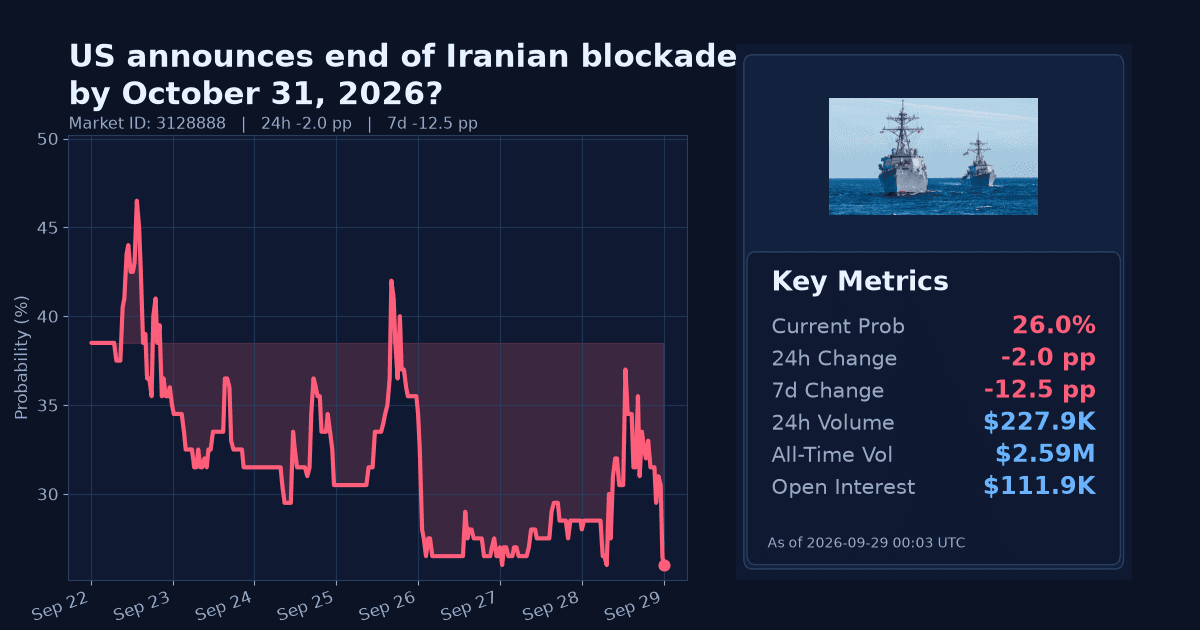
The Polymarket contract on whether the United States will officially announce an end or suspension of its naval blockade of Iranian ships and customers by October 31, 2026 moved lower. As of September 29, it trades at 26%, down 2 percentage points over 24 hours and 12.5 percentage points over the past week.
The contract window runs from market creation to 11:59 PM ET on October 31, 2026. The latest repricing comes with just over a month remaining in the window.
Why It Likely Moved
- The decline appears driven by reporting on September 28 that President Trump rejected an Iranian offer to pause fighting, with coverage describing Gulf security and Strait of Hormuz shipping as still in limbo, reducing the likelihood of an imminent US policy reversal (NPR, 2026-09-28).
- Markets reacted to an official interview on September 28 in which Australia’s Assistant Minister for Foreign Affairs and Trade highlighted the ongoing conflict and impacts from the closure of the Strait of Hormuz, signaling no clear near-term de-escalation from government vantage points (Australian Government DFAT, 2026-09-28).
- Repricing follows the approaching October 31 resolution deadline without a qualifying US announcement to date, increasing time-decay pressure on near-term odds under the market’s resolution criteria.
- Broader risk and energy context may be reinforcing caution: WTI crude stands at $93.25/bbl, up 11.81% over 30 days, while the VIX is up 8.07% over 7 days, conditions consistent with sustained geopolitical and supply-risk premia.
How Strong the Move Is
The 24-hour shift of -2 percentage points carries a 24h z-score of 8.0, which is statistically extreme relative to this market’s recent trading history. The 7-day decline of -12.5 percentage points is also extreme (7d z-score 7.65).
Together, the prints indicate a sharp repricing rather than routine noise, pointing to a continuation of the recent downward trend in the near-term probability of a qualifying US announcement before the October 31 deadline.
Cross-Market Confirmation
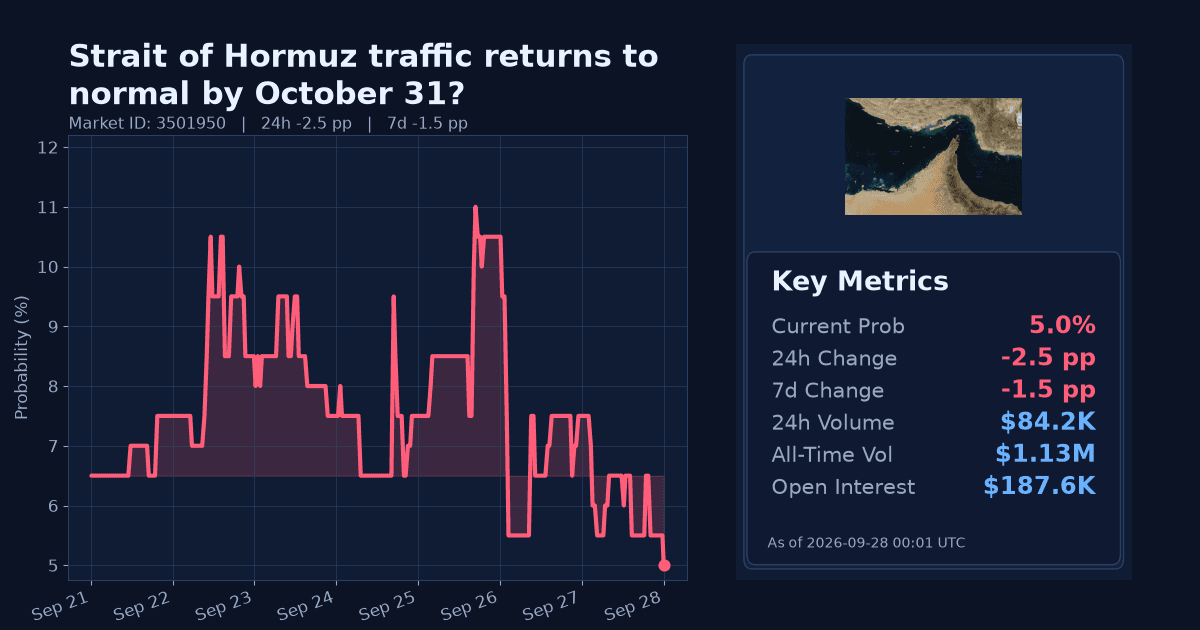
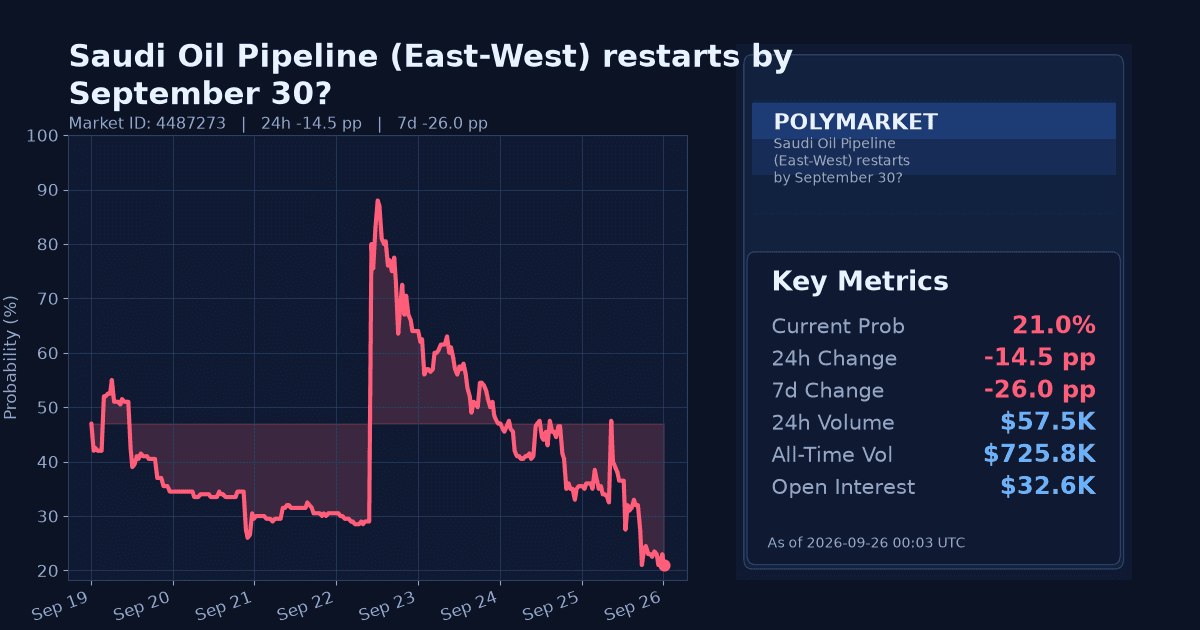
- The shorter-dated sister market (end by September 30, 2026) also fell (delta_24h -1.5pp; delta_7d -7.9pp), confirming weaker near-term expectations.
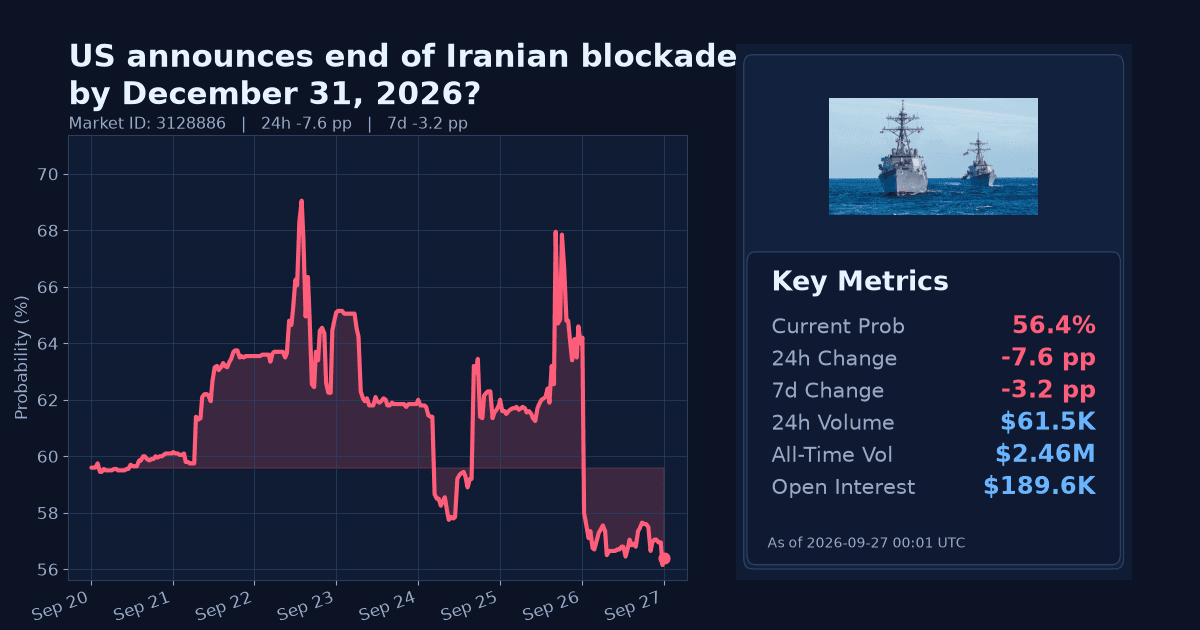
- The year-end version (end by December 31, 2026) declined as well (delta_24h -2.25pp; delta_7d -8.15pp) but still prices higher overall, suggesting traders see more room for a later announcement than a near-term one.
- A related geopolitical market, “US-Iran Final Nuclear Deal by October 31, 2026,” ticked up slightly (delta_24h +0.5pp; delta_7d +1.55), a modest divergence that does not materially confirm the blockade-termination move.
News & Real-World Context
On September 28, NPR reported that President Trump rejected an Iranian offer to pause fighting, leaving Gulf security and shipping through the Strait of Hormuz unresolved and “in limbo” (NPR, 2026-09-28). This framing aligns with traders marking down the likelihood of a near-term US announcement to end or suspend the blockade.
Also on September 28, the Australian government’s Assistant Minister for Foreign Affairs and Trade said in an official interview that the conflict has dragged on and that closure of the Strait of Hormuz is pushing up costs, while expressing hope for a US–Iran agreement so the strait can reopen (Australian Government DFAT, 2026-09-28). As an official government statement, this serves as a policy-relevant signal that the status quo persists.
Bottom Line
The market is marking down the odds of a US announcement ending the Iran blockade before October 31 amid signals of continued standoff and no qualifying US communication so far. The move is statistically extreme for this market and looks like a short-term repricing as the deadline approaches rather than a structural shift in year-end views.
Market Conditions at Time of Writing
- Current Probability: 26.0%
- 24h Change: -2.0pp
- 7d Change: -12.5pp
- Volume (24h, $): 227,944.71
- Open Interest ($): 111,909.01
- Spread (pp): 2.0
- Z-score (24h): 8.0