What Moved the Market
Polymarket’s contract on whether Benjamin Netanyahu will be the next Prime Minister of Israel moved higher. The contract concerns the individual formally appointed and sworn in after Israel’s parliamentary election process; interim or caretaker premiers do not count. The market window runs from Nov. 15, 2025 to Oct. 28, 2026, with the description also noting resolution rules if no qualifying prime minister is sworn in by Dec. 31, 2027.
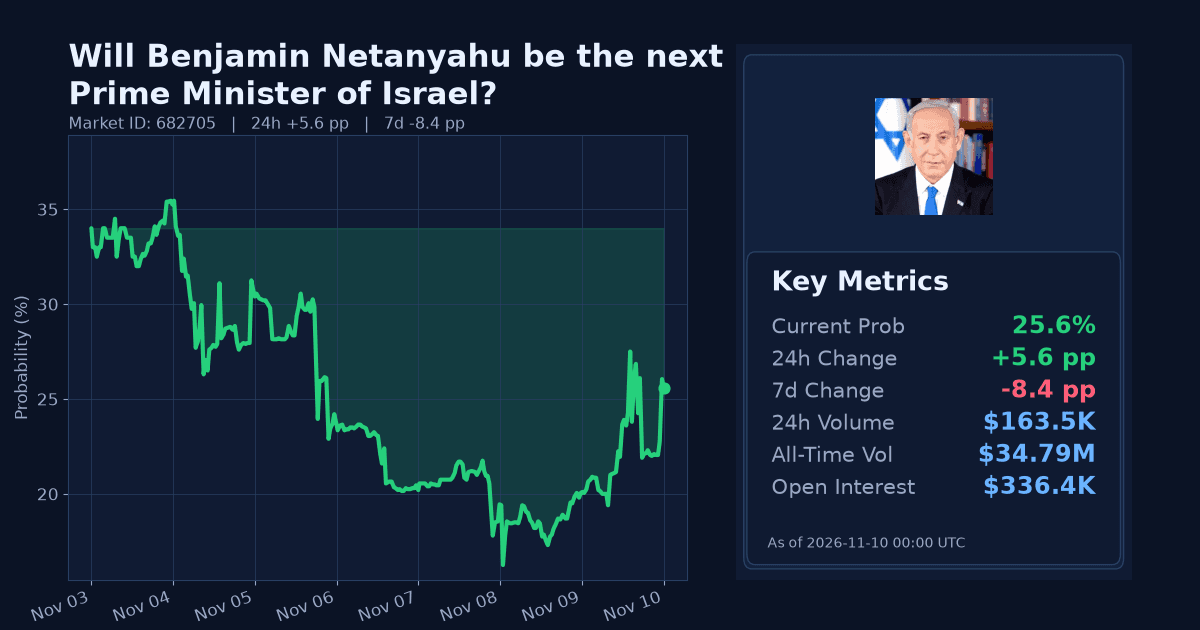
At the time of writing, Netanyahu’s probability was in the mid-20s after a roughly five-and-a-half-point daily rise. The move came despite the market still being lower over the past week, making the latest trading a rebound rather than a clean continuation of the prior direction.
Why It Likely Moved
- The repricing appears driven by renewed attention to Iran and regional security, especially after official U.S. remarks emphasized that a nuclear Iran would be “unacceptable” and framed U.S. regional actions as defensive.
- Markets appear to have reacted to the absence of near-term diplomatic progress with Iran. The U.S. statement said Washington was not “on the verge of a breakthrough,” which likely kept regional-risk scenarios salient for Israel-linked political markets.
- The move also follows Iran-linked news outside Israel, including French accusations of cyberattacks attributed to Iran. That supports a broader security-information backdrop, though it is not direct evidence about Israeli electoral dynamics.
- The available evidence does not include a Netanyahu-specific polling, coalition, or official Israeli-government development. That limits confidence in any direct political-causality claim.
- Macro conditions do not show a broad risk shock: Brent crude was at $92.36 per barrel and down 11.84% over seven days, while the VIX was 19.92 and down 5.82% over seven days. The move therefore looks more tied to political/security interpretation than to generalized market stress.
How Strong the Move Is
The one-day change was significant: the market rose 5.55 percentage points over 24 hours, and the 24-hour z-score was 24.0. The supplied interpretation labels this an “extreme” upward move relative to the market’s recent trading history.
The seven-day picture points in the opposite direction. Netanyahu remained down 8.4 percentage points over the week, with a 7-day z-score of 3.9604, also labeled “extreme” but in the downward direction. That combination classifies the latest move as a sharp short-term spike and partial reversal inside a still-negative weekly trend.
Cross-Market Confirmation
- The market on a senior U.S.-Iran diplomatic meeting by Nov. 30, 2026 moved up 5.5 points over 24 hours but remained down 10.0 points over seven days. That confirms a short-term Iran-related repricing, but it does not point unambiguously toward escalation.
- The market on a U.S. invasion of Iran before 2027 fell 2.0 points over 24 hours and 7.0 points over seven days. That diverges from a simple war-risk explanation for Netanyahu’s rise.
- The U.S.-Iran Hormuz agreement market rose 2.0 points over 24 hours while falling 13.0 points over seven days. This partially confirms active repricing around Iran diplomacy, but not a consistent directional signal for Israeli leadership outcomes.
News & Real-World Context
- On Nov. 9, 2026, the U.S. State Department published Secretary Marco Rubio’s remarks stating that a nuclear Iran would be unacceptable “not just Israel, not just the Middle East,” and that the U.S. would act defensively against threats to forces or shipping. He also said there was no diplomatic breakthrough to report with Iran.
- Also on Nov. 9, 2026, the UK government published Minister Chris Elmore’s remarks on combating antisemitism at home and abroad. This is an official diplomatic-policy signal tied to Jewish communities and international antisemitism, though it does not directly address the Israeli election market.
- On Nov. 9, 2026, TechCrunch reported that France’s foreign minister blamed Iran for cyberattacks targeting industrial refrigeration systems, including grocery stores and blood banks, according to TechCrunch. This added to the Iran-related security backdrop.
- Relief actors also reported Gaza flooding and shelter damage from Nov. 6-7, with the CCCM Cluster and IOM describing humanitarian needs and response actions, according to ReliefWeb. This is relevant regional context but not a direct Netanyahu-specific signal.
Bottom Line
The market’s rise looks like an extreme short-term rebound tied to regional-security attention, especially Iran-related official statements and news. Cross-market signals confirm active repricing around Iran, but they do not consistently confirm a move toward military escalation. Because the supplied context lacks direct Israeli electoral evidence, the structural significance of the Netanyahu move remains uncertain.
Market Conditions at Time of Writing
- Current Probability (%): 25.6%
- 24h Change (pp): +5.55
- 7d Change (pp): -8.4
- Volume (24h, $): $163,530.12
- Open Interest ($): $336,428.97
- Spread (pp): 1.1
- Z-score (24h): 24.0