What Moved the Market
Polymarket’s contract on whether Benjamin Netanyahu will be the next Prime Minister of Israel moved lower. The market covers the individual formally appointed and sworn in after Israel’s scheduled October 27, 2026 legislative election, or after an earlier election if one is called; caretaker or interim prime ministers do not count. The listed contract window runs from November 15, 2025 to October 28, 2026.
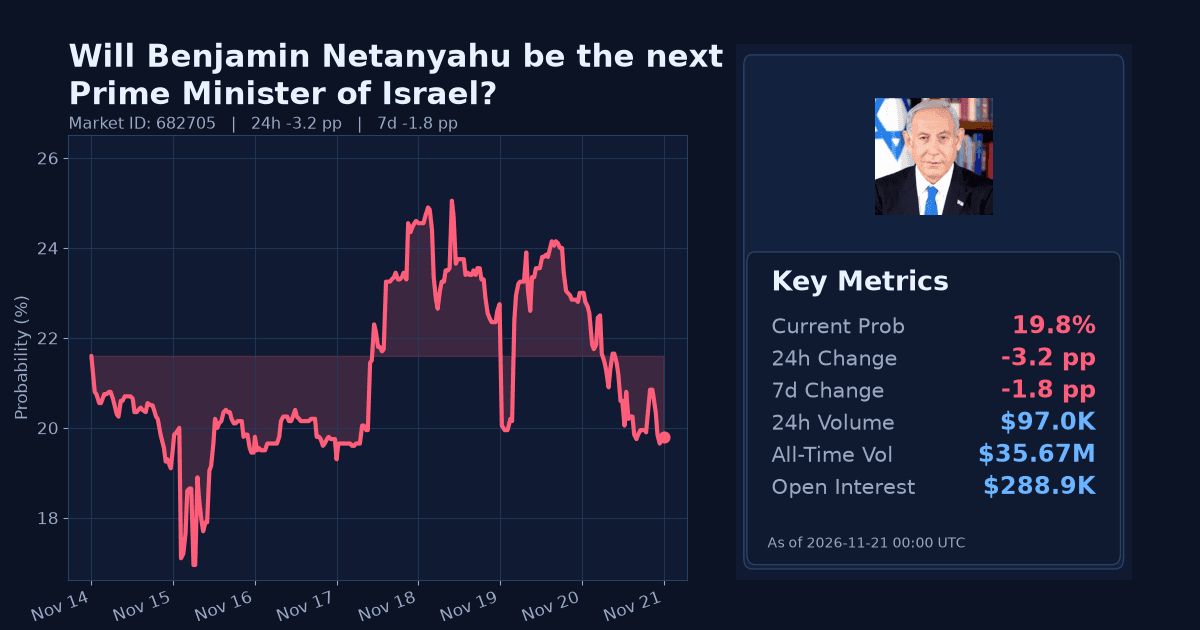
As of the latest snapshot, Netanyahu is priced below one-in-four after a clear one-day decline. The repricing came alongside a stronger move into Gadi Eizenkot in the closely related next-prime-minister market.
Why It Likely Moved
- The move appears driven first by cross-market rotation: the most directly comparable market, Gadi Eizenkot to be the next prime minister, rose over both the daily and weekly horizon while Netanyahu fell.
- Markets appear to be reacting to official diplomatic pressure on Israel’s current government, especially sanctions-related statements from Australia and the United Kingdom over settlement activity and settler violence.
- Repricing follows a news backdrop focused on regional conflict costs and strategic risk, including reporting on U.S. spending tied to the Iran conflict, which may be reinforcing attention on Israeli political leadership risk.
- Broader risk conditions were elevated: the VIX stood at 35.89 and was up 85.96% over seven days, giving the political move a risk-off macro backdrop rather than an isolated low-volatility tape.
How Strong the Move Is
The 24-hour move is best classified as a significant downward spike, not just ordinary noise. The market’s 24h change was -3.2 percentage points, and the 24h z-score was 13.0; the supplied interpretation labels this an extreme move down relative to this market’s recent trading history.
The weekly picture is less decisive. The 7d change was -1.8 percentage points, and the 7d z-score was 0.6457, which the supplied interpretation classifies as normal. That combination suggests a sharp short-term repricing inside a still-limited weekly trend, rather than confirmed structural capitulation in Netanyahu’s odds.
Cross-Market Confirmation
- Gadi Eizenkot’s next-prime-minister market confirms the direction of the Netanyahu move: Eizenkot rose +2.45 pp over 24h and +3.1 pp over 7d, a direct inverse signal in the same Israeli succession theme.
- The Iran leadership-change-by-December market rose +1.0 pp over 24h and +1.0 pp over 7d, suggesting some broader regional political-risk bid, though it is less directly tied to the Israeli prime-minister outcome.
- The Iran leadership-change-by-November market was mixed, up +0.25 pp over 24h but down -0.6 pp over 7d, so it offers weaker confirmation of a broad regional-risk repricing.
News & Real-World Context
Official government statements provide the clearest policy signal in the supplied evidence. On November 18, Australian Foreign Minister Penny Wong said Australia had sanctioned three individuals and four entities involved with the settlement enterprise, and stated that settlement activity “supported by the current Israeli Government” was contrary to peace and a two-state outcome, according to the Australian foreign minister. On November 20, Australia’s Assistant Minister for Foreign Affairs and Trade Matt Thistlethwaite said Australia, the United Kingdom and other countries had announced further sanctions against Israeli government officials and organisations involved in settler violence in the occupied Palestinian territories, according to Australia’s DFAT ministers. These are official policy signals, not merely commentary.
The news context is more regional than election-specific. On November 20, AP reported that U.S. war-related spending tied to the conflict with Iran had surpassed $48 billion, with lawmakers seeking unreleased damage assessments on military bases, according to AP News. Separately, reporting said Donald Trump described nuclear arms limits with China and Russia as “very hard” to achieve after talks with Xi Jinping and Vladimir Putin, according to Ground News. These items do not directly determine the Israeli succession market, but they align with a broader geopolitical-risk environment around Israel and the region.
Bottom Line
The Netanyahu market move looks like a sharp short-term repricing, with strong confirmation from the Eizenkot market but only normal movement on the weekly horizon. The evidence supports a rotation away from Netanyahu, reinforced by official international pressure on the current Israeli government, but it does not yet establish a structural break in the 2026 post-election succession outlook.
Market Conditions at Time of Writing
- Current Probability (%): 19.8
- 24h Change (pp): -3.2
- 7d Change (pp): -1.8
- Volume (24h, $): 96,987.21
- Open Interest ($): 288,930.78
- Spread (pp): 0.1
- Z-score (24h): 13.0