What Moved the Market
Polymarket’s contract asks whether Benjamin Netanyahu will be the next individual formally appointed and sworn in as Prime Minister of Israel after the parliamentary election. The listed market window runs from November 15, 2025 to October 28, 2026, and the rules exclude interim or caretaker prime ministers.
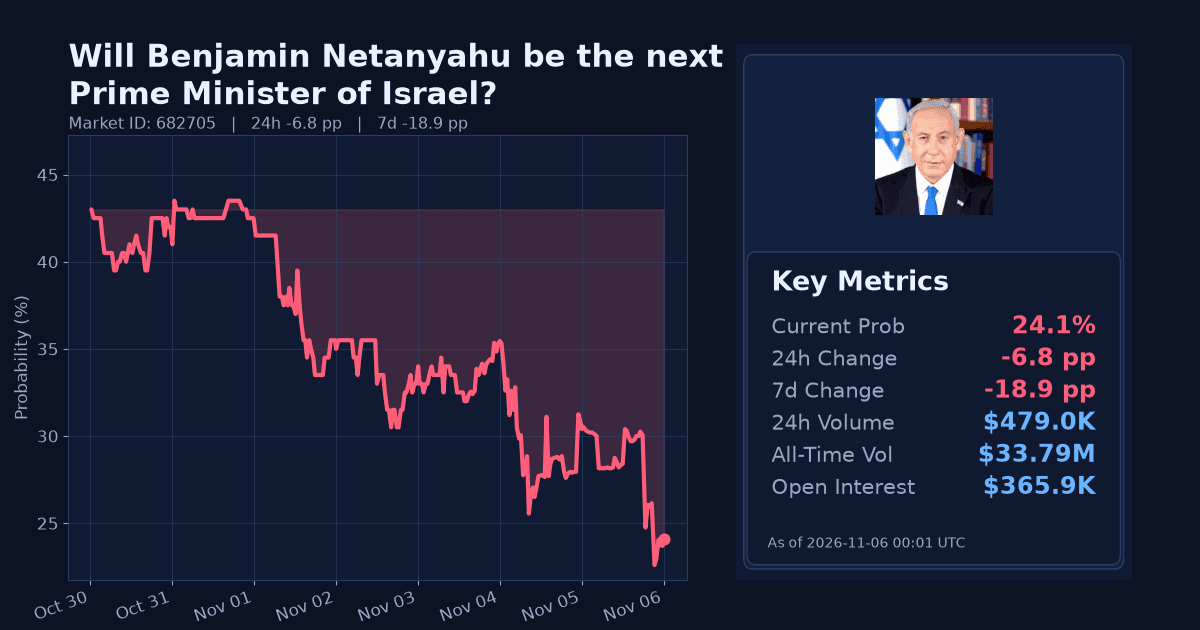
The Netanyahu market moved sharply lower. At the time of writing, the contract was priced at 24.1%, reflecting a material decline over both the daily and weekly windows.
Why It Likely Moved
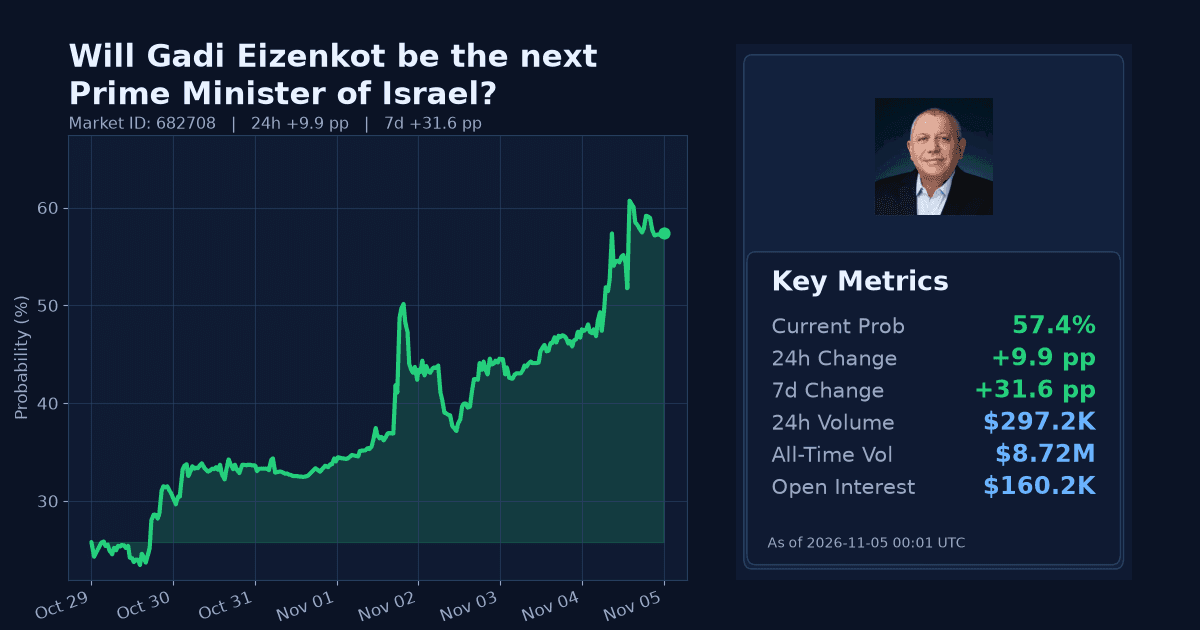
- The repricing appears driven mainly by candidate rotation inside the same Israeli leadership complex: related markets show stronger demand for Gadi Eizenkot and, to a lesser extent, Avigdor Lieberman.
- Markets reacted to the contract’s resolution mechanics, which require a formally sworn-in post-election prime minister rather than incumbent status or caretaker authority. That makes coalition-forming expectations central to pricing.
- The move appears more candidate-specific than macro-driven. Broader risk conditions were volatile, with the VIX at 28.18 and up 63.84% over seven days, but that does not by itself explain the direction of the Netanyahu leg.
- Official European context shows continued external scrutiny of Israel-related issues, but the supplied government items do not establish a direct Netanyahu-specific electoral catalyst.
How Strong the Move Is
The 24-hour change was -6.8 percentage points, with a 24-hour z-score of 27.6. The provided interpretation classifies this as an extreme downward move relative to this market’s recent trading history, so the change should not be treated as routine noise.
The seven-day change was -18.9 percentage points, with a seven-day z-score of 6.9928, also classified as extreme. Because both time windows point in the same direction, the move looks like an extreme downward repricing rather than a single isolated tick.
Cross-Market Confirmation
- Gadi Eizenkot’s next-prime-minister market confirms the anti-Netanyahu rotation: it rose +6.3 pp over 24 hours and +33.15 pp over seven days.
- Avigdor Lieberman’s market also moved higher, adding +2.4 pp over 24 hours and +4.15 pp over seven days, offering secondary confirmation that some probability shifted to alternatives.
- The unrelated Trump-out-before-2027 market moved slightly lower, at -0.35 pp over both 24 hours and seven days, and does not confirm the Israel-specific repricing.
News & Real-World Context
The supplied recent news set contains limited direct Israeli electoral reporting. The most regionally relevant article is a November 5 report that Putin met Iranian security council chief Rezaei in Moscow, though the report did not detail outcomes or agreements, according to Ground News. That is regional-security context rather than direct evidence about Israel’s next prime minister.
Official context is similarly more about diplomatic scrutiny than candidate-specific developments. On November 4, the European Parliament published a written question on violations of the education rights of Palestinian minors and holding Israel to account, according to the European Parliament. On November 5, the European Parliament also published a written question on an eastern Mediterranean electrical interconnection project. Other official items in the supplied set — a UK government statement on Tanzania, a European Commission notice on ERC nominations, and a Canadian prime ministerial travel release — do not provide direct evidence about Israeli leadership succession.
Bottom Line
The Netanyahu selloff is best read as an extreme, candidate-specific repricing supported by cross-market movement toward Eizenkot and other alternatives. The evidence does not identify a single news catalyst, so whether this is structural or short-term remains uncertain.
Market Conditions at Time of Writing
- Current Probability (%): 24.1
- 24h Change (pp): -6.8
- 7d Change (pp): -18.9
- Volume (24h, $): 478,961.99
- Open Interest ($): 365,892.06
- Spread (pp): 0.8
- Z-score (24h): 27.6