What Moved the Market
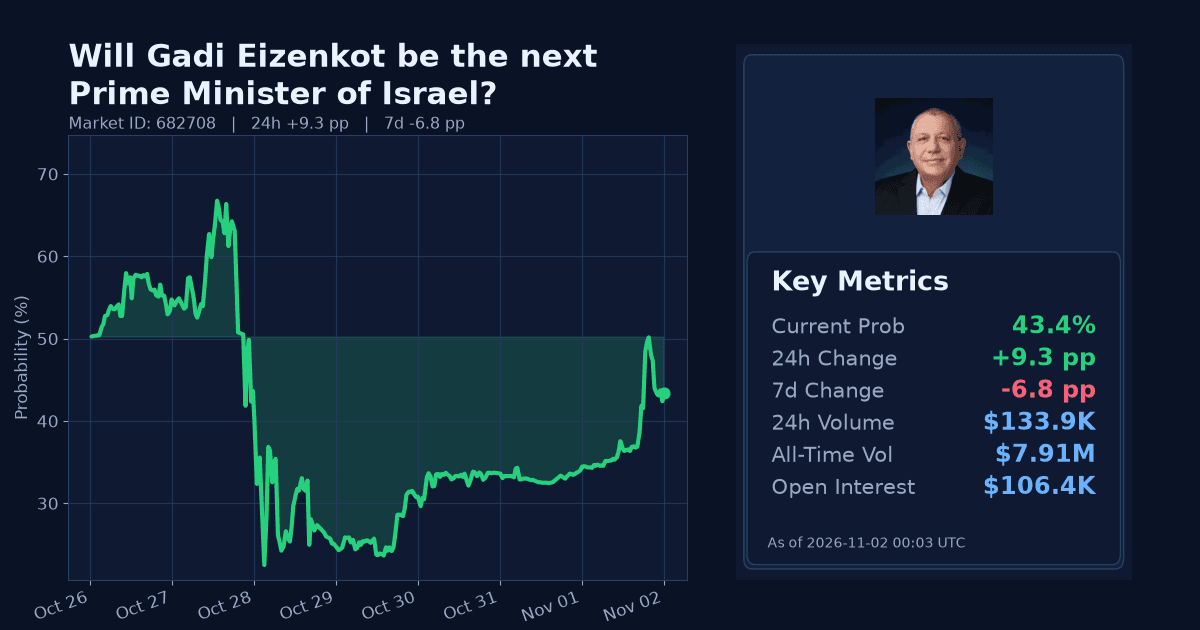
Polymarket’s market on whether Gadi Eizenkot will be the next Prime Minister of Israel moved higher. The contract asks whether Eizenkot will be the individual formally appointed and sworn in after Israel’s next parliamentary election, with the listed market window running from November 15, 2025 to October 28, 2026.
At the time of writing, Eizenkot is priced at 43.4%, after a sharp one-day rise. The market’s rules specify that caretaker or interim prime ministers do not count; resolution depends on a formal swearing-in, with “Other” applying if no qualifying prime minister is sworn in by December 31, 2027.
Why It Likely Moved
- The repricing appears driven by rotation within the Israel prime-minister candidate set: Eizenkot rose while Benjamin Netanyahu’s related contract fell over the same short window.
- Markets reacted as if traders were reallocating probability away from Netanyahu and toward alternative post-election outcomes, rather than pricing a broad regional shock.
- The move also appears supported by market depth: Eizenkot’s market showed substantial 24-hour turnover and more than $100,000 in open interest, indicating the shift was not merely a dormant-market tick.
- The contract design likely focuses traders on coalition-formation and formal appointment risk, not only election-day performance, because the winning condition is being sworn in as prime minister.
- Available news and official-government inputs do not provide a direct Israel-specific catalyst, so the most defensible explanation is market-internal repricing across related Polymarket contracts.
How Strong the Move Is
This is a significant short-term spike, not a routine fluctuation. The 24-hour change was +9.35 percentage points, and the supplied z-score is 37.6. The market’s own z-interpretation classifies that as an “extreme” upward move relative to its recent trading history.
The broader weekly picture is more mixed. Eizenkot remains down 6.85 percentage points over seven days, with a 7-day z-score of 1.24662, described as “elevated” but not extreme. That combination points to a sharp one-day reversal inside a still-uneven weekly trend, rather than a clean multi-day continuation.
Cross-Market Confirmation
- Netanyahu’s related market moved in the opposite direction, falling 6.5 percentage points over 24 hours while remaining up 8.5 points over seven days. That divergence supports the view that the Eizenkot move is a candidate-rotation trade.
- Avigdor Lieberman’s next-PM market rose 1.65 points over 24 hours and 2.75 points over seven days, offering partial confirmation that traders were adding probability to non-Netanyahu alternatives.
- The Iranian-regime-fall market moved lower by 1.0 point over both 24 hours and seven days, which does not confirm a broad regional-crisis explanation for Eizenkot’s repricing.
News & Real-World Context
The supplied news set does not include a direct Israeli election development or an Israeli government announcement tied to Eizenkot, Netanyahu, or coalition formation. Recent political news in the feed instead focused on other electoral and institutional stories: Bulgaria’s presidential runoff on November 1, 2026, was reported as a close second-round contest by Ground News, while a separate November 1 report described Serbian police officials being detained after an election-related episode, according to Ground News. NPR also framed the U.S. midterms as a test of political direction and confidence on November 1, 2026, in NPR.
Official-government context is similarly not Israel-specific. France’s foreign ministry published foreign-affairs items involving Jean-Noël Barrot on October 28, October 31, and November 1, 2026, including a G20 foreign ministers interview from the French Ministry for Europe and Foreign Affairs. Australia’s Department of Foreign Affairs and Trade announced a China visit on November 1, 2026, stating that two-way goods and services trade with China was worth $326 billion in 2025, via Australia’s DFAT ministers. These are official policy signals, but the supplied text does not connect them to Israel’s prime-minister succession market.
Macro conditions also do not show an obvious confirming shock. The S&P 500 was down 0.572% over seven days, while the VIX stood at 19.42 and was up 26.845% over 30 days; those figures describe a somewhat more volatile backdrop, but they do not establish a direct driver for this contract.
Bottom Line
Eizenkot’s odds made an extreme one-day move higher, but the weekly change remains negative, making the signal more consistent with a sharp short-term reversal than a clearly established structural trend. The strongest support comes from cross-market rotation away from Netanyahu and toward alternatives, while the supplied news and government context provides no direct Israel-specific catalyst.
Market Conditions at Time of Writing
- Current Probability (%): 43.4
- 24h Change (pp): +9.35
- 7d Change (pp): -6.85
- Volume (24h, $): 133,916.29
- Open Interest ($): 106,446.25
- Spread (pp): 1.1
- Z-score (24h): 37.6