What Moved the Market
-
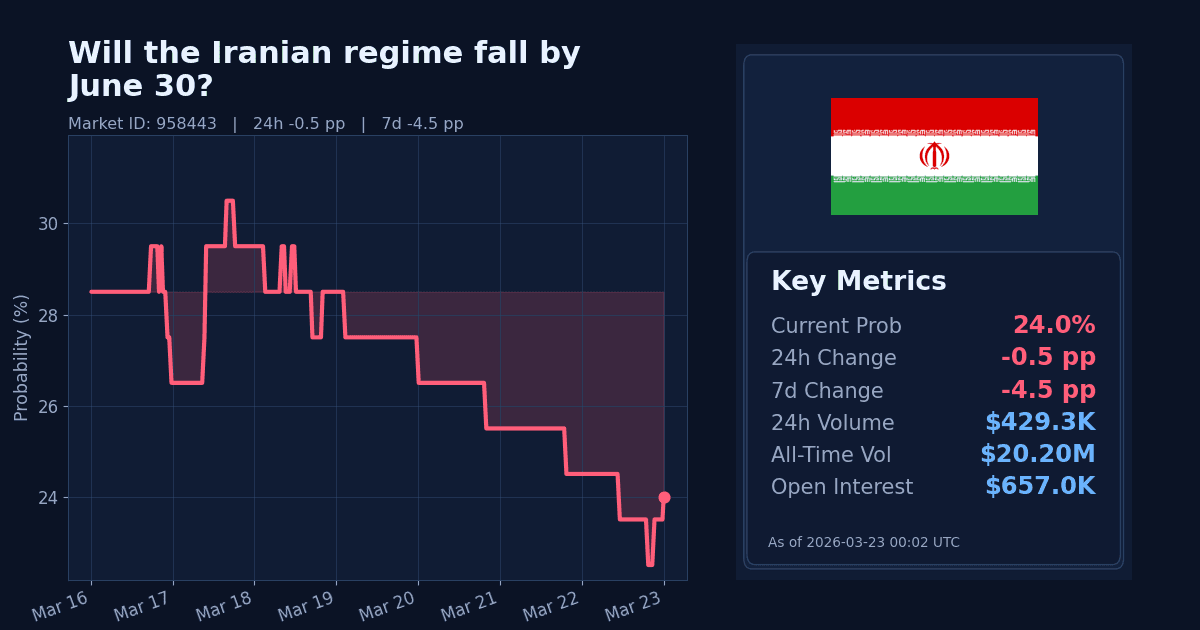
The Polymarket contract on whether Iran’s Islamic Republic will cease to govern by June 30, 2026 (11:59 PM ET) is priced at 24.0% as of March 23, 2026. Over the last 24 hours, the contract fell by 0.5 percentage points; over the last 7 days, it declined by 4.5 percentage points.
-
Vendor metrics flag the move as unusual relative to recent trading: the 24-hour change is labeled “extreme” versus recent history, and the 7-day move is also labeled “extreme” on a downward basis. The market has been active within a contract window that ultimately resolves on June 30, 2026 under criteria requiring a clear break in the Islamic Republic’s core governing structures.
Why It Likely Moved
- Repricing appears driven by headlines centering on external confrontation (Iranian missile strikes on Israeli cities and U.S. threats against Iranian power infrastructure), which do not directly indicate imminent domestic regime collapse within the contract window.
- Markets reacted to statements that Russia “remains a loyal friend to Iran,” which may be read as external backing that reduces perceived short-term vulnerability of core regime structures.
- Cross-market context shows very low odds for near-term regime fall (by March 31) and active interest in ceasefire scenarios, which collectively do not point to immediate systemic change in Tehran.
- Elevated energy benchmarks over the last month (WTI near $98/bbl and Brent near $107/bbl, both up roughly ~48% month-on-month) suggest a broader geopolitical risk premium that aligns more with regional conflict risk than with internal regime collapse signals.
How Strong the Move Is
-
Despite a modest 24-hour decline of 0.5pp, the vendor’s 24-hour z-interpretation flags the shift as extreme versus recent trading patterns, indicating outsized sensitivity or thinner liquidity in short horizons. The 7-day drop of 4.5pp is also flagged as an extreme downward move.
-
Taken together, this reads as a significant weekly repricing rather than noise. The short-term print looks like a continuation of this week’s downtick, not a one-off spike or clear reversal of a longer trend.
Cross-Market Confirmation
- “Will the Iranian regime fall by March 31?” trades at 1.9%, which confirms very low near-term collapse expectations and is consistent with pressure on the longer-window contract.
- “US x Iran ceasefire by March 31?” at 11% does not indicate strong confidence in immediate de-escalation, but it does not support a regime-collapse thesis either.
- “US x Iran ceasefire by April 15?” at 32% implies a non-trivial chance of negotiated pause; this leans toward stability and does not confirm imminent systemic change in Iran.
News & Real-World Context
-
Recent reporting highlights Iranian missile strikes on two Israeli cities near a key nuclear research area, alongside U.S. threats to “obliterate” Iranian power plants and a 48-hour ultimatum tied to the Strait of Hormuz. Separately, Russia signaled it “remains a loyal friend to Iran.” Switzerland moved to halt new arms exports to the U.S. over the Iran war.
-
The overall news flow emphasizes regional confrontation and great-power positioning. These narratives highlight external conflict dynamics rather than concrete signs of an internal breakdown of the Islamic Republic’s core governing institutions within the market’s June 30, 2026 resolution window.
Bottom Line
- The market marked down regime-fall odds to 24%, with an extreme-labeled weekly decline amid headlines focused on external conflict. Cross-market signals and macro context lean toward regional risk rather than imminent regime collapse.
- This looks like a short-term repricing anchored to recent news flow, not a structural reassessment of the contract’s end-state.
Market Conditions at Time of Writing
- Current Probability (%): 24.0
- 24h Change (pp): -0.5
- 7d Change (pp): -4.5
- Volume (24h, $): 429,260.4
- Open Interest ($): 656,983.2
- Spread (pp): 1.0
- Z-score (24h): 8.0
- Z-score (7d): 24.0