What Moved the Market
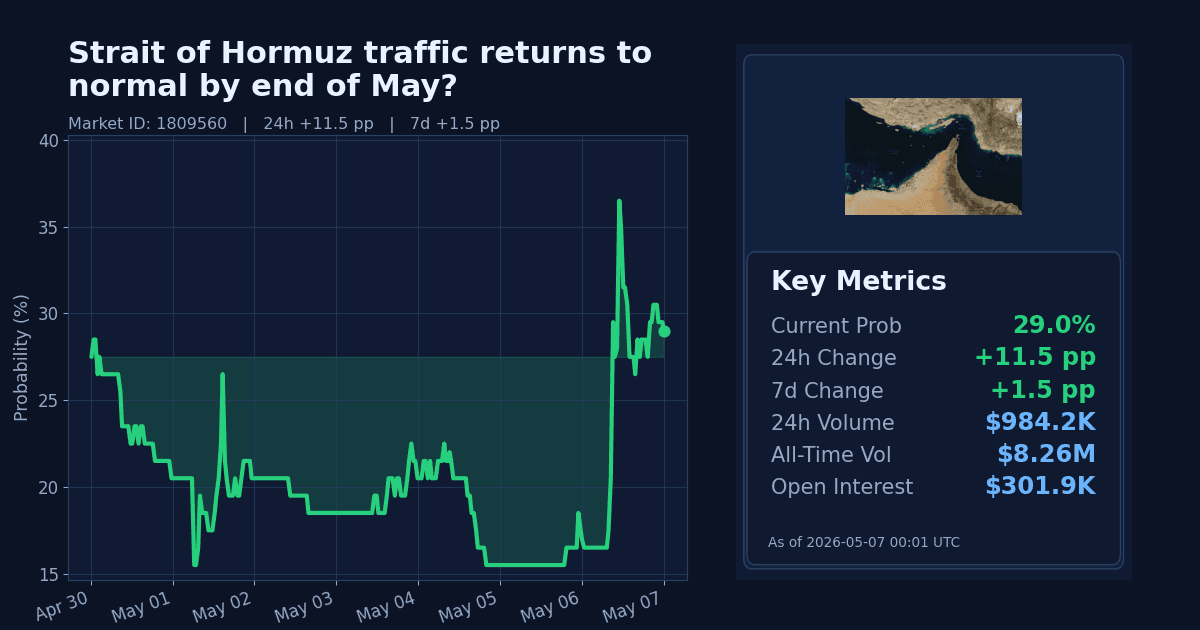
The Polymarket contract “Strait of Hormuz traffic returns to normal by end of May?” rose 11.5 percentage points in the past 24 hours to 29% as of May 7. The market resolves “Yes” if IMF Portwatch shows a 7‑day moving average of Strait of Hormuz transit calls at or above 60 on any date between market creation (March 31, 2026) and May 31, 2026.
Over the last 7 days, pricing is up a modest 1.5 percentage points. The sharp daily repricing contrasts with a relatively small move over the week.
Why It Likely Moved
- Repricing appears driven by official U.S. updates on “Project Freedom,” a defensive mission to escort commercial shipping through the strait. On May 5–6, the U.S. Secretary of State said two U.S.-flag merchant ships had safely transited and described expanding naval and air coverage to build a protected corridor (U.S. State Department, May 6).
- The U.S. Department of Defense also outlined the mission’s goal to restore the safe flow of international shipping and oil through Hormuz, reinforcing expectations of incremental throughput restoration (U.S. DoD “war.gov”, May 5).
- Markets reacted to messaging from Iran’s Revolutionary Guard that ships can now pass and would be given safe passage, potentially reducing immediate transit risk (NPR, May 6).
- A broader easing in energy risk is visible: Brent crude fell 13.6% over 7 days to $101.94/bbl, a macro signal consistent with lower perceived disruption premiums and improved odds of normalized flows by month-end (Yahoo Finance data as of May 6).
How Strong the Move Is
The 24-hour shift carries an extreme z-score of 48.0, indicating an outlier upside move versus recent trading history. By contrast, the 7-day z-score is normal (0.424), suggesting the weekly trend remains only mildly higher.
Taken together, this reads as a news-driven spike rather than an established trend. Elevated 24-hour volume ($984k) and a tight spread (1.0 pp) indicate active repricing on fresh signals.
Cross-Market Confirmation
- “Strait of Hormuz traffic returns to normal by May 15?” sits at 5.2% (delta_24h: +2.2 pp; delta_7d: -3.35 pp). This low near-dated price diverges from the end‑May optimism, implying traders still see limited odds of very near‑term normalization.
- “Will 40 ships transit the Strait of Hormuz on any day by April 30?” is at 1.6% (delta_24h: +0.95 pp; delta_7d: +0.8 pp), a small uptick but not a confirming signal for sustained normalization.
- “U.S. blockade lifted by May 8?” is 6.2% (delta_24h: +2.95 pp; delta_7d: -7.9 pp), showing a minor daily rise but a weaker weekly profile, offering only partial alignment with today’s move.
News & Real-World Context
- The U.S. Secretary of State said on May 5–6 that “Project Freedom” is guiding stranded ships through Hormuz under a defensive umbrella and reported two U.S.-flag merchant transits as proof of concept, with additional naval and air assets deploying to expand coverage (U.S. State Department, May 6). The U.S. Department of Defense similarly framed the mission’s objective as restoring the safe flow of commerce through the strait (war.gov, May 5).
- Iran’s Revolutionary Guard said ships can now pass and promised safe passage, following changes in U.S. escort posture, a statement that could ease immediate risk perceptions for transits (NPR, May 6).
- European posture shifted: a French carrier group moved south of Suez ahead of a conditional UK‑French Hormuz mission, indicating possible allied support if activated (AP News, May 6).
- Risk remains present: a CMA CGM container ship was hit transiting Hormuz, injuring crew (Ground News, May 6). Separately, reporting that the U.S. and Iran are closing in on a one‑page memo and related remarks contributed to oil’s slide, a market cue of reduced geopolitical risk (Ground News/Axios, May 6).
Bottom Line
Pricing jumped on authoritative U.S. government signals of active escorts and initial successful transits, plus macro confirmation from softer oil. Conflicting on‑water reports and still‑cautious near‑dated markets temper confidence.
This looks like a short‑term, news‑driven repricing toward end‑May normalization odds. Sustained follow‑through likely depends on continued escorted throughput sufficient to push IMF Portwatch’s 7DMA to the 60‑transit threshold before May 31.
Market Conditions at Time of Writing
- Current Probability: 29.0%
- 24h Change: +11.5 pp
- 7d Change: +1.5 pp
- Volume (24h, $): 984,178.09
- Open Interest ($): 301,904.12
- Spread (pp): 1.0
- Z-score (24h): 48.0