
Falkland Islands
A self-governing British Overseas Territory in the South Atlantic claimed by Argentina
The Falkland Islands are a self-governing British Overseas Territory in the South Atlantic, known as the Islas Malvinas in Argentina, whose sovereignty is disputed between the United Kingdom and Argentina.
Definition
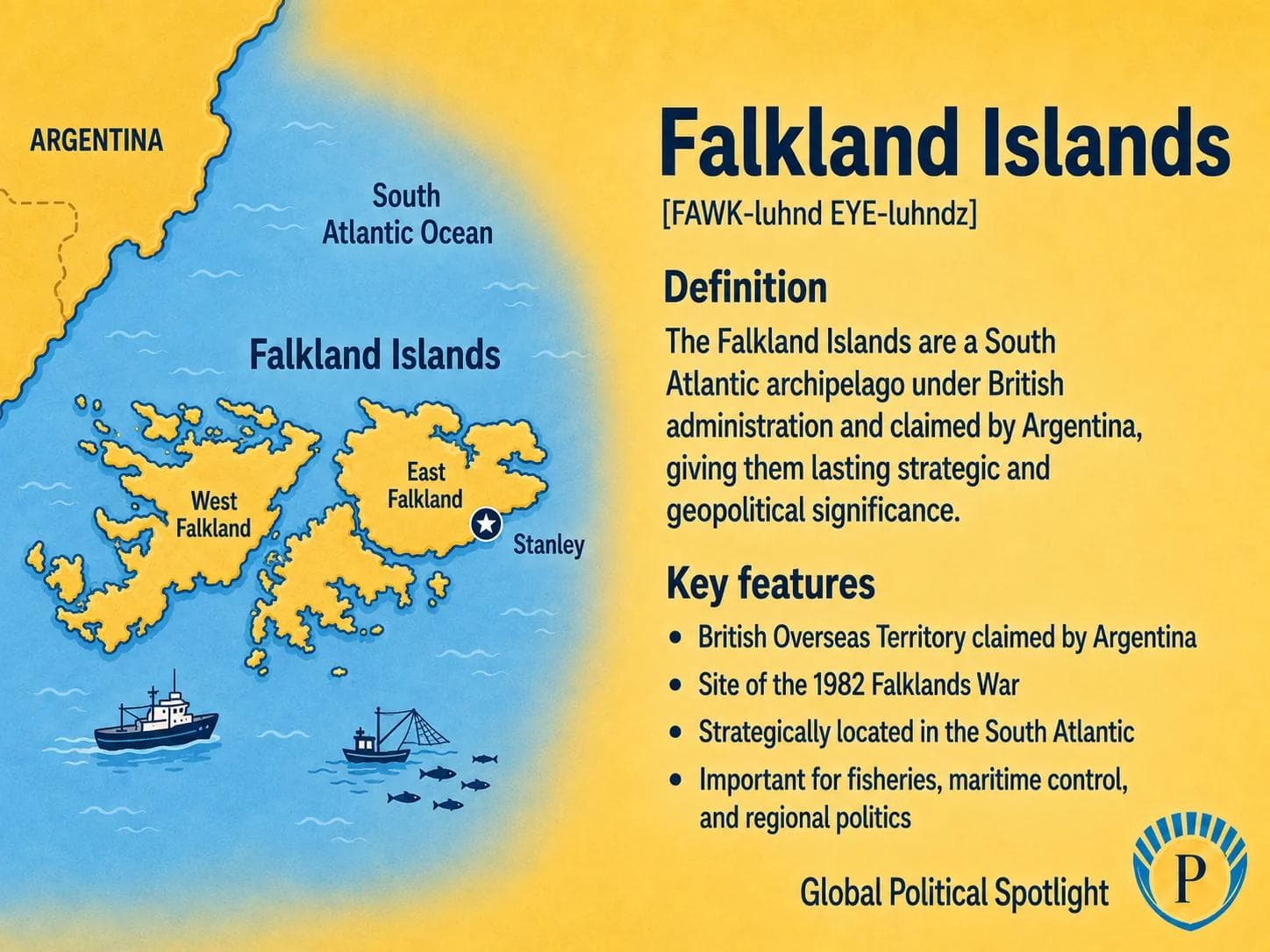
The Falkland Islands are an archipelago in the South Atlantic Ocean, located east of southern Argentina and consisting mainly of East Falkland, West Falkland, and many smaller islands. They are administered as a self-governing British Overseas Territory, with the United Kingdom responsible for defence and foreign affairs.
Argentina claims the islands, which it calls the Islas Malvinas, and argues that sovereignty should be negotiated with the United Kingdom. The United Kingdom and the Falkland Islands Government emphasize the islanders' right to self-determination, including the 2013 referendum in which voters overwhelmingly chose to remain a British Overseas Territory.
Why It Matters
The Falkland Islands matter because they combine territorial sovereignty, self-determination, military posture, maritime jurisdiction, fisheries, and South Atlantic strategic access in one long-running dispute. The issue remains diplomatically sensitive in UK-Argentina relations and is regularly raised in international forums.
Their location gives them relevance beyond local politics. The islands sit near important South Atlantic sea space, support valuable fisheries, and host British military facilities intended to deter renewed conflict and protect UK overseas territory interests.
GPS should track the Falkland Islands as an enduring sovereignty dispute where self-determination, decolonization debates, UK defence commitments, Argentine diplomacy, fisheries governance, and South Atlantic strategic access intersect. The main watchpoints are changes in UK-Argentina diplomatic posture, UN decolonization discussions, local constitutional or referendum politics, fisheries and maritime regulation, and any shifts in British military presence in the South Atlantic.
Key Facts
- Type
- Disputed South Atlantic archipelago and self-governing British Overseas Territory
- Location
- South Atlantic Ocean, east of southern Argentina and north of South Georgia
- Main settlement
- Stanley, on East Falkland
- Primary actors
- Falkland Islands Government, United Kingdom, Argentina
- Legal status
- Administered by the United Kingdom as a self-governing Overseas Territory; claimed by Argentina as the Islas Malvinas
- 1982 conflict
- Argentina invaded in April 1982; British forces retook the islands in June 1982 after a short war
- Strategic role
- UK defence posture, South Atlantic maritime access, fisheries governance, and overseas territory security
- UN context
- The islands are listed by the United Nations as a Non-Self-Governing Territory under the name Falkland Islands (Malvinas)
FAQ
What are the Falkland Islands?
The Falkland Islands are a remote archipelago in the South Atlantic Ocean. They are internally self-governing and administered as a British Overseas Territory, while Argentina claims sovereignty over them under the name Islas Malvinas.
Why are the Falkland Islands disputed?
The dispute centers on competing sovereignty claims. Argentina argues the islands are part of its national territory, while the United Kingdom maintains sovereignty and points to the islanders' right to self-determination.
Who controls the Falkland Islands today?
The Falkland Islands are administered by their own local government under the framework of a British Overseas Territory. The United Kingdom is responsible for defence and foreign affairs.
What happened in the Falklands War?
In 1982, Argentina invaded the islands. The United Kingdom sent a military task force and retook control after a short but costly conflict. The war remains central to the modern political sensitivity of the dispute.
Why do the Falkland Islands matter geopolitically?
They matter because they connect sovereignty, self-determination, overseas military commitments, South Atlantic maritime access, fisheries, and UK-Argentina diplomacy. The islands are also a reference case in debates over decolonization and territorial disputes.
Are the Falkland Islands the same as the Malvinas?
Yes. Falkland Islands is the name used by the local government and the United Kingdom, while Islas Malvinas is the Spanish name used by Argentina and many Spanish-language sources.
Recent Developments
The UK reiterated its sovereignty position at the Organization of American States
In a June 2024 statement, the UK government said it had no doubt about its sovereignty over the Falkland Islands, South Georgia and the South Sandwich Islands, while emphasizing the principle of self-determination for the islanders.
UK GovernmentThe UN continued to list the islands as a Non-Self-Governing Territory
The United Nations decolonization portal identifies the Falkland Islands (Malvinas) as one of the territories on the UN list of Non-Self-Governing Territories, reflecting the issue's continued institutional relevance.
United NationsSources5 references
- Falkland Islands Government
Official local government background on the islands, their history, population, constitution, and self-government.
- United Nations Decolonization
UN reference page listing the Falkland Islands (Malvinas) as a Non-Self-Governing Territory.
- UK Government
Official UK guidance on British forces in the Falkland Islands and the South Atlantic.
- UK Government
UK statement outlining its sovereignty position and reference to self-determination.
- Falkland Islands Government History
Official local history page including the 1982 conflict and its impact on the islands.

GPSNews App
Read GPSNews on iPhone
Daily geopolitical briefings, government updates, and prediction signals in one focused app.
Newsletter
Stay Ahead Of The Next Signal
Get briefings in your inbox when new analysis and reports are published.