
Kuril Islands
A Russia-controlled island chain between Japan and Kamchatka with disputed southern islands
The Kuril Islands are a Russia-controlled island chain between Japan and Kamchatka. Japan claims the southern islands as the Northern Territories, leaving a World War II-era dispute unresolved.
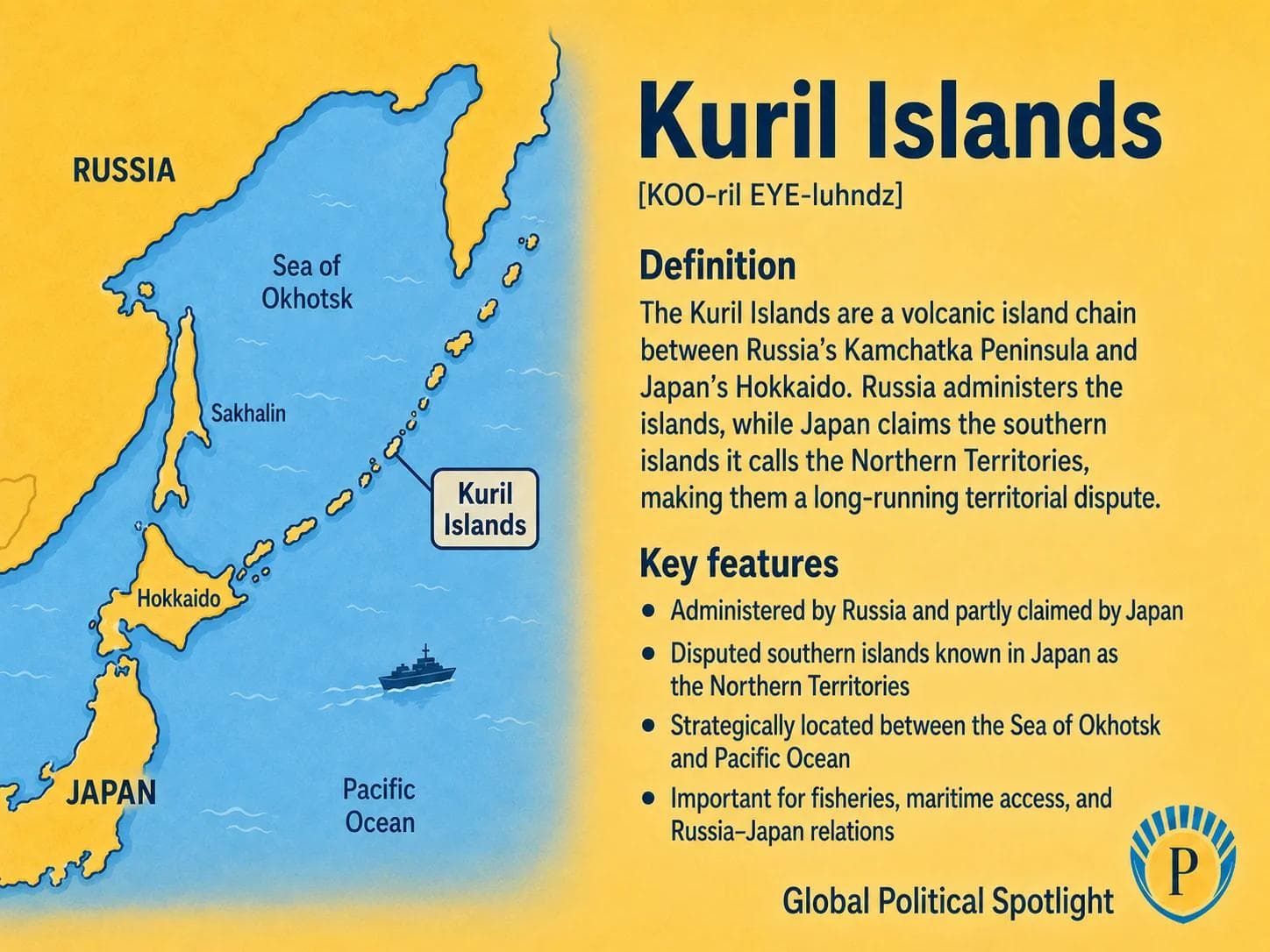
Definition
The Kuril Islands are a volcanic island chain running from Russia's Kamchatka Peninsula to Japan's Hokkaido, separating the Sea of Okhotsk from the northern Pacific Ocean. Russia administers the chain, including the southern islands that Japan calls the Northern Territories.
The main dispute concerns Iturup, Kunashir, Shikotan, and the Habomai islets. Japan argues these are its Northern Territories and not part of the Kuril chain ceded after World War II, while Russia treats them as part of its sovereign territory following Soviet control at the end of the war.
Why It Matters
The Kuril Islands matter because they are a long-running territorial dispute between Russia and Japan and one reason the two countries never signed a formal World War II peace treaty. The dispute affects diplomacy, sanctions-era relations, regional security, and public politics in both countries.
The islands also have strategic value. They shape access between the Sea of Okhotsk and the Pacific, support fisheries, host Russian military infrastructure, and sit near routes relevant to naval operations, air patrols, and the security environment around Japan's northern approaches.
GPS should track the Kuril Islands as an enduring Russia-Japan territorial dispute where post-World War II legal claims, military deployments, Pacific access, fisheries, sanctions, and the absence of a formal peace treaty intersect. Key watchpoints include Russian military activity on the southern islands, Japanese diplomatic statements on the Northern Territories, Russia-Japan negotiation status, fishing-access arrangements, and broader effects of Russia-West tensions on Tokyo-Moscow relations.
Key Facts
- Type
- Disputed island chain and strategic maritime geography
- Location
- Between Russia's Kamchatka Peninsula and Japan's Hokkaido, separating the Sea of Okhotsk from the northern Pacific
- Current control
- Administered by Russia as part of Sakhalin Oblast
- Japanese claim
- Japan claims Iturup, Kunashir, Shikotan, and the Habomai islets as the Northern Territories
- Primary actors
- Russia and Japan, with local residents, fishing communities, and regional security actors also affected
- Historical turning point
- Soviet forces took control of the islands at the end of World War II, and the dispute has remained unresolved since
- Strategic role
- Pacific access, Sea of Okhotsk security, northern approaches to Japan, military deployments, and maritime surveillance
- Economic relevance
- Fisheries, marine resources, local access arrangements, and maritime economic zones are central to the dispute's practical impact
FAQ
What are the Kuril Islands?
The Kuril Islands are a volcanic island chain between Russia's Kamchatka Peninsula and Japan's Hokkaido. They separate the Sea of Okhotsk from the northern Pacific Ocean and are administered by Russia.
Why are the Kuril Islands disputed?
The dispute concerns the southern islands of Iturup, Kunashir, Shikotan, and the Habomai islets. Japan claims them as the Northern Territories, while Russia administers them and considers them part of its territory after Soviet control at the end of World War II.
Who controls the Kuril Islands today?
Russia exercises de facto control over the Kuril Islands, including the southern islands claimed by Japan. Japan maintains a sovereignty claim over the Northern Territories but does not administer them.
Why did Russia and Japan not sign a World War II peace treaty?
The unresolved territorial dispute over the southern Kuril Islands, known in Japan as the Northern Territories issue, has been one of the main obstacles to concluding a formal peace treaty between Russia and Japan.
Why do the Kuril Islands matter militarily?
The islands affect access between the Sea of Okhotsk and the Pacific Ocean. They also support Russian military deployments, surveillance, coastal defence, and regional posture near Japan's northern approaches.
Why are fisheries important in the Kuril Islands dispute?
The waters around the islands are valuable fishing grounds. Access to fisheries, maritime zones, and marine resources gives the dispute practical economic importance for local communities and bilateral arrangements.
Recent Developments
Russia suspended peace treaty talks with Japan
Russia said it would stop peace treaty negotiations with Japan after Tokyo joined sanctions related to Russia's full-scale invasion of Ukraine. The move reinforced how the Kuril Islands dispute is connected to wider Russia-Japan and Russia-West relations.
Russian Ministry of Foreign AffairsJapan continued to identify the Northern Territories as an unresolved issue
Japan's Diplomatic Bluebook continued to describe the Northern Territories issue as a central unresolved matter in relations with Russia, alongside the absence of a concluded peace treaty after World War II.
Japan Ministry of Foreign AffairsSources6 references
- Japan Ministry of Foreign Affairs
Official Japanese government overview of the Northern Territories issue and Japan's position.
- Japan Ministry of Foreign Affairs Diplomatic Bluebook
Japan's annual diplomatic reference document discussing relations with Russia and the Northern Territories issue.
- Russian Ministry of Foreign Affairs
Official Russian statement on suspending peace treaty negotiations with Japan in 2022.
- Encyclopaedia Britannica
Reference overview of the Kuril Islands' geography, history, and political status.
- Central Intelligence Agency World Factbook
Reference source summarizing international territorial disputes, including Russia-Japan issues.
- Congressional Research Service
Reference background on Japan-Russia relations and the territorial dispute's relevance to regional security.

GPSNews App
Read GPSNews on iPhone
Daily geopolitical briefings, government updates, and prediction signals in one focused app.
Newsletter
Stay Ahead Of The Next Signal
Get briefings in your inbox when new analysis and reports are published.