
Khyber Pass
A historic mountain corridor linking Afghanistan and Pakistan
The Khyber Pass is a strategic mountain pass between Afghanistan and Pakistan, historically used for trade, migration, military movement, and transit between Central Asia and the Indian subcontinent.
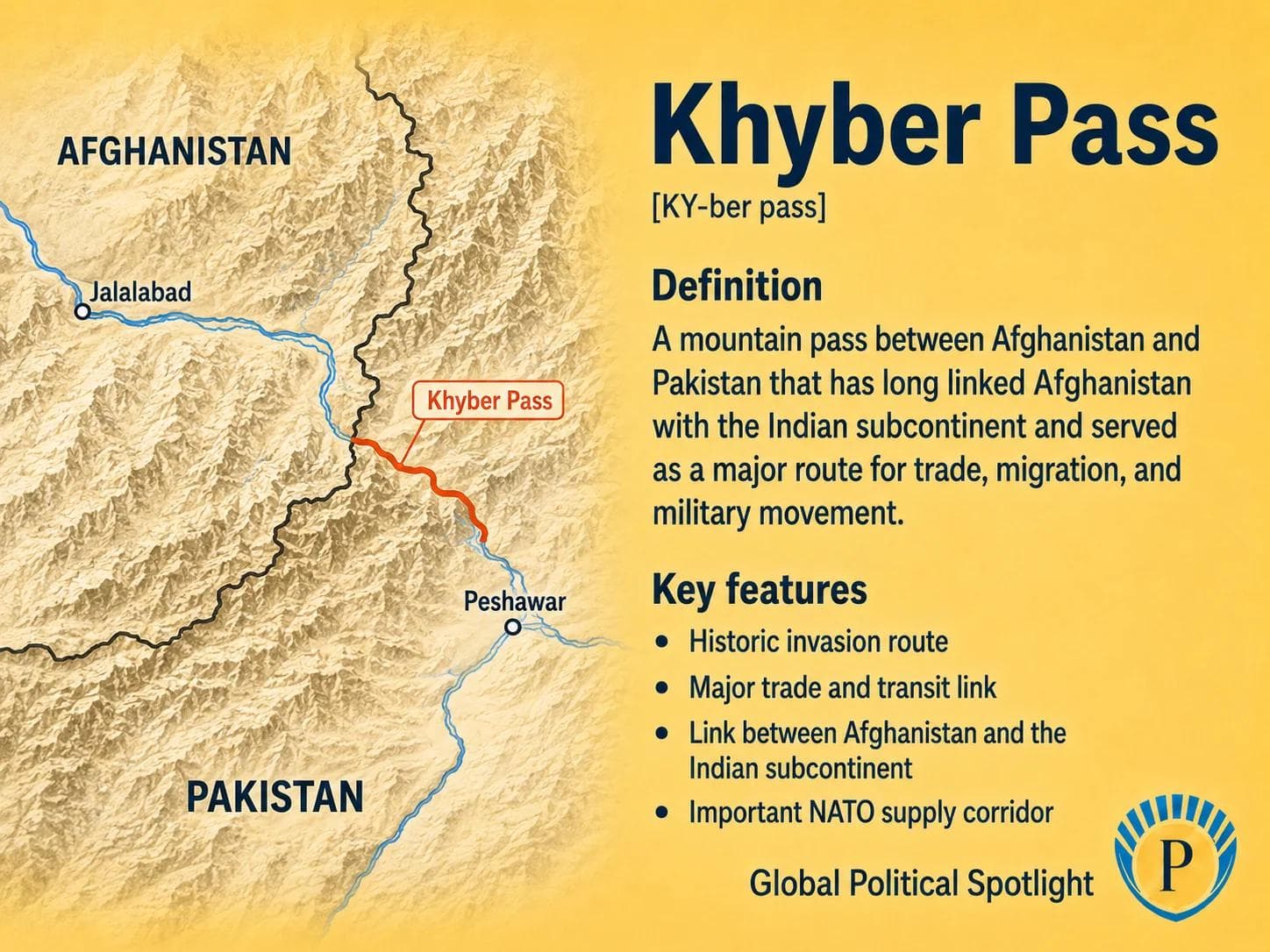
Definition
The Khyber Pass is a mountain pass through the Hindu Kush region linking eastern Afghanistan with northwestern Pakistan. It connects the area around Kabul and Jalalabad with Peshawar and the broader routes into the Indian subcontinent.
For centuries, the pass has served as a corridor for trade, migration, armies, empires, and cross-border movement. Its geography makes it one of the most famous land routes between Central Asia and South Asia.
Why It Matters
The Khyber Pass matters because it concentrates movement through difficult mountain terrain. Whoever can secure, disrupt, or monitor the route gains influence over trade, border control, military logistics, and political access between Afghanistan and Pakistan.
Its importance continued into the modern era through its role in regional transit, Afghan-Pakistani border politics, and supply routes used during international military operations in Afghanistan.
GPS should watch the Khyber Pass as a durable indicator of Afghanistan-Pakistan border dynamics, regional trade connectivity, military logistics, and the security of land corridors between Central Asia and South Asia. Its relevance is strongest when analysis involves border governance, militant movement, trade transit, or external military supply lines.
Key Facts
- Type
- Strategic mountain pass
- Location
- Between eastern Afghanistan and northwestern Pakistan
- Connects
- Afghanistan with Pakistan and the wider Indian subcontinent
- Nearby cities
- Jalalabad, Landi Kotal, and Peshawar
- Historic role
- Trade, migration, imperial campaigns, and military movement
- Modern role
- Cross-border transit route and historically important NATO supply corridor
- Primary actors
- Afghanistan, Pakistan, local border communities, and external military or logistics actors
- Core vulnerability
- Security conditions, border controls, militant activity, infrastructure limits, and Afghanistan-Pakistan political tensions
FAQ
What is the Khyber Pass?
The Khyber Pass is a mountain pass between Afghanistan and Pakistan. It has long been used as a route for trade, migration, and military movement between Central Asia and the Indian subcontinent.
Why is the Khyber Pass important?
It is important because it provides one of the most historically significant land routes through difficult mountain terrain, shaping trade, warfare, border politics, and regional connectivity.
Where is the Khyber Pass located?
The pass lies along the Afghanistan-Pakistan frontier, connecting eastern Afghanistan with Pakistan's Khyber Pakhtunkhwa region and the route toward Peshawar.
Why is the Khyber Pass called an invasion route?
It is often described as an invasion route because armies and empires historically used it to move between Central Asia, Afghanistan, and the Indian subcontinent.
How was the Khyber Pass used by NATO?
During the international military presence in Afghanistan, routes through Pakistan, including the Khyber Pass area, were important for moving supplies into Afghanistan.
What are the limits of the Khyber Pass as a transit route?
The pass is strategically useful but vulnerable to insecurity, border closures, political tensions, terrain constraints, and disruption of road or logistics infrastructure.
Sources6 references
- Encyclopaedia Britannica
Reference background on the geography and historical significance of the Khyber Pass.
- CIA World Factbook - Afghanistan
Reference context on Afghanistan's geography and regional position.
- CIA World Factbook - Pakistan
Reference context on Pakistan's geography, borders, and regional position.
- NATO
Institutional background on NATO's role in Afghanistan, relevant to international logistics and supply corridor context.
- World Bank - Afghanistan
Country context for Afghanistan's development, connectivity, and regional economic environment.
- World Bank - Pakistan
Country context for Pakistan's infrastructure, development, and regional economic position.

GPSNews App
Read GPSNews on iPhone
Daily geopolitical briefings, government updates, and prediction signals in one focused app.
Newsletter
Stay Ahead Of The Next Signal
Get briefings in your inbox when new analysis and reports are published.