
Drake Passage
A storm-prone Southern Ocean passage linking the Atlantic and Pacific near Antarctica
The Drake Passage is the wide sea passage between South America's southern tip and Antarctica, connecting the Atlantic and Pacific Oceans and serving as a major gateway to the Southern Ocean and Antarctic research routes.
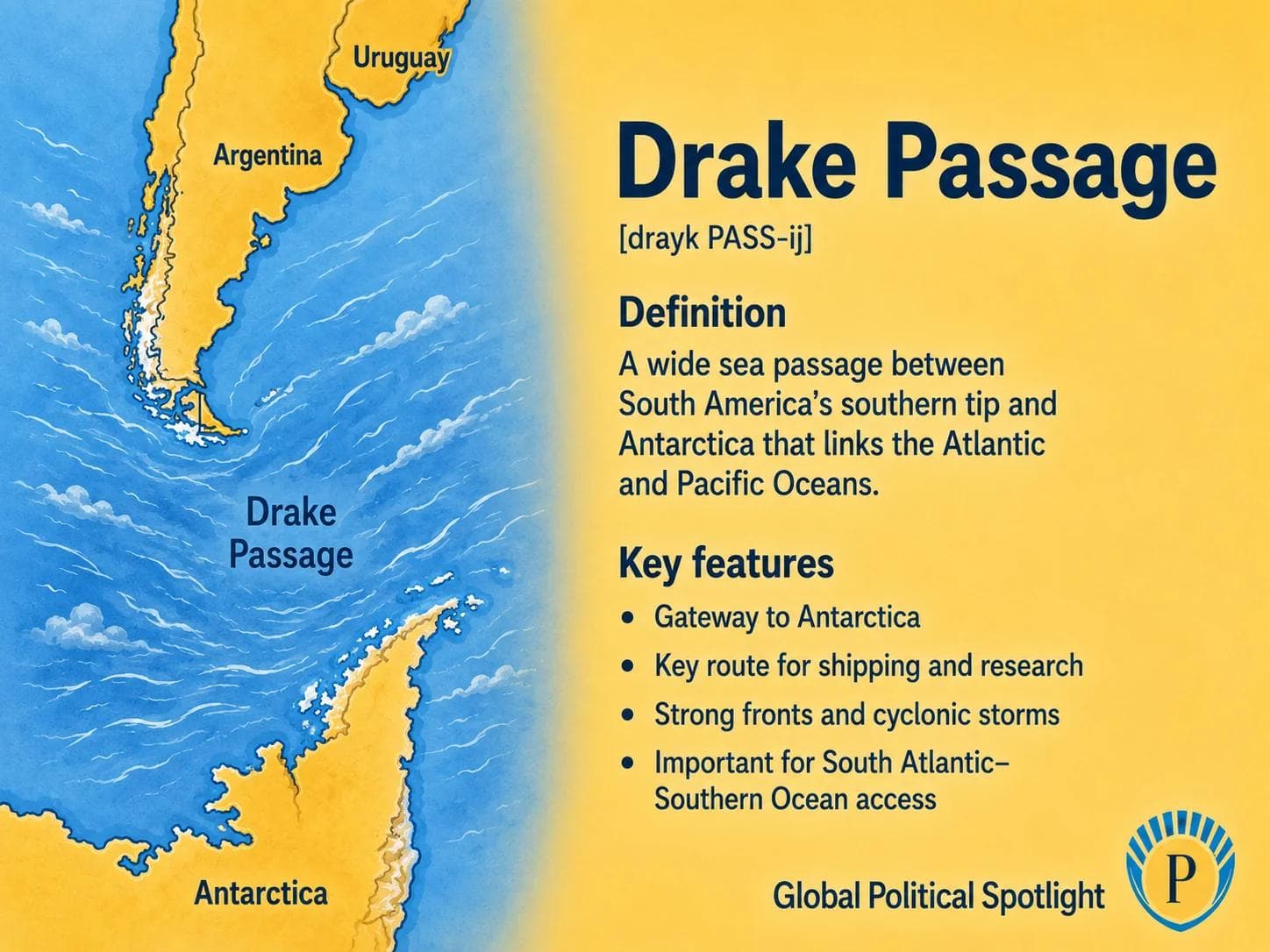
Definition
The Drake Passage is the open sea passage between Cape Horn at the southern tip of South America and the Antarctic Peninsula. It connects the southwestern Atlantic Ocean with the southeastern Pacific Ocean and forms part of the wider Southern Ocean system.
Unlike narrow canal or strait chokepoints, the Drake Passage is a broad but physically demanding maritime corridor. Its exposure to the Antarctic Circumpolar Current, strong winds, frontal systems, and cyclonic storms makes it one of the most challenging sea passages for ships, research vessels, and Antarctic tourism.
Why It Matters
The Drake Passage matters because it is one of the main maritime gateways to Antarctica. Scientific research, logistics, environmental monitoring, fisheries management, and tourism routes often depend on access through this corridor between South America and the Antarctic Peninsula.
Its geopolitical relevance is tied to Antarctic governance, Southern Ocean access, climate science, maritime safety, and the strategic geography of the South Atlantic. Weather, distance, port access, and rescue constraints make operations in and around the passage unusually sensitive to planning and state capacity.
GPS should watch the Drake Passage as an enduring indicator of Antarctic access, Southern Ocean logistics, South Atlantic maritime geography, polar research activity, climate monitoring, fisheries governance, and the operational risks created by extreme weather and remoteness.
Key Facts
- Type
- Wide sea passage and polar maritime gateway
- Location
- Between Cape Horn in South America and the Antarctic Peninsula
- Connects
- Atlantic Ocean, Pacific Ocean, and Southern Ocean system
- Strategic role
- Major maritime gateway to Antarctica from South America
- Operational challenge
- Known for strong winds, rough seas, fronts, and cyclonic storms
- Research relevance
- Important for Antarctic logistics, climate science, oceanography, and polar monitoring
- Nearby access points
- Ushuaia in Argentina and Punta Arenas in Chile are common departure hubs
- Governance context
- Linked to Antarctic Treaty System interests and Southern Ocean maritime governance
FAQ
What is the Drake Passage?
The Drake Passage is the sea passage between the southern tip of South America and the Antarctic Peninsula. It connects the Atlantic and Pacific Oceans through the Southern Ocean region.
Why is the Drake Passage important?
It is important because it is a major gateway to Antarctica. Research vessels, supply ships, tourism operators, and scientific expeditions often use it to reach the Antarctic Peninsula and nearby Southern Ocean areas.
Why is the Drake Passage so rough?
The passage is exposed to strong westerly winds, large waves, frontal systems, and the Antarctic Circumpolar Current. With few land barriers at these latitudes, weather systems can move across the Southern Ocean with great force.
Is the Drake Passage a chokepoint?
It is not a narrow chokepoint like the Suez Canal or Strait of Hormuz. However, it is a strategic maritime gateway because it concentrates many practical routes between South America and Antarctica into a difficult but important corridor.
Who controls the Drake Passage?
No single state controls the entire passage as a canal or inland waterway. It lies between South America and Antarctica, with nearby interests involving Argentina, Chile, Antarctic Treaty parties, research programs, and international maritime rules.
How does the Drake Passage affect geopolitics?
It affects geopolitics by shaping access to Antarctica, polar research, fisheries management, environmental monitoring, tourism safety, and South Atlantic maritime logistics. Its remoteness and harsh weather make operational capacity especially important.
Recent Developments
Antarctic Treaty parties continued focus on environmental protection
Antarctic Treaty Consultative Meetings have continued to emphasize environmental protection, science, tourism management, and safety, keeping access routes such as the Drake Passage relevant to Antarctic governance.
Antarctic Treaty SecretariatPolar shipping safety remained a core IMO concern
International maritime safety discussions have continued to treat polar operations as a specialized risk area, reinforcing the importance of route planning, vessel standards, and rescue preparedness in Southern Ocean passages.
International Maritime OrganizationSources5 references
- Antarctic Treaty Secretariat
Institutional source for the Antarctic Treaty System, Antarctic governance, consultative meetings, and environmental protection measures.
- International Maritime Organization
Institutional source for maritime safety, polar shipping standards, and the International Code for Ships Operating in Polar Waters.
- National Oceanic and Atmospheric Administration
Official scientific source for ocean, climate, weather, and polar environmental context.
- British Antarctic Survey
Scientific source for Antarctic geography, Southern Ocean research, climate science, and polar operations.
- Encyclopaedia Britannica
Reference source for basic geography and historical background on the Drake Passage.

GPSNews App
Read GPSNews on iPhone
Daily geopolitical briefings, government updates, and prediction signals in one focused app.
Newsletter
Stay Ahead Of The Next Signal
Get briefings in your inbox when new analysis and reports are published.