
USV Kamikaze Boats
Explosive unmanned surface vessels used for naval attack and coastal warfare
USV kamikaze boats are unmanned surface vessels designed to strike maritime targets by carrying an explosive payload into or near a ship, port, bridge, or coastal asset.
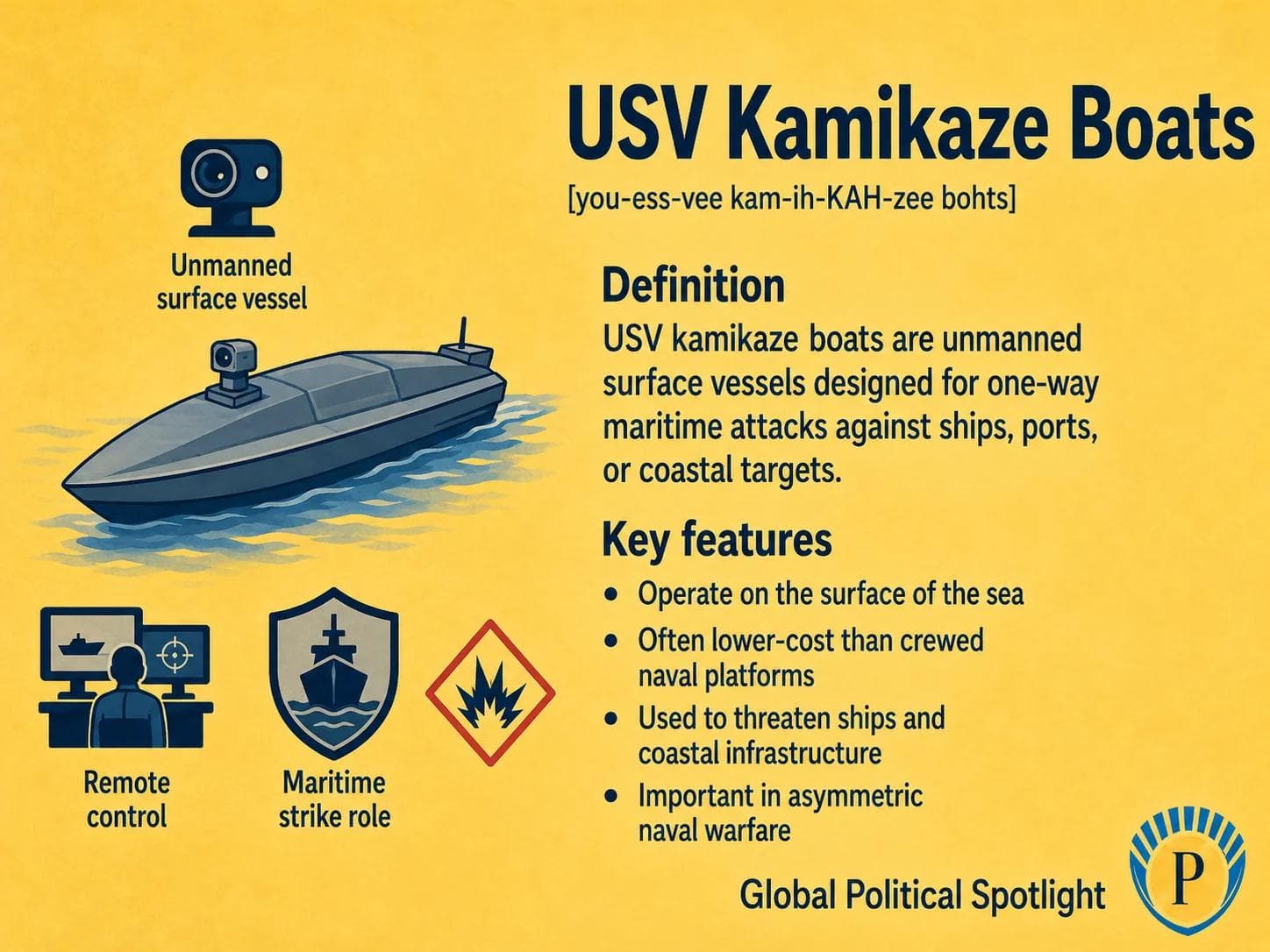
Definition
USV kamikaze boats are unmanned surface vessels built or adapted to carry explosive payloads toward maritime or coastal targets. They are usually remotely operated or semi-autonomous and are intended to damage targets through direct impact, detonation, or close-in explosive effect.
They belong to a wider family of unmanned naval systems that includes surveillance USVs, mine-countermeasure craft, decoys, and loitering surface platforms. Their military significance comes from combining small size, low visibility, expendability, and the ability to threaten much larger naval assets.
Why It Matters
USV kamikaze boats matter because they change the cost balance of naval warfare. A comparatively inexpensive unmanned craft can force expensive warships, ports, bridges, and coastal facilities to invest in layered defenses, surveillance, electronic warfare, barriers, and patrol systems.
They are especially relevant in enclosed or semi-enclosed waters, contested coastlines, and littoral environments where geography, civilian shipping, ports, and naval operations overlap. Their use raises persistent questions about maritime security, escalation, attribution, and the protection of critical infrastructure.
GPS should watch USV kamikaze boats as a durable indicator of asymmetric naval innovation, especially in the Black Sea, Persian Gulf, Red Sea, Taiwan Strait, and other contested maritime zones. Their relevance rises when states or non-state actors seek low-cost tools to threaten fleets, ports, sea lanes, bridges, and offshore infrastructure.
Key Facts
- Type
- Explosive unmanned surface vessel
- Domain
- Maritime and littoral warfare
- Primary role
- Strike ships, port facilities, bridges, coastal infrastructure, or other maritime targets
- Operating concept
- Remote or semi-autonomous surface craft used as an expendable attack platform
- Strategic value
- Creates asymmetric pressure against higher-value naval and infrastructure targets
- Key actors
- Ukraine, Russia, Iran-linked forces, Houthi forces, naval powers, and defense technology firms
- Security relevance
- Important for port defense, fleet protection, maritime chokepoints, and coastal surveillance
- Core limits
- Vulnerable to detection, electronic warfare, weather, sea state, barriers, patrol craft, and close-in defensive systems
FAQ
What are USV kamikaze boats?
USV kamikaze boats are unmanned surface vessels designed to carry explosives toward a target such as a ship, harbor facility, bridge, or coastal asset.
Why are USV kamikaze boats important?
They are important because they allow smaller or less powerful actors to threaten expensive naval platforms and maritime infrastructure with relatively low-cost, hard-to-detect systems.
How are USV kamikaze boats different from aerial drones?
Aerial drones fly through the air, while USV kamikaze boats travel on the water's surface. This makes them relevant to naval bases, ports, bridges, anchored ships, and coastal waters.
Who uses USV kamikaze boats?
They are associated with modern naval conflicts and asymmetric maritime tactics. Ukraine's Black Sea operations made them especially visible, while other states and armed groups have also explored unmanned surface attack systems.
What are the limits of USV kamikaze boats?
Their limits include sea conditions, range, communications, detection by sensors, defensive fire, physical barriers, electronic warfare, and the difficulty of operating in crowded or closely monitored waters.
Are USV kamikaze boats legal under international law?
Unmanned systems are not automatically illegal, but their use must still follow international humanitarian law, including rules on distinction, proportionality, military necessity, and precautions to protect civilians and civilian infrastructure.
Recent Developments
Unmanned surface vessels became central to Black Sea naval operations
Ukraine's use of explosive unmanned surface vessels against Russian maritime assets helped make USVs a major reference point in discussions of asymmetric naval warfare, port security, and fleet vulnerability.
Royal United Services InstituteRed Sea attacks reinforced concern over unmanned maritime threats
Attacks and attempted attacks involving drones, missiles, and unmanned maritime systems in and around the Red Sea highlighted the growing importance of protecting shipping lanes and naval forces from low-cost asymmetric systems.
International Maritime OrganizationSources6 references
- International Maritime Organization
Institutional context on maritime safety, shipping security, and the protection of maritime activity.
- United Nations Convention on the Law of the Sea
Legal framework relevant to maritime zones, navigation, and state rights at sea.
- International Committee of the Red Cross - International Humanitarian Law
Reference context on the legal principles that apply to the use of weapons and military operations.
- NATO - Maritime Security
Institutional context on maritime security, naval operations, and protection of sea lines of communication.
- Royal United Services Institute
Defense and security analysis relevant to unmanned systems, naval warfare, and Black Sea lessons.
- U.S. Naval Institute
Professional naval analysis on maritime warfare, unmanned vessels, and fleet protection.

GPSNews App
Read GPSNews on iPhone
Daily geopolitical briefings, government updates, and prediction signals in one focused app.
Newsletter
Stay Ahead Of The Next Signal
Get briefings in your inbox when new analysis and reports are published.