
Kamikaze / Loitering Munitions
One-way attack drones that can search, wait, and strike a target
Kamikaze or loitering munitions are one-way attack drones designed to search, observe, or wait near a target area before striking, combining surveillance functions with precision attack.
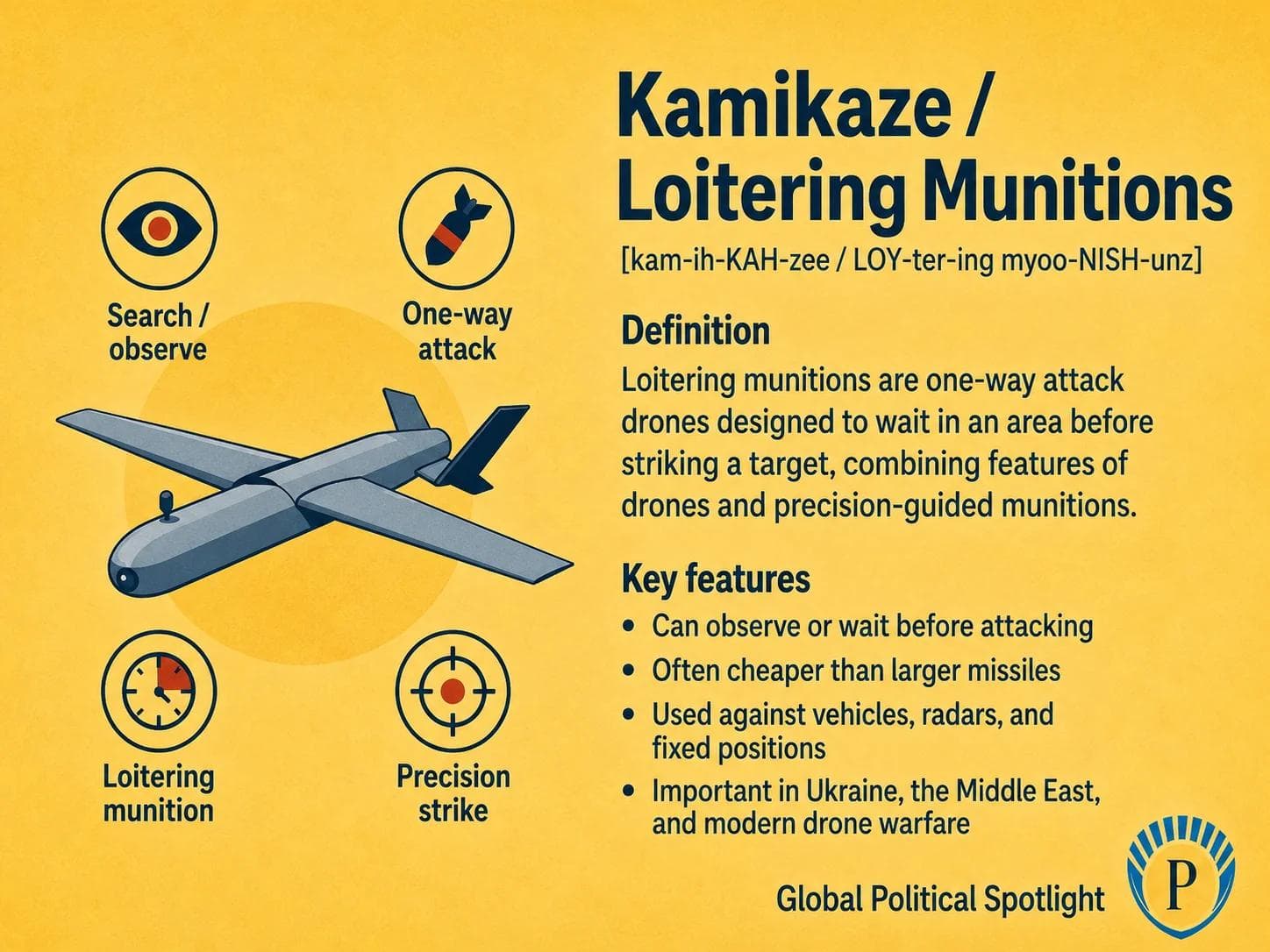
Definition
Kamikaze drones, more formally called loitering munitions, are one-way attack systems that combine features of drones and precision munitions. They can fly to an area, search or wait for a target, and then strike by destroying themselves on impact or detonation.
The term covers a wide range of systems, from small tactical drones used near the front line to longer-range munitions designed to attack air defenses, vehicles, radar sites, command posts, or infrastructure. Their defining feature is the ability to loiter before attack rather than immediately follow a fixed missile trajectory.
Why It Matters
Loitering munitions matter because they lower the cost and complexity of some precision-strike missions. Compared with larger missiles or manned aircraft, they can provide commanders with a cheaper way to observe, wait, and attack time-sensitive targets.
They also matter because they reshape battlefield defense. Armies must protect vehicles, trenches, radars, logistics sites, and command posts from small aerial threats that may be difficult to detect, cheap enough to use in large numbers, and flexible enough to strike after waiting for an opportunity.
GPS should watch loitering munitions as a major indicator of modern drone warfare, defense-industrial adaptation, and the spread of lower-cost precision strike. Key long-term issues include mass production, electronic warfare, counter-drone systems, export controls, civilian harm risks, autonomous targeting debates, and how states and non-state actors integrate one-way attack drones into military doctrine.
Key Facts
- Type
- One-way attack drone or loitering munition
- Core function
- Search, observe, loiter, and then strike a selected target
- Attack profile
- Designed to be expended during the strike rather than recovered after flight
- Military role
- Used for precision attack, suppression of air defenses, anti-armor missions, and strikes on exposed battlefield targets
- Cost logic
- Often cheaper than larger missiles, crewed aircraft missions, or complex long-range strike packages
- Operational advantage
- Can wait for a target to appear rather than requiring the target to be fixed at launch
- Main constraints
- Vulnerable to electronic warfare, air defenses, weather, limited endurance, and command-link disruption depending on design
- Strategic relevance
- Widely associated with the diffusion of precision strike to more militaries and some non-state actors
FAQ
What are kamikaze drones or loitering munitions?
They are one-way attack drones designed to fly to a target area, search or wait, and then strike by destroying themselves. The formal military term is usually loitering munition.
Why are they called loitering munitions?
They are called loitering munitions because they can remain in the air for a period of time before attacking. This allows the operator or onboard system to wait for a target to appear or confirm a target before striking.
How are loitering munitions different from missiles?
A missile is usually launched toward a known target or target area. A loitering munition can spend time searching or observing before attack, giving it a drone-like surveillance function before it becomes a weapon.
Why do loitering munitions matter in modern warfare?
They matter because they make precision attack more accessible, flexible, and scalable. They can threaten vehicles, radars, artillery, air defenses, logistics, and exposed troops without requiring a crewed aircraft strike.
Are loitering munitions cheap?
Costs vary widely, but many loitering munitions are cheaper than larger cruise missiles or crewed aircraft missions. Their appeal often comes from combining precision, persistence, and relatively low unit cost.
What are the limits of loitering munitions?
They can be disrupted by electronic warfare, jamming, air defenses, weather, camouflage, decoys, limited battery or fuel endurance, and communications problems. Their effectiveness depends on sensors, targeting, training, and integration with wider military operations.
Recent Developments
U.S. Department of Defense announced the Replicator initiative
The U.S. Department of Defense announced Replicator as an effort to field large numbers of attritable autonomous systems, reflecting the growing importance of lower-cost uncrewed systems in modern military competition.
U.S. Department of DefenseNATO highlighted drone warfare lessons from Ukraine
NATO analysis and public commentary continued to identify uncrewed systems, electronic warfare, and counter-drone adaptation as major lessons from the war in Ukraine, where loitering munitions and one-way attack drones became highly visible.
NATOSources6 references
- U.S. Congressional Research Service
Reference background on loitering munitions, their role, and policy considerations.
- NATO
Institutional background on NATO adaptation and lessons from modern conflict, including uncrewed systems.
- U.S. Department of Defense
Official remarks announcing the Replicator initiative and the importance of attritable autonomous systems.
- International Committee of the Red Cross
Institutional source on legal and humanitarian concerns around autonomy in weapon systems.
- RAND Corporation
Research background on uncrewed aerial systems and their implications for military operations.
- SIPRI
Institutional research on emerging military technologies, autonomy, and arms-control implications.

GPSNews App
Read GPSNews on iPhone
Daily geopolitical briefings, government updates, and prediction signals in one focused app.
Newsletter
Stay Ahead Of The Next Signal
Get briefings in your inbox when new analysis and reports are published.