
Failed States
Countries unable to perform essential state functions such as security, authority, and public services
Failed states are countries whose governments are unable to control territory, provide basic security, maintain legitimate authority, or deliver essential public services.
Definition
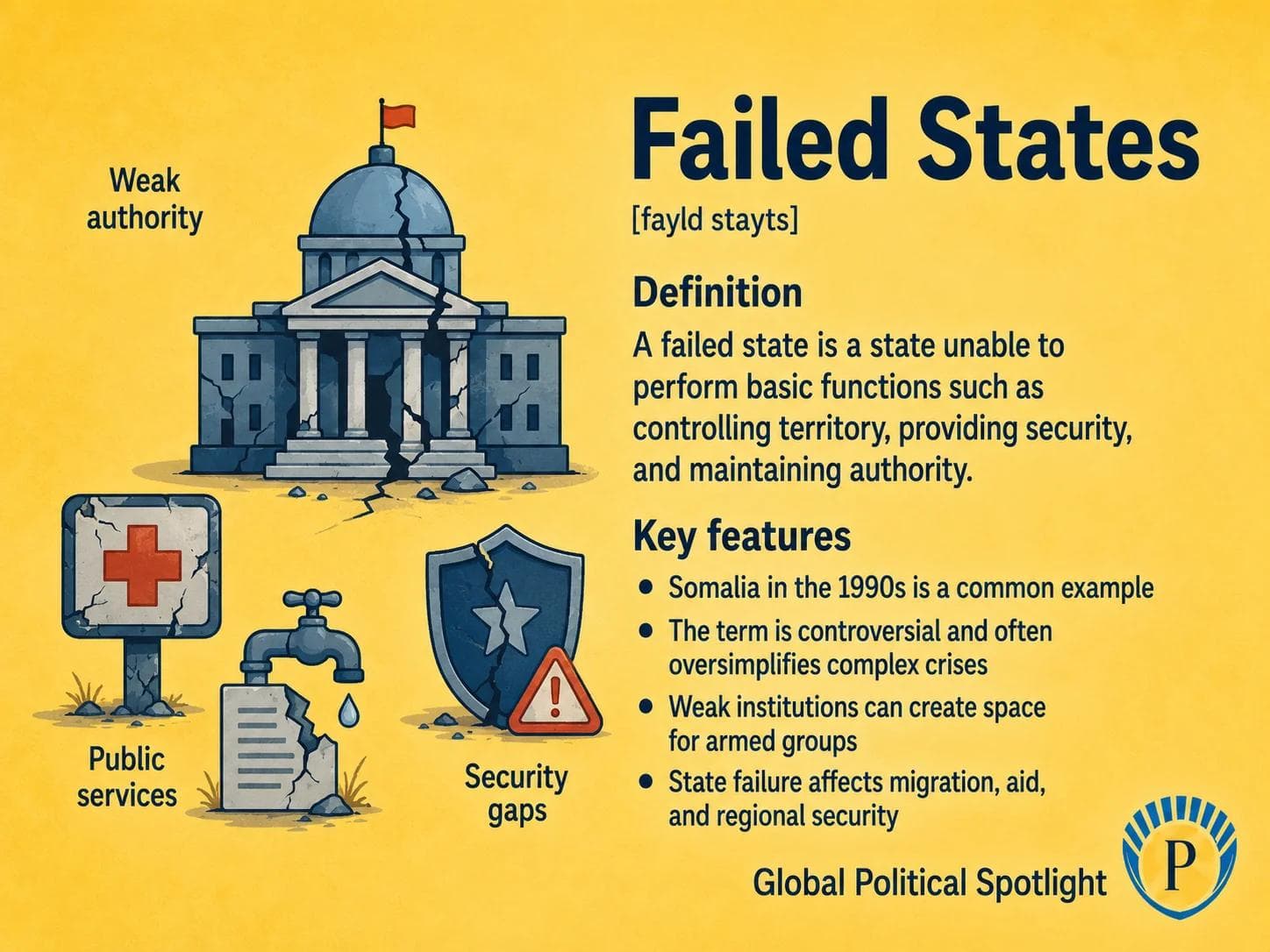
A failed state is commonly understood as a country whose government is unable to perform essential state functions, such as controlling territory, providing security, enforcing law, maintaining legitimate authority, collecting revenue, and delivering basic public services.
The term is often used when central authority has weakened so severely that armed groups, criminal networks, local militias, foreign actors, or informal authorities control parts of the country. Somalia in the 1990s is frequently cited as a classic example because the collapse of central government authority created severe insecurity, humanitarian crisis, and fragmented political control.
The label is controversial because it can oversimplify complex crises, imply a single path of collapse, or ignore local governance that continues to function outside the central state. Many analysts therefore prefer more specific terms such as fragile state, state failure, weak state capacity, or contested governance.
Why It Matters
Failed states matter because weak state capacity can create severe human insecurity. When governments cannot protect civilians, provide services, or resolve disputes, communities may become more vulnerable to violence, displacement, famine, disease, organized crime, and exploitation by armed groups.
State failure can also affect regional and international security. Conflict, refugee flows, trafficking networks, piracy, terrorism, arms smuggling, and cross-border instability may spread beyond the borders of the affected country.
For policymakers, the concept raises difficult questions about humanitarian aid, peacekeeping, state-building, sovereignty, foreign intervention, development finance, and how to support institutions without reinforcing abusive or exclusionary power structures.
Failed states are important for GPS because they connect domestic governance breakdown with regional security, migration, humanitarian aid, armed group activity, and international intervention debates. GPS should track territorial control, state legitimacy, public service delivery, security force cohesion, external patronage, displacement flows, and whether local governance structures are stabilizing or fragmenting the country.
Key Facts
- Type
- State capacity and governance concept
- Core idea
- A state is unable to perform essential functions such as security, authority, services, and territorial control
- Common indicators
- Weak institutions, contested authority, insecurity, corruption, poor services, displacement, and economic breakdown
- Security dimension
- Armed groups, militias, criminal networks, or rival authorities may control parts of the territory
- Public services
- Health care, education, courts, policing, infrastructure, and revenue collection may be limited or uneven
- Common example
- Somalia in the 1990s is often cited as a classic case of central state collapse
- Main controversy
- The term can oversimplify complex political crises and overlook functioning local governance
- Strategic relevance
- State failure can affect migration, humanitarian aid, regional security, counterterrorism, and peacekeeping
FAQ
What is a failed state?
A failed state is commonly described as a country whose government can no longer perform essential functions such as controlling territory, providing security, maintaining authority, enforcing law, or delivering basic public services.
What are the signs of a failed state?
Common signs include weak central authority, loss of territorial control, widespread insecurity, poor public services, corruption, economic collapse, displacement, armed group activity, and low public trust in institutions.
Why is the term failed state controversial?
The term is controversial because it can oversimplify complex political crises, treat state collapse as a single condition, and ignore local institutions or informal governance that may continue to function. Many analysts prefer terms such as fragile state or weak state capacity.
Is Somalia an example of a failed state?
Somalia in the 1990s is widely cited as a classic example because the collapse of central authority led to fragmented territorial control, severe insecurity, humanitarian crisis, and the rise of competing armed groups and local authorities.
How do failed states affect other countries?
Failed states can affect neighboring and distant countries through refugee flows, regional instability, arms trafficking, piracy, terrorism, organized crime, humanitarian crises, and pressure for international aid or intervention.
Can a failed state recover?
Yes, but recovery is usually slow and uneven. It can involve rebuilding institutions, improving security, restoring public services, negotiating political settlements, strengthening revenue systems, and gaining legitimacy across different communities.
Recent Developments
UN agencies warned of severe humanitarian needs in fragile conflict settings
UN humanitarian reporting in 2024 continued to identify conflict, weak governance, displacement, and service collapse as major drivers of humanitarian need in several fragile state contexts.
UN OCHAFragile States Index highlighted persistent governance stress
The 2024 Fragile States Index continued to track state fragility through indicators such as security apparatus, public services, legitimacy, economic decline, human rights, and external intervention.
The Fund for PeaceSources6 references
- World Bank
Institutional source on fragility, conflict, violence, and development challenges.
- OECD
Institutional background on fragile contexts, resilience, conflict prevention, and development policy.
- UN OCHA
UN humanitarian overview documenting conflict, displacement, service gaps, and fragility-related humanitarian needs.
- United Nations Charter
Primary source for sovereignty, international peace and security, and the framework for collective international action.
- The Fund for Peace
Reference index tracking indicators associated with state fragility and institutional stress.
- Encyclopaedia Britannica
Reference background on Somalia's political history and state collapse context.

GPSNews App
Read GPSNews on iPhone
Daily geopolitical briefings, government updates, and prediction signals in one focused app.
Newsletter
Stay Ahead Of The Next Signal
Get briefings in your inbox when new analysis and reports are published.