
AUKUS
A trilateral security partnership for nuclear-powered submarines, advanced defense technology, and Indo-Pacific deterrence
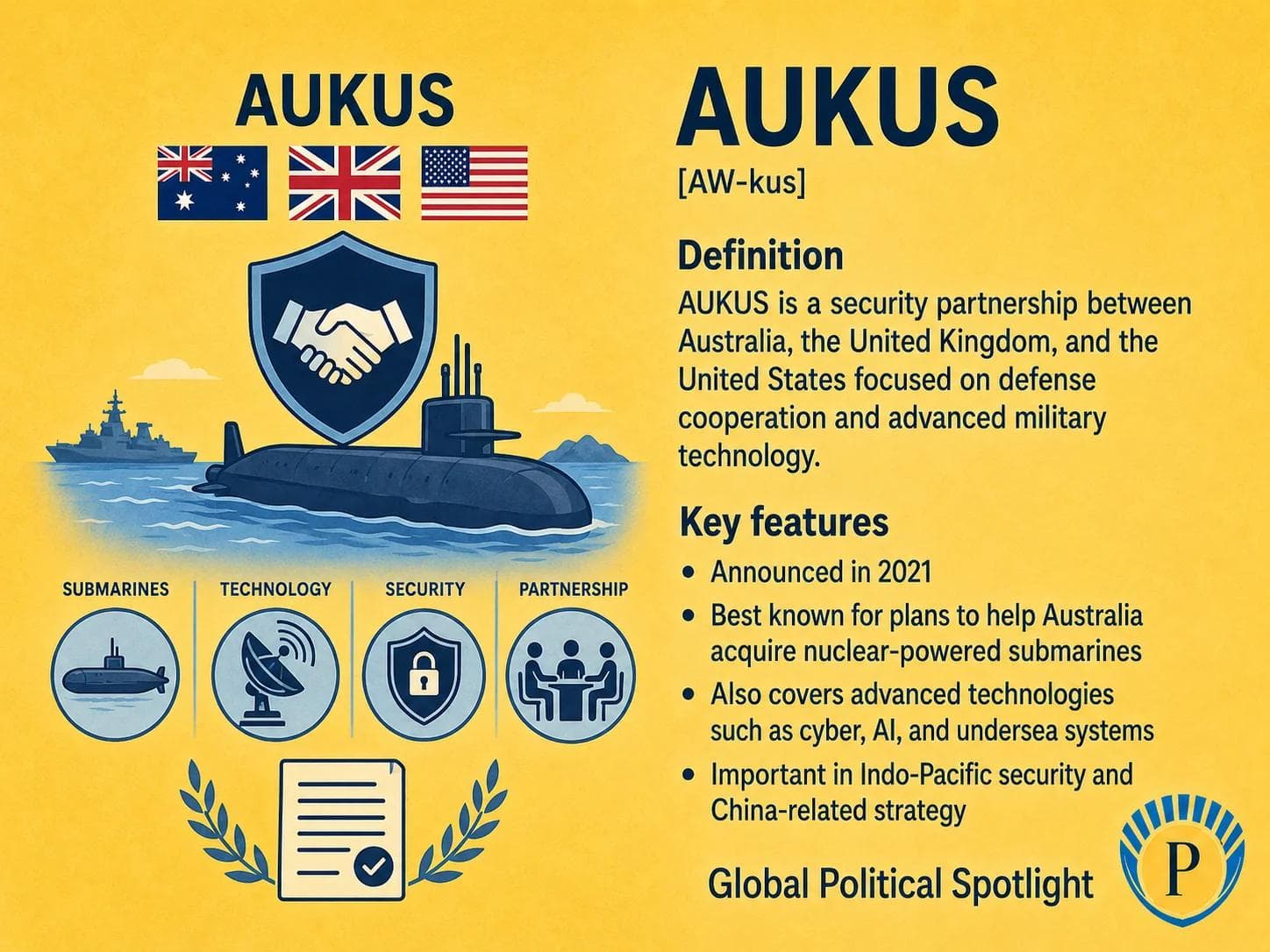
AUKUS is a security partnership among Australia, the United Kingdom, and the United States focused on nuclear-powered submarines, advanced defense technology, interoperability, and Indo-Pacific deterrence.
Definition
AUKUS is a trilateral security partnership announced in 2021 by Australia, the United Kingdom, and the United States. Its central purpose is to deepen defense cooperation, strengthen deterrence in the Indo-Pacific, and improve interoperability among three closely aligned maritime powers.
The partnership has two broad pillars. Pillar I supports Australia's acquisition of conventionally armed, nuclear-powered submarines. Pillar II focuses on advanced defense capabilities such as undersea systems, artificial intelligence, quantum technologies, cyber, electronic warfare, hypersonics, and defense innovation.
AUKUS is not a collective defense treaty like NATO. It is a technology, industrial-base, and military-capability partnership whose strategic significance comes from long-range undersea capability, defense integration, and signaling toward the Indo-Pacific security environment, especially amid concern about China's military modernization.
Why It Matters
AUKUS matters because nuclear-powered submarines can travel farther, stay submerged longer, and operate with greater endurance than conventional diesel-electric submarines. For Australia, this changes the scale of possible undersea operations across the Indian and Pacific Oceans.
The partnership also matters because it links defense technology sharing to strategic competition. By integrating industrial bases, submarine supply chains, advanced research, and military interoperability, AUKUS aims to strengthen allied deterrence while raising questions about capacity, cost, export controls, and delivery timelines.
AUKUS is also closely watched for nuclear non-proliferation reasons. Australia is a non-nuclear-weapon state under the Nuclear Non-Proliferation Treaty, and the transfer of naval nuclear propulsion technology requires safeguards arrangements that reassure the International Atomic Energy Agency and other states that the program remains conventionally armed.
GPS should track AUKUS as a long-term indicator of Indo-Pacific deterrence, allied technology integration, submarine industrial-base capacity, and non-proliferation politics. Key watchpoints include Australia's pathway to nuclear-powered submarines, U.S. and UK shipyard capacity, Pillar II technology delivery, Chinese and regional reactions, IAEA safeguards arrangements, export-control reform, and whether AUKUS becomes a model for deeper minilateral security cooperation.
Key Facts
- Type
- Trilateral security and defense technology partnership
- Members
- Australia, the United Kingdom, and the United States
- Announced
- 15 September 2021
- Pillar I
- Supports Australia's acquisition of conventionally armed, nuclear-powered submarines
- Pillar II
- Develops advanced capabilities including undersea systems, artificial intelligence, quantum technologies, cyber, electronic warfare, hypersonics, and defense innovation
- Strategic region
- Indo-Pacific, with emphasis on maritime deterrence and undersea operations
- Submarine pathway
- Includes increased U.S. and UK submarine visits, a rotational submarine presence in Australia, possible Australian purchase of Virginia-class submarines, and future SSN-AUKUS construction
- Non-proliferation issue
- The submarines are intended to be conventionally armed, but naval nuclear propulsion creates safeguards scrutiny because Australia is a non-nuclear-weapon state
FAQ
What is AUKUS?
AUKUS is a security partnership among Australia, the United Kingdom, and the United States. It focuses on nuclear-powered submarine cooperation, advanced defense technology, military interoperability, and deterrence in the Indo-Pacific.
Is AUKUS a military alliance?
AUKUS is not a collective defense alliance like NATO. It is a trilateral defense and technology partnership. Its importance comes from capability development, submarine cooperation, defense industrial integration, and strategic signaling rather than a formal automatic-defense clause.
What are AUKUS Pillar I and Pillar II?
Pillar I is the nuclear-powered submarine pathway for Australia. Pillar II covers advanced defense technologies such as undersea capabilities, artificial intelligence, quantum technologies, cyber, electronic warfare, hypersonics, and innovation cooperation.
Why does AUKUS matter for the Indo-Pacific?
AUKUS matters because it strengthens allied undersea and advanced-technology capabilities in a region shaped by maritime chokepoints, long distances, U.S.-China competition, and concern about China's military modernization. It is intended to support deterrence and interoperability.
Are AUKUS submarines nuclear weapons?
No. The planned Australian submarines are intended to be conventionally armed but nuclear-powered. Their reactors provide propulsion, while their weapons are not nuclear weapons. This distinction is central to AUKUS non-proliferation arguments.
Why is AUKUS controversial?
AUKUS is controversial because it raises concerns about nuclear safeguards, regional arms competition, delivery costs, submarine industrial capacity, export-control barriers, and the strategic message it sends to China and other Indo-Pacific states.
Recent Developments
AUKUS partners announced the nuclear-powered submarine pathway
Australia, the United Kingdom, and the United States announced the Optimal Pathway for Australia to acquire conventionally armed, nuclear-powered submarines. The plan includes a phased approach involving training, rotations, possible Virginia-class submarine purchases, and eventual SSN-AUKUS production.
Australian Government Department of DefenceIAEA noted AUKUS non-proliferation commitments in naval nuclear propulsion discussions
The International Atomic Energy Agency noted that the AUKUS naval nuclear propulsion agreement reiterated commitments to set high non-proliferation standards. The statement reflected continuing safeguards scrutiny around the transfer of naval nuclear propulsion technology to Australia.
International Atomic Energy AgencySources6 references
- Australian Government Department of Defence
Official Australian Government overview of AUKUS and Australia's role in the partnership.
- Australian Government Department of Defence
Official announcement of the AUKUS nuclear-powered submarine pathway.
- The White House
Official U.S. fact sheet on the implementation of the AUKUS partnership.
- UK Government
Official UK publication of the AUKUS nuclear-powered submarine pathway joint leaders' statement.
- International Atomic Energy Agency
IAEA statement on AUKUS developments and safeguards-related engagement.
- International Atomic Energy Agency
IAEA statement on the naval nuclear propulsion agreement and non-proliferation standards.

GPSNews App
Read GPSNews on iPhone
Daily geopolitical briefings, government updates, and prediction signals in one focused app.
Newsletter
Stay Ahead Of The Next Signal
Get briefings in your inbox when new analysis and reports are published.