
Minuteman III ICBM
A silo-based U.S. intercontinental ballistic missile and the land leg of the nuclear triad
The Minuteman III is a U.S. land-based intercontinental ballistic missile deployed in hardened silos as part of the nuclear triad, designed to provide long-range strategic deterrence.
Definition
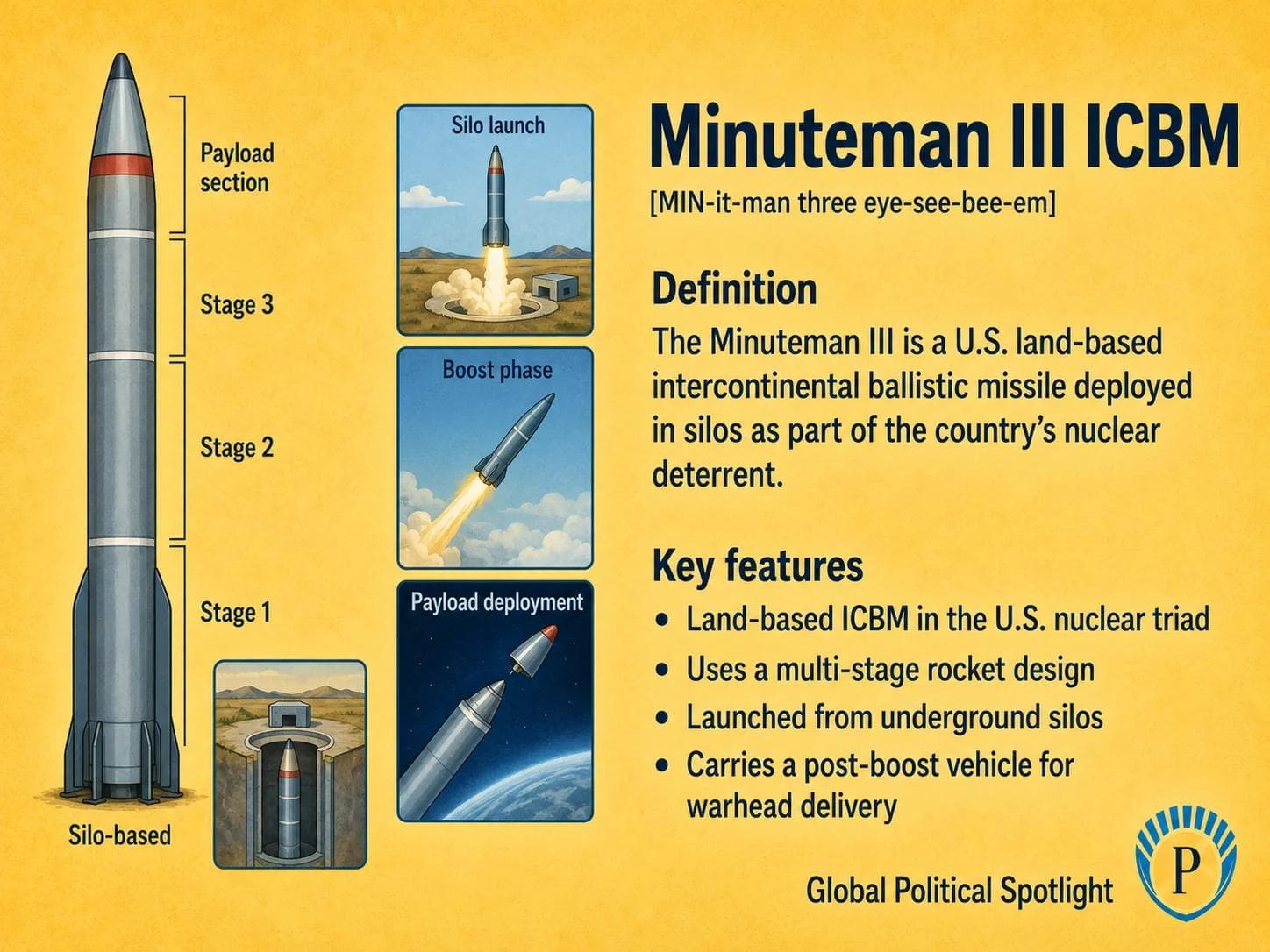
The Minuteman III is a U.S. land-based intercontinental ballistic missile, or ICBM, deployed in hardened underground silos. It forms the land-based component of the U.S. nuclear triad, alongside submarine-launched ballistic missiles and strategic bomber aircraft.
The missile uses a multi-stage rocket design to carry a nuclear payload over intercontinental distances. In broad terms, an ICBM launches from a silo, accelerates through a boost phase, travels on a ballistic trajectory, and delivers its payload section toward a target area.
For geopolitical analysis, Minuteman III is best understood as a strategic deterrent rather than a battlefield weapon. Its role is tied to nuclear command and control, survivability, arms-control debates, modernization, and crisis stability between nuclear-armed powers.
Why It Matters
Minuteman III matters because land-based ICBMs are intended to complicate an adversary's planning and strengthen nuclear deterrence. Their dispersed silo network forces any potential attacker to consider the risks of escalation, retaliation, and uncertainty.
The system also matters because it sits at the center of debates over nuclear modernization, arms control, first-strike stability, and the future of the U.S. nuclear triad. Supporters see ICBMs as a stabilizing deterrent; critics argue that silo-based missiles can increase crisis pressure because they are fixed and highly time-sensitive assets.
GPS should monitor Minuteman III as a core reference point for U.S. nuclear deterrence and modernization. Key watch areas include the transition to the Sentinel ICBM program, arms-control limits, command-and-control resilience, debates over the land leg of the nuclear triad, test-launch signaling, and how Russia, China, and other nuclear-armed states interpret U.S. strategic posture.
Key Facts
- Type
- Land-based intercontinental ballistic missile
- Operator
- United States Air Force
- Deployment mode
- Hardened underground missile silos
- Strategic role
- Land leg of the U.S. nuclear triad
- Broad design
- Multi-stage solid-fuel ballistic missile with a payload section
- Mission purpose
- Long-range strategic nuclear deterrence
- Deployment areas
- Missile fields associated with U.S. bases in states such as Montana, North Dakota, Wyoming, Nebraska, and Colorado
- Modernization issue
- The system is planned to be replaced by the LGM-35A Sentinel ICBM
FAQ
What is the Minuteman III ICBM?
The Minuteman III is a U.S. land-based intercontinental ballistic missile deployed in underground silos. It is part of the U.S. nuclear triad and is designed for strategic deterrence.
What does ICBM mean?
ICBM stands for intercontinental ballistic missile. It refers to a long-range ballistic missile designed to deliver a payload across intercontinental distances.
Why is Minuteman III part of the nuclear triad?
The nuclear triad consists of land-based missiles, submarine-launched missiles, and strategic bombers. Minuteman III represents the land leg, providing a dispersed silo-based deterrent that complements submarines and bombers.
How does a silo-based ICBM work in broad terms?
In broad terms, a silo-based ICBM launches from a hardened underground silo, accelerates through a boost phase using rocket stages, follows a ballistic trajectory, and delivers its payload section. Operational details are closely controlled for security reasons.
Why is the Minuteman III being replaced?
Minuteman III entered service during the Cold War and has been extended through decades of upgrades. The United States plans to replace it with the Sentinel ICBM to modernize infrastructure, command systems, and long-term sustainment.
Why are land-based ICBMs debated?
Supporters argue that land-based ICBMs strengthen deterrence by complicating adversary planning and providing a visible, responsive force. Critics argue that fixed silos can create crisis instability and that modernization is costly.
Recent Developments
U.S. Air Force awarded the Ground Based Strategic Deterrent contract
The U.S. Air Force awarded the engineering and manufacturing development contract for the program later named Sentinel, intended to replace Minuteman III as the future land-based leg of the U.S. nuclear triad.
U.S. Air ForcePentagon continued Sentinel after Nunn-McCurdy review
The U.S. Department of Defense announced that the Sentinel ICBM program would continue after a critical Nunn-McCurdy review, underscoring the political and budgetary significance of replacing Minuteman III.
U.S. Department of DefenseSources6 references
- U.S. Air Force - LGM-30G Minuteman III Fact Sheet
Official U.S. Air Force reference on the Minuteman III system, role, basing, and basic characteristics.
- U.S. Strategic Command
Official source for U.S. strategic deterrence, nuclear command context, and triad-related mission information.
- U.S. Department of Defense - Nuclear Posture Review
Official U.S. defense policy source for nuclear deterrence, triad posture, and modernization priorities.
- U.S. Air Force - GBSD Contract Announcement
Official announcement of the contract for the program intended to replace Minuteman III.
- Congressional Research Service
Institutional source for U.S. nuclear modernization, ICBM policy, arms control, and congressional oversight.
- Federation of American Scientists - Nuclear Notebook
Reference source for public analysis of nuclear forces, deterrence posture, and modernization trends.

GPSNews App
Read GPSNews on iPhone
Daily geopolitical briefings, government updates, and prediction signals in one focused app.
Newsletter
Stay Ahead Of The Next Signal
Get briefings in your inbox when new analysis and reports are published.