
B61-12
A modernized U.S. nuclear gravity bomb for aircraft delivery and extended deterrence
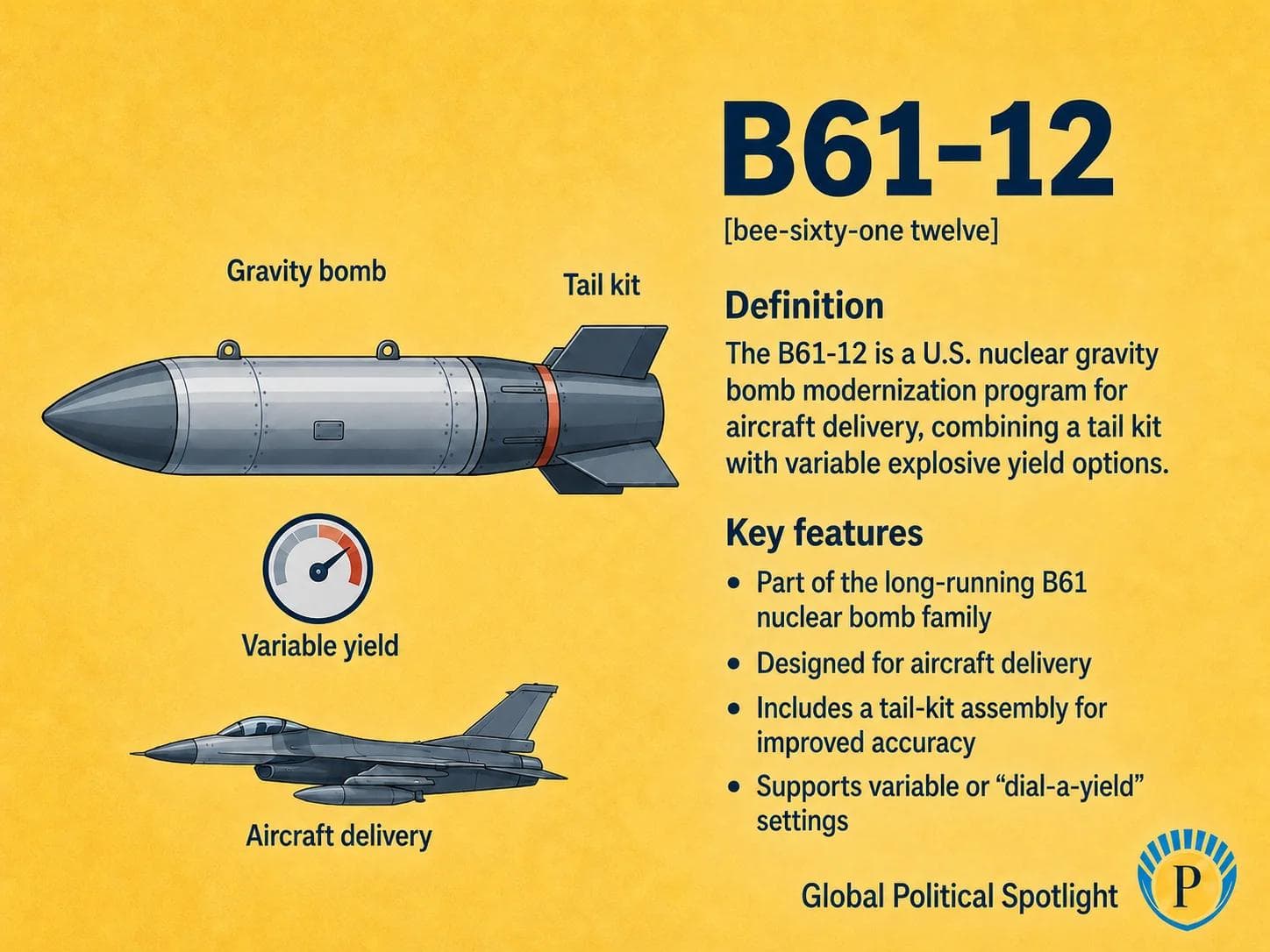
The B61-12 is a modernized U.S. nuclear gravity bomb variant that combines refurbished B61 components with a guided tail kit, variable-yield options, and aircraft delivery for U.S. and NATO deterrence missions.
Definition
The B61-12 is a modernized variant of the U.S. B61 nuclear gravity bomb family. Unlike a missile, a gravity bomb is delivered by aircraft and falls toward a target after release. The B61-12 combines refurbished nuclear and non-nuclear components with a new tail-kit assembly intended to improve accuracy compared with older unguided variants.
The weapon is part of the air-delivered component of the U.S. nuclear posture and is also central to NATO nuclear sharing arrangements, under which certain European allies maintain dual-capable aircraft while U.S. nuclear weapons remain under U.S. control.
Why It Matters
The B61-12 matters because it links technology, alliance politics, and nuclear deterrence. Its tail kit and aircraft-delivered role are intended to sustain a credible air-delivered nuclear option, while its variable-yield design makes it part of wider debates about escalation control, deterrence signaling, and the threshold for nuclear use.
In Europe, the B61-12 is especially politically sensitive because it sits at the center of NATO nuclear sharing debates. Supporters view the arrangement as a symbol of allied burden-sharing and extended deterrence; critics argue that forward-deployed nuclear weapons create escalation risks and domestic political controversy.
GPS should watch the B61-12 as a durable indicator of U.S. extended deterrence, NATO nuclear sharing, and the modernization of air-delivered nuclear forces. Key long-term issues include dual-capable aircraft transitions, allied basing politics, arms-control debates, Russian responses, and whether precision improvements change perceptions of nuclear escalation risk.
Key Facts
- Type
- Nuclear gravity bomb
- Primary operator
- United States
- Delivery method
- Released by dual-capable aircraft rather than launched as a missile
- Modernization feature
- Uses a tail-kit assembly to improve accuracy compared with older B61 gravity bombs
- Yield concept
- Designed with selectable yield options, allowing different explosive settings within the weapon's certified design
- Strategic role
- Supports U.S. air-delivered nuclear deterrence and NATO extended deterrence
- Alliance relevance
- Closely linked to NATO nuclear sharing and dual-capable aircraft such as the F-35A
- Program milestone
- The U.S. National Nuclear Security Administration announced completion of the B61-12 Life Extension Program in January 2025
FAQ
What is the B61-12?
The B61-12 is a modernized U.S. nuclear gravity bomb. It is designed for aircraft delivery and combines refurbished B61 components with a tail-kit assembly and variable-yield options.
Is the B61-12 a missile?
No. The B61-12 is a gravity bomb, meaning it is carried and released by an aircraft. It is not launched from a missile silo, submarine, or ballistic missile system.
Why is the B61-12 controversial?
The B61-12 is controversial because it modernizes a nuclear weapon used in alliance deterrence. Supporters argue it strengthens deterrence credibility, while critics worry that improved accuracy and forward deployment may complicate arms control and escalation management.
How does the B61-12 relate to NATO nuclear sharing?
NATO nuclear sharing involves allied dual-capable aircraft that can support the alliance's nuclear mission while U.S. nuclear weapons remain under U.S. control. The B61-12 is central to this mission as older aircraft and bomb variants are modernized.
What does variable yield mean?
Variable yield means the weapon can be configured for different explosive settings within its certified design. This does not make it conventional; it remains a nuclear weapon and is governed by nuclear command, control, and political decision-making.
What are the limits of the B61-12?
Because it is aircraft-delivered, the B61-12 depends on aircraft survivability, basing access, air defense penetration, political authorization, and alliance procedures. Its role is therefore as much political and strategic as it is technical.
Recent Developments
NNSA announced completion of the B61-12 Life Extension Program
The U.S. National Nuclear Security Administration said the B61-12 Life Extension Program had been completed, describing it as a modernization effort to sustain the air-delivered nuclear deterrent and extend the bomb's service life.
U.S. National Nuclear Security AdministrationNetherlands confirmed F-35 transition for NATO nuclear role
The Dutch Ministry of Defence stated that the F-35 would take over the Netherlands' nuclear role within NATO from the F-16, highlighting the link between the B61-12, dual-capable aircraft modernization, and NATO nuclear sharing.
Netherlands Ministry of DefenceSources5 references
- U.S. National Nuclear Security Administration
Official announcement on completion of the B61-12 Life Extension Program.
- U.S. Air Force Nuclear Weapons Center
Official U.S. Air Force reference page on the B61 gravity bomb family.
- NATO
NATO reference page on nuclear deterrence and the alliance's nuclear policy.
- Netherlands Ministry of Defence
Official statement on the Dutch F-35 transition within NATO's nuclear role.
- Congressional Research Service
Reference source for U.S. nuclear modernization, arms control, and nuclear posture analysis.

GPSNews App
Read GPSNews on iPhone
Daily geopolitical briefings, government updates, and prediction signals in one focused app.
Newsletter
Stay Ahead Of The Next Signal
Get briefings in your inbox when new analysis and reports are published.