
Shahed-136
An Iranian-designed one-way attack drone used for long-range, lower-cost strike campaigns
The Shahed-136 is an Iranian-designed delta-wing one-way attack drone, used by Iran and by Russia under the Geran-2 name, known for long-range low-cost strikes and saturation attacks.
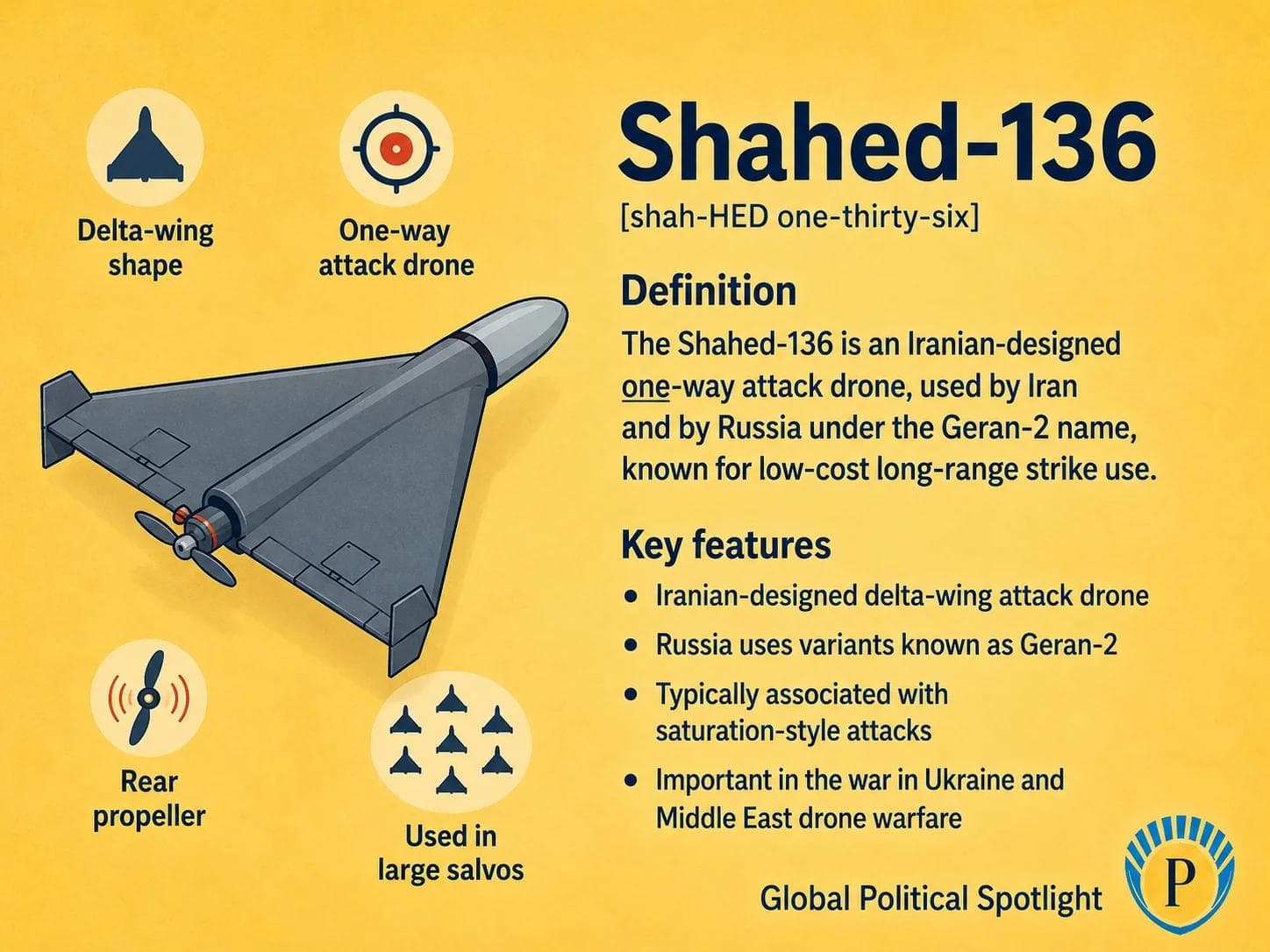
Definition
The Shahed-136 is an Iranian-designed one-way attack drone with a distinctive delta-wing shape and rear-mounted propeller. It is designed to fly toward a target and detonate rather than return, placing it in the wider category of loitering munitions or one-way attack drones.
The system has become internationally prominent because Russia has used a related version under the Geran-2 name in the Russia-Ukraine war. Its significance comes from the combination of range, relatively low cost, simple production logic, and the ability to be launched in groups to pressure air defenses.
Why It Matters
The Shahed-136 matters because it shows how lower-cost uncrewed systems can create strategic effects when used at scale. Even when intercepted, large salvos can force defenders to spend attention, ammunition, and expensive air-defense interceptors.
It also matters because it links Middle East drone development to European security. The Shahed-136 has become a symbol of drone proliferation, sanctions evasion concerns, defense-industrial adaptation, and the growing importance of counter-drone systems in modern war.
GPS should watch the Shahed-136 as a reference point for drone proliferation, lower-cost long-range strike, and the diffusion of Iranian uncrewed systems. Key indicators include Iran-Russia military cooperation, component supply chains, sanctions enforcement, production localization, counter-drone adaptation, and the balance between cheap attack drones and costly air-defense interceptors.
Key Facts
- Type
- One-way attack drone or loitering munition
- Design origin
- Iranian-designed system associated with Iran's Shahed drone family
- Russian designation
- Used by Russia under the Geran-2 name
- Visual profile
- Delta-wing airframe with a rear-mounted propeller
- Operational logic
- Used for long-range one-way strike and saturation attacks against defended targets
- Cost logic
- Often discussed as a lower-cost alternative to larger cruise missiles for some strike missions
- Conflict relevance
- Widely associated with Russian attacks in the Russia-Ukraine war and with broader Middle East drone warfare
- Defense challenge
- Can pressure air defenses through volume, low flight profiles, dispersed launch patterns, and cost asymmetry
FAQ
What is the Shahed-136?
The Shahed-136 is an Iranian-designed one-way attack drone. It is built to fly toward a target and detonate, rather than return like a reusable surveillance drone.
Why is the Shahed-136 also called Geran-2?
Russia has used a related version of the Shahed-136 under the Geran-2 name. The naming reflects Russian operational use and does not change the system's association with Iranian drone design.
Why does the Shahed-136 matter in the Russia-Ukraine war?
It matters because Russia has used Shahed-type drones for repeated long-range attacks, including salvos intended to pressure Ukrainian air defenses, strike infrastructure, and create cost asymmetry between attackers and defenders.
Is the Shahed-136 a missile or a drone?
It is usually described as a one-way attack drone or loitering munition rather than a traditional missile. It uses drone-like flight and propulsion but functions as an expendable weapon.
Why are Shahed-136 drones considered relatively low cost?
They are generally viewed as cheaper than larger cruise missiles or crewed aircraft strike missions. Their strategic value often comes from being produced and launched in enough numbers to stress defenses.
What are the limits of the Shahed-136?
Shahed-136 drones can be vulnerable to air defenses, electronic warfare, small-arms fire under some conditions, poor weather, navigation disruption, and improved counter-drone networks. Their effectiveness depends on launch volume, target selection, routing, and defensive readiness.
Recent Developments
EU expanded sanctions related to Iranian drones used by Russia
The European Union adopted additional restrictive measures connected to Iran's military support for Russia's war against Ukraine, reflecting the Shahed-136's role in sanctions, export-control, and drone-proliferation debates.
Council of the European UnionUnited States targeted Iran-linked drone procurement networks
The U.S. Treasury announced sanctions against networks connected to Iran's unmanned aerial vehicle procurement, illustrating how the Shahed-136 issue is tied to components, supply chains, and sanctions enforcement.
U.S. Department of the TreasurySources6 references
- Council of the European Union
Official EU sanctions framework related to Iran's military support for Russia, including drone-related concerns.
- U.S. Department of the Treasury
Official U.S. sanctions announcement concerning Iran-linked unmanned aerial vehicle procurement networks.
- U.S. Defense Intelligence Agency
U.S. defense intelligence reference on Iranian drones used in Ukraine.
- Center for Strategic and International Studies Missile Defense Project
Reference profile of the Shahed-136 system and its operational context.
- International Institute for Strategic Studies
Institutional research source for military balance, drone proliferation, and regional security analysis.
- SIPRI
Institutional source on emerging military technologies, uncrewed systems, and arms-control implications.

GPSNews App
Read GPSNews on iPhone
Daily geopolitical briefings, government updates, and prediction signals in one focused app.
Newsletter
Stay Ahead Of The Next Signal
Get briefings in your inbox when new analysis and reports are published.