
Asian Development Bank
Asia-Pacific's regional development bank for infrastructure, climate finance, poverty reduction, and economic integration
The Asian Development Bank is a multilateral development bank that finances infrastructure, climate action, poverty reduction, private-sector projects, and regional integration across Asia and the Pacific.
Definition
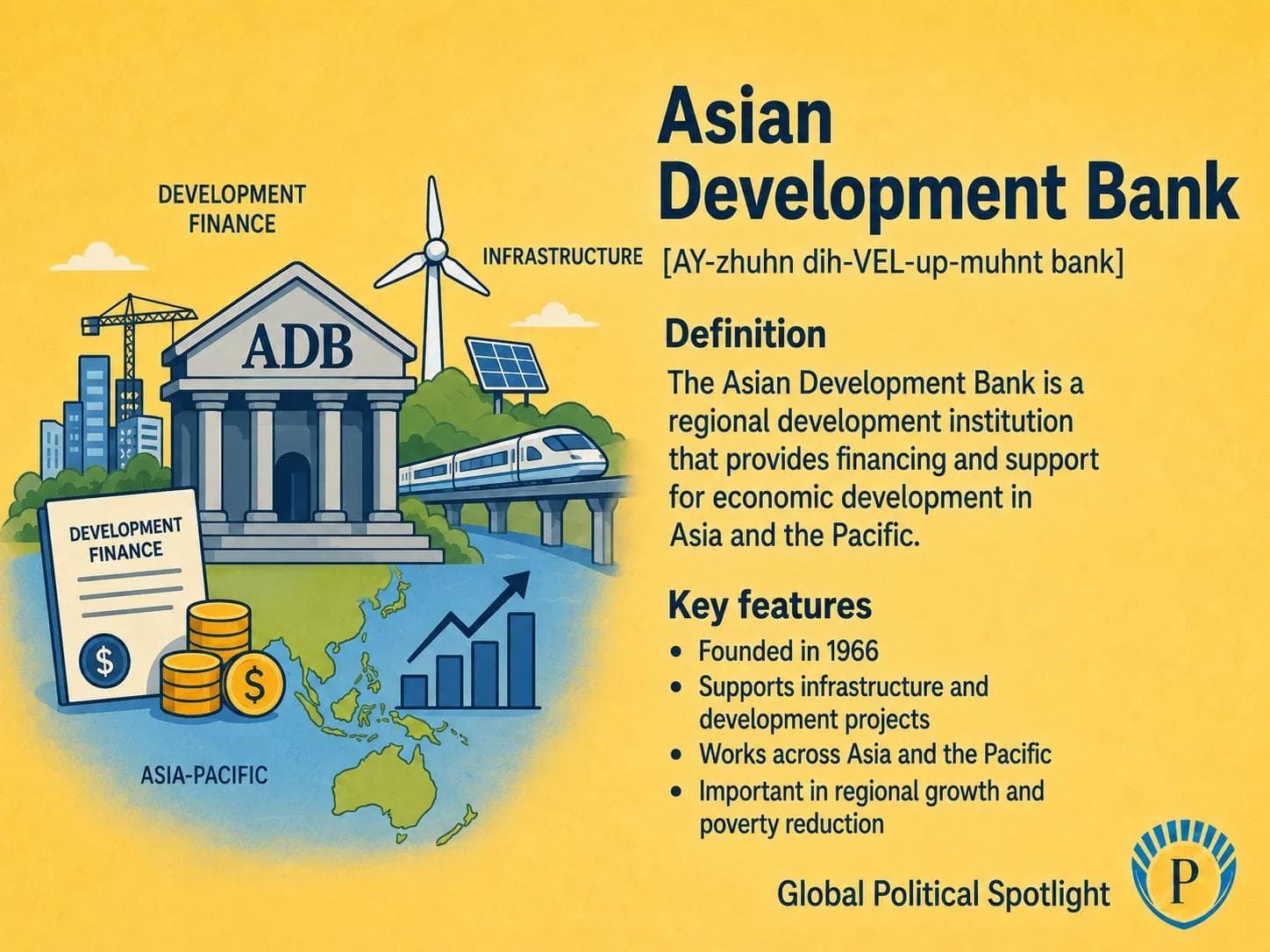
The Asian Development Bank, often abbreviated ADB, is a multilateral development bank founded in 1966 to promote social and economic development in Asia and the Pacific. It finances governments, public institutions, and private-sector projects through loans, grants, guarantees, equity investments, technical assistance, and policy support.
ADB is headquartered in Metro Manila, Philippines, and is owned by regional and non-regional member countries. Japan and the United States are the largest shareholders, giving the institution a distinctive governance profile compared with China-led or China-backed infrastructure finance institutions.
Its work covers transport corridors, energy systems, urban development, water, digital connectivity, climate adaptation, disaster resilience, private-sector investment, poverty reduction, and cross-border economic integration. Strategy 2030 frames the Bank's long-term goal as a prosperous, inclusive, resilient, and sustainable Asia and the Pacific.
Why It Matters
The Asian Development Bank matters because infrastructure, climate exposure, and financing gaps shape Asia-Pacific growth, supply chains, energy security, and state capacity. Roads, ports, railways, power grids, urban systems, and digital infrastructure influence how economies connect to regional and global markets.
ADB lending and technical assistance help lower financing costs for developing member countries, especially where private capital is limited or projects require long time horizons. Its concessional resources and grant support are particularly relevant for poorer, smaller, or climate-vulnerable economies.
Geopolitically, ADB is part of the development-finance landscape in which Japan, the United States, China, regional governments, and other lenders compete and cooperate over infrastructure standards, climate finance, debt sustainability, connectivity corridors, and influence in Asia and the Pacific.
GPS should track the Asian Development Bank as a key institution in Asia-Pacific development finance, infrastructure connectivity, climate adaptation, and regional economic integration. Important watchpoints include Japan and U.S. shareholder influence, comparison with China-backed finance and the Asian Infrastructure Investment Bank, climate-finance commitments, transport and energy corridors, debt-sustainability conditions, private-sector mobilization, and how ADB projects shape strategic connectivity across the Indo-Pacific.
Key Facts
- Type
- Multilateral development bank
- Founded
- 1966
- Headquarters
- Mandaluyong, Metro Manila, Philippines
- Membership
- 69 members, including 50 from Asia and the Pacific and 19 from outside the region
- Largest shareholders
- Japan and the United States are the largest shareholders, each holding about 15.6% of total shares as of ADB's 2024 investor reporting
- Core tools
- Sovereign lending, non-sovereign lending, grants, guarantees, equity investments, technical assistance, and policy advice
- Strategic priorities
- Infrastructure, climate action, poverty reduction, gender equality, private-sector development, governance, and regional cooperation
- Regional role
- Finances connectivity corridors, energy systems, urban infrastructure, and development projects that shape Asia-Pacific integration
FAQ
What is the Asian Development Bank?
The Asian Development Bank is a multilateral development bank that finances development across Asia and the Pacific. It supports infrastructure, climate resilience, poverty reduction, private-sector investment, regional integration, governance, and social development.
Who owns the Asian Development Bank?
ADB is owned by its member countries, including regional members from Asia and the Pacific and non-regional members from outside the region. Japan and the United States are the largest shareholders, each holding about 15.6% of total shares in recent ADB reporting.
How is the Asian Development Bank different from the World Bank?
The World Bank is a global development institution, while the Asian Development Bank has a regional mandate focused on Asia and the Pacific. ADB's lending and technical assistance are tailored to regional infrastructure, climate, poverty, and connectivity priorities.
How does the Asian Development Bank compare with the Asian Infrastructure Investment Bank?
Both finance development and infrastructure in Asia, but they differ in history, governance, shareholder structure, and strategic context. ADB was founded in 1966 and has Japan and the United States as its largest shareholders, while the Asian Infrastructure Investment Bank was launched later with China as its largest shareholder.
Why does ADB matter for infrastructure corridors?
ADB finances roads, railways, ports, power systems, digital networks, and cross-border corridors that reduce trade costs and connect economies. These projects can shape regional supply chains, market access, energy security, and strategic connectivity.
What are the limits of the Asian Development Bank?
ADB cannot close Asia-Pacific financing gaps alone. Its impact depends on shareholder capital, borrower capacity, project governance, debt sustainability, co-financing, private-sector participation, environmental and social safeguards, and political conditions in member countries.
Recent Developments
ADB approved a climate finance roadmap to scale up support through 2030
ADB approved a Climate Change Action Plan for 2023 to 2030, reinforcing its goal of scaling climate finance and supporting low-carbon and climate-resilient development across Asia and the Pacific. The plan is relevant to adaptation, energy transition, disaster risk, and infrastructure resilience.
Asian Development BankMasato Kanda became President of the Asian Development Bank
Masato Kanda assumed office as President of the Asian Development Bank in February 2025, continuing the institution's long-standing pattern of Japanese leadership. The transition matters for ADB's strategic direction, shareholder politics, and role in Asia-Pacific development finance.
Asian Development BankSources6 references
- Asian Development Bank
Official overview of ADB, including its mandate, membership, and development role.
- Asian Development Bank
Official ADB information on governance, organization, and member ownership.
- Asian Development Bank
Official Strategy 2030 overview describing ADB's long-term vision for Asia and the Pacific.
- Asian Development Bank
Official investor information on ADB's capital structure, shareholders, and financial profile.
- Asian Development Bank
Official Climate Change Action Plan for 2023 to 2030.
- Asian Development Bank
Official ADB information on regional cooperation and integration.

GPSNews App
Read GPSNews on iPhone
Daily geopolitical briefings, government updates, and prediction signals in one focused app.
Newsletter
Stay Ahead Of The Next Signal
Get briefings in your inbox when new analysis and reports are published.