
Interpol
An international police cooperation body for cross-border crime information sharing
Interpol is an international organization that helps national police forces share criminal data, notices, and investigative support across borders, while operating under neutrality rules and without its own arrest powers.
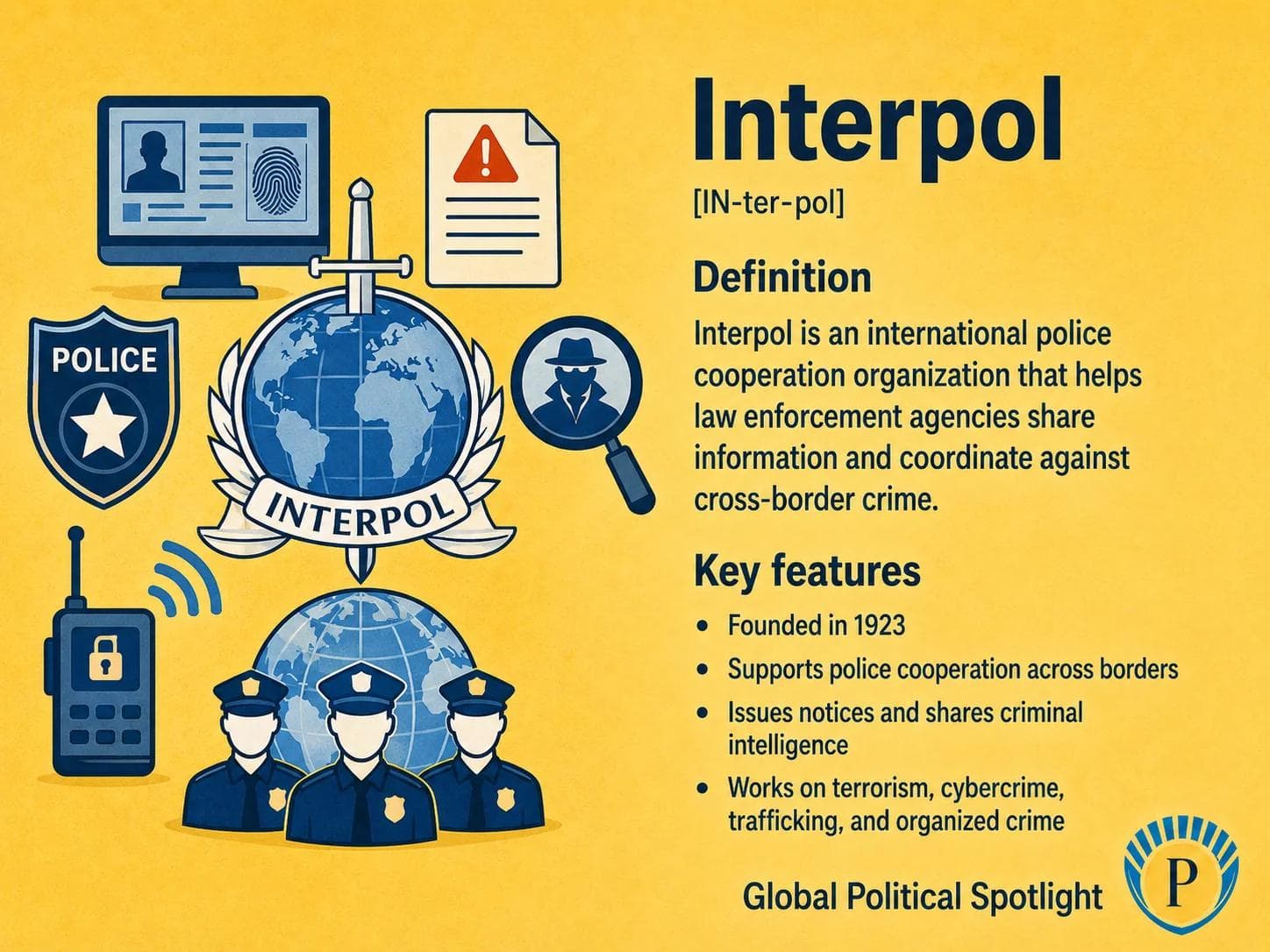
Definition
Interpol, formally the International Criminal Police Organization, is an intergovernmental organization that enables police forces in member countries to share information, issue notices, access criminal databases, and coordinate investigative support across borders.
Its best-known tools include Red Notices, which request the location and provisional arrest of wanted persons pending extradition or other legal action. Interpol also supports cooperation on terrorism, cybercrime, organized crime, trafficking, financial crime, stolen documents, and fugitives.
Interpol is not a supranational police force. It does not conduct arrests, prosecute cases, or override national law. Its work depends on national authorities and is constrained by rules requiring political neutrality and prohibiting intervention in activities of a political, military, religious, or racial character.
Why It Matters
Interpol matters because many security threats cross borders faster than national law-enforcement systems can respond alone. Fugitive movement, terrorism financing, cybercrime infrastructure, stolen travel documents, trafficking networks, and transnational fraud all require police cooperation across jurisdictions.
The organization also sits at the intersection of law enforcement and geopolitics. Its notices and databases can help states locate suspects, but they can also raise disputes over due process, extradition, human rights, and whether a request is genuinely criminal or politically motivated.
For analysts, Interpol is important as a durable mechanism of international security cooperation: it shows how states coordinate against shared crime risks while still preserving national sovereignty over arrests, prosecutions, and legal procedures.
GPS should track Interpol as a long-term node of cross-border law-enforcement cooperation, especially where Red Notices, terrorism investigations, cybercrime, financial crime, extradition disputes, and allegations of politically motivated misuse intersect with sovereignty, human rights, and great-power tensions.
Key Facts
- Type
- International police cooperation organization
- Headquarters
- Lyon, France
- Formal name
- International Criminal Police Organization
- Core tool
- Notices and databases used to share alerts, identity information, and criminal intelligence among member countries
- Red Notice
- A request to locate and provisionally arrest a wanted person, subject to national law and extradition procedures
- Main crime areas
- Terrorism, cybercrime, organized crime, financial crime, trafficking, fugitives, stolen documents, and border-related crime
- Legal limit
- Interpol does not make arrests, run prisons, prosecute suspects, or replace national police and courts
- Neutrality rule
- Interpol's constitution prohibits intervention in activities of a political, military, religious, or racial character
FAQ
What is Interpol?
Interpol is an international organization that helps national police agencies cooperate across borders by sharing notices, criminal databases, alerts, and investigative support. It connects police systems but does not replace national law enforcement.
Is Interpol a global police force?
No. Interpol has no independent power to arrest people, prosecute cases, or enforce laws inside a country. Arrests and legal action are carried out by national authorities under their own laws.
What is an Interpol Red Notice?
A Red Notice is a request circulated through Interpol asking authorities to locate and provisionally arrest a wanted person pending extradition, surrender, or similar legal action. It is not itself an international arrest warrant.
Why does Interpol matter for geopolitics?
Interpol matters because it connects criminal justice systems across borders. Its tools can help track fugitives, terrorism suspects, cybercriminals, and trafficking networks, but they can also become controversial when states disagree over political motivation, due process, or extradition.
What limits Interpol's work?
Interpol is limited by national sovereignty, domestic law, extradition rules, data quality, and its own neutrality obligations. Its constitution bars the organization from intervening in activities of a political, military, religious, or racial character.
What crimes does Interpol focus on?
Interpol supports cooperation on terrorism, cybercrime, organized crime, human trafficking, drug trafficking, financial crime, corruption, stolen travel documents, fugitives, and other transnational crime areas.
Recent Developments
Interpol continued to emphasize cybercrime and organized crime as major cross-border priorities
Interpol's public communications around its 2024 General Assembly highlighted the continuing importance of international police cooperation against cybercrime, organized crime, trafficking, and other transnational threats that require coordination between national authorities.
InterpolDebate over Red Notice safeguards remained a durable governance issue
Civil-society and legal organizations have continued to scrutinize the use of Red Notices and diffusion alerts, particularly where requests may affect refugees, dissidents, journalists, or political opponents. The issue remains central to how Interpol balances crime cooperation with neutrality and due-process safeguards.
Fair TrialsSources6 references
- Interpol - About Interpol
Official overview of Interpol's role, structure, and international police cooperation mandate.
- Interpol - Notices
Official explanation of Interpol notices, including Red Notices and other alert types.
- Interpol - Constitution
Official legal documents, including the constitutional framework and neutrality rules.
- Interpol - Crimes
Official overview of major crime areas covered by Interpol cooperation.
- Council on Foreign Relations - Interpol
Reference background on Interpol's purpose, powers, limits, and controversies.
- Fair Trials - Interpol reform
Civil-society analysis of due-process concerns and reform debates around Interpol alerts.

GPSNews App
Read GPSNews on iPhone
Daily geopolitical briefings, government updates, and prediction signals in one focused app.
Newsletter
Stay Ahead Of The Next Signal
Get briefings in your inbox when new analysis and reports are published.