
Eurasian Economic Union
A Russia-led Eurasian economic bloc focused on customs rules, trade, labor movement, and limited market integration
The Eurasian Economic Union is a Russia-led economic bloc linking Armenia, Belarus, Kazakhstan, Kyrgyzstan, and Russia through customs rules, trade policy, labor mobility, and partial market integration.
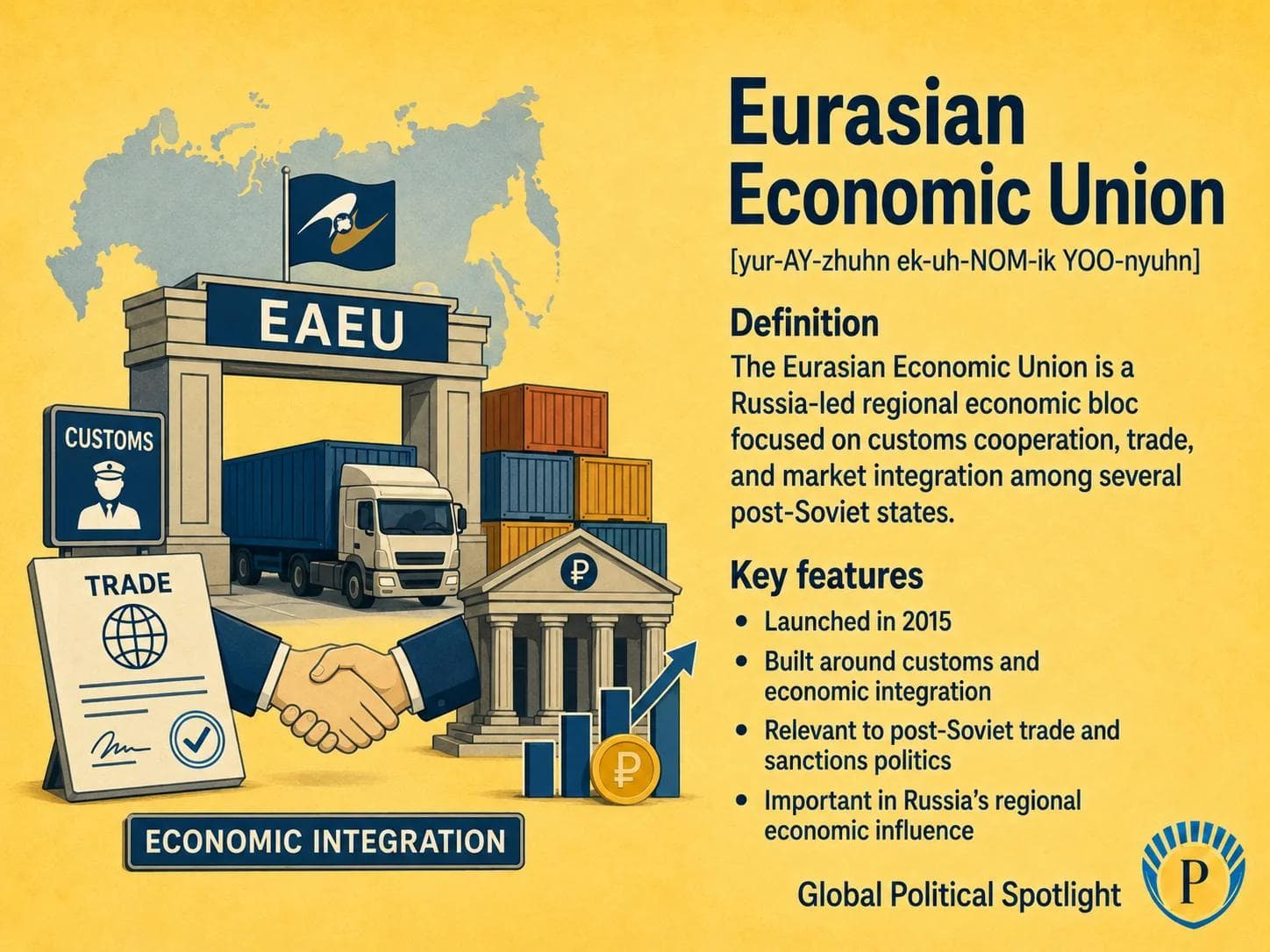
Definition
The Eurasian Economic Union, or EAEU, is a regional economic bloc in Eurasia made up of Armenia, Belarus, Kazakhstan, Kyrgyzstan, and Russia. It was launched in 2015 to deepen economic integration through a customs union, common external tariff rules, coordinated regulations, and freer movement of goods, services, capital, and labor.
The EAEU is built around economic integration rather than collective defense. Its institutions include the Eurasian Economic Commission and the Court of the Eurasian Economic Union, which support regulatory coordination, customs administration, technical standards, competition policy, and dispute resolution within the bloc.
Russia is the largest economy and dominant political actor in the EAEU, which gives the bloc geopolitical significance beyond trade policy. At the same time, smaller members use the union selectively, balancing market access to Russia with sovereignty concerns, ties to China, relations with the European Union, and exposure to sanctions pressure.
Why It Matters
The EAEU matters because it is one of Russia's main institutional tools for maintaining economic influence in the post-Soviet space. It shapes customs rules, regulatory alignment, labor migration, trade access, and supply-chain routes across parts of Eastern Europe, the Caucasus, and Central Asia.
For Armenia, Belarus, Kazakhstan, and Kyrgyzstan, the bloc offers access to Russian markets, labor mobility, customs simplification, and regulatory coordination. But it also creates dependence on Russia's economy, currency cycles, logistics networks, political preferences, and sanctions exposure.
The union's geopolitical relevance increased after Russia's full-scale invasion of Ukraine, because sanctions on Russia changed trade incentives, re-export risks, financial flows, and customs enforcement pressures. The EAEU is therefore both an economic-integration project and a channel through which sanctions, trade diversion, and regional balancing are monitored.
GPS should track the Eurasian Economic Union as a Russia-led regional economic bloc that affects customs policy, labor migration, trade diversion, sanctions exposure, and post-Soviet integration. Key watchpoints include Russia's ability to use the EAEU for regional influence, Kazakhstan and Armenia's balancing behavior, Belarus's deep alignment with Moscow, Kyrgyzstan's labor and remittance dependence, customs enforcement under sanctions pressure, and whether the bloc deepens integration or remains a limited market-access framework.
Key Facts
- Type
- Regional economic union and customs bloc
- Founded
- The Treaty on the Eurasian Economic Union entered into force on 1 January 2015
- Members
- Armenia, Belarus, Kazakhstan, Kyrgyzstan, and Russia
- Main institution
- Eurasian Economic Commission, based in Moscow
- Core functions
- Customs policy, common external tariff rules, technical standards, trade regulation, labor mobility, and partial market integration
- Dominant actor
- Russia is the largest economy and main geopolitical center of gravity inside the union
- Labor mobility
- EAEU citizens generally have simplified access to employment across member states compared with non-member workers
- Strategic limit
- Integration remains limited by economic asymmetry, national sovereignty concerns, sanctions pressure, logistics constraints, and diverging foreign-policy priorities
FAQ
What is the Eurasian Economic Union?
The Eurasian Economic Union is a regional economic bloc made up of Armenia, Belarus, Kazakhstan, Kyrgyzstan, and Russia. It coordinates customs rules, trade policy, technical standards, labor movement, and parts of market regulation among member states.
Who are the members of the Eurasian Economic Union?
The EAEU's members are Armenia, Belarus, Kazakhstan, Kyrgyzstan, and Russia. Russia is by far the largest economy in the bloc, while the other members use the union for market access, labor mobility, and regional economic coordination.
Is the Eurasian Economic Union like the European Union?
The EAEU borrows some language from regional market integration, but it is much less integrated than the European Union. It has customs and regulatory coordination, but it does not have the EU's level of legal authority, political integration, budgetary capacity, single currency, or broad institutional depth.
Why does Russia matter so much in the EAEU?
Russia matters because it is the bloc's largest economy, main labor market, dominant security actor in the surrounding region, and central source of geopolitical influence. This makes the EAEU both an economic institution and a tool of Russian regional power.
How do sanctions affect the Eurasian Economic Union?
Sanctions on Russia affect the EAEU by changing trade routes, re-export incentives, customs scrutiny, banking channels, and compliance risks for other members. Countries such as Kazakhstan, Armenia, and Kyrgyzstan face pressure to prevent sanctioned goods from being redirected to Russia.
What are the limits of the Eurasian Economic Union?
The EAEU is limited by Russia's dominance, unequal economic benefits, national sovereignty concerns, sanctions spillovers, weak supranational enforcement, competing ties with China and the EU, and different foreign-policy priorities among member states.
Recent Developments
EAEU leaders marked ten years since the founding treaty was signed
EAEU leaders met in Moscow around the tenth anniversary of the Treaty on the Eurasian Economic Union. The summit underlined the bloc's continued institutional role while also highlighting the challenge of deepening integration amid sanctions pressure, regional balancing, and unequal economic weight among members.
Eurasian Economic UnionThe EAEU continued work on economic integration priorities through 2030 and 2045
EAEU members adopted long-term integration priorities intended to guide the bloc's development through 2030 and toward 2045. The agenda emphasized common markets, trade facilitation, transport connectivity, digital cooperation, and industrial coordination, while deeper implementation remains shaped by member-state interests.
Eurasian Economic CommissionSources6 references
- Eurasian Economic Union
Official portal of the Eurasian Economic Union.
- Eurasian Economic Commission
Official website of the Eurasian Economic Commission, the main regulatory body of the EAEU.
- Eurasian Economic Commission
Official information about the Eurasian Economic Commission and its role in EAEU governance.
- Eurasian Economic Union
Official overview of the EAEU's purpose, member states, and integration framework.
- World Trade Organization
WTO country profile useful for cross-checking Kazakhstan's external trade commitments alongside EAEU customs participation.
- International Monetary Fund
IMF country resources provide macroeconomic context for EAEU members affected by Russia-linked trade, sanctions, and financial conditions.

GPSNews App
Read GPSNews on iPhone
Daily geopolitical briefings, government updates, and prediction signals in one focused app.
Newsletter
Stay Ahead Of The Next Signal
Get briefings in your inbox when new analysis and reports are published.