
Quad
A strategic Indo-Pacific dialogue among the United States, India, Japan, and Australia
The Quad is a strategic dialogue among the United States, India, Japan, and Australia focused on a free and open Indo-Pacific, maritime security, resilient supply chains, technology, infrastructure, climate, health, and China-related balancing.
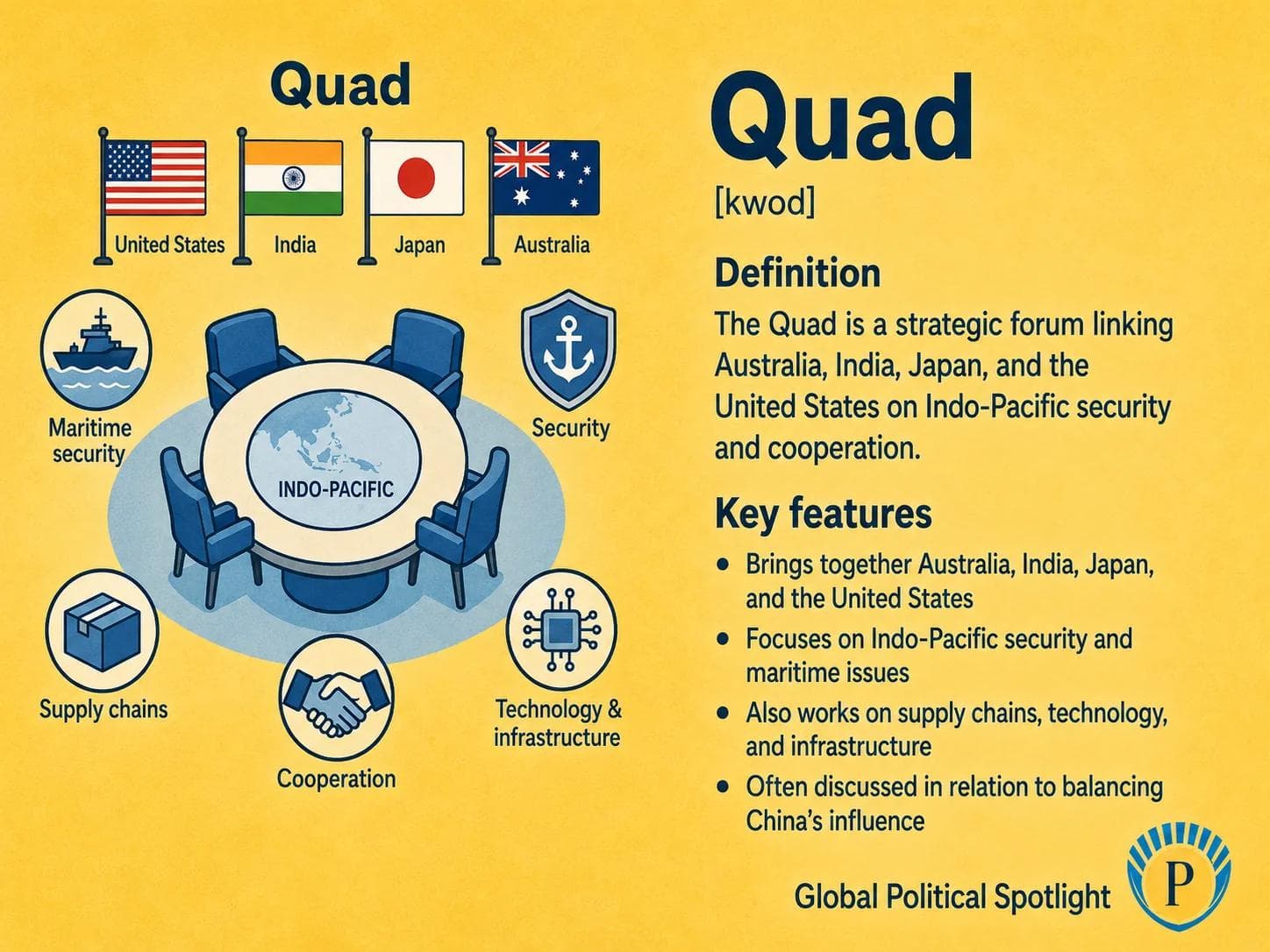
Definition
The Quad, formally the Quadrilateral Security Dialogue, is a strategic forum among the United States, India, Japan, and Australia. It is centered on the Indo-Pacific and is often framed around support for a free, open, inclusive, and rules-based regional order.
The Quad is not a treaty alliance and does not create a NATO-style collective defense obligation. It functions through leader summits, foreign-minister meetings, working groups, military-to-military coordination among some members, and practical cooperation on maritime domain awareness, infrastructure, technology, climate, health, and supply chains.
Its strategic significance comes from the combined weight of four major Indo-Pacific democracies with complementary geography: the United States as a global naval power, India in the Indian Ocean, Japan in Northeast Asia, and Australia linking the Indian and Pacific Oceans.
Why It Matters
The Quad matters because the Indo-Pacific contains major sea lanes, advanced technology supply chains, maritime chokepoints, large economies, and several flashpoints involving China. Cooperation among the four members affects deterrence, regional diplomacy, infrastructure competition, and strategic signaling.
Its maritime-security work is especially important because the region depends on open sea lines of communication for trade, energy flows, and military access. Quad initiatives on maritime domain awareness are designed to help regional states track illegal fishing, coercive activity, and other maritime risks.
The Quad also shows how modern security cooperation extends beyond traditional military alliances. Its agenda includes vaccines, climate resilience, critical technologies, cyber, telecommunications, infrastructure standards, disaster relief, and supply-chain resilience, reflecting the wider definition of strategic competition.
GPS should track the Quad as a durable indicator of Indo-Pacific strategic alignment among the United States, India, Japan, and Australia. Key watchpoints include maritime domain awareness, China-related signaling, India's willingness to deepen security coordination without treaty alignment, technology and supply-chain initiatives, infrastructure competition, climate and health deliverables, and whether the Quad remains flexible while avoiding the political constraints of a formal alliance.
Key Facts
- Type
- Strategic dialogue and minilateral cooperation forum
- Members
- United States, India, Japan, and Australia
- Strategic region
- Indo-Pacific, spanning the Indian and Pacific Oceans
- Origins
- Emerged from cooperation after the 2004 Indian Ocean tsunami and was first formalized as a dialogue in 2007
- Revival
- The Quad was revived in 2017 amid growing concern about Indo-Pacific security and China's regional assertiveness
- Main agenda
- Maritime security, resilient supply chains, critical technology, cyber, infrastructure, climate, health security, disaster response, and regional capacity building
- Non-alliance character
- The Quad is not a treaty alliance and does not create a formal collective defense commitment
- Strategic role
- Supports Indo-Pacific balancing by coordinating four major democracies without requiring a single alliance structure
FAQ
What is the Quad?
The Quad, or Quadrilateral Security Dialogue, is a strategic forum among the United States, India, Japan, and Australia. It focuses on Indo-Pacific cooperation, including maritime security, technology, supply chains, infrastructure, climate, health, and regional resilience.
Is the Quad a military alliance?
No. The Quad is not a treaty alliance and does not include a NATO-style collective defense clause. It is a strategic dialogue and cooperation platform, although its members also conduct bilateral and multilateral defense cooperation outside the Quad framework.
Why does the Quad matter for China?
The Quad matters for China because it brings together four major Indo-Pacific democracies that share concerns about coercion, maritime disputes, military modernization, supply-chain dependence, and the future regional balance of power. The Quad rarely functions as a direct anti-China alliance, but China-related strategic context is central to its relevance.
What does the Quad do on maritime security?
The Quad supports maritime domain awareness, information sharing, regional capacity building, disaster response, and cooperation around open sea lanes. Its maritime work is designed to help Indo-Pacific states monitor activity at sea and respond to risks such as illegal fishing, coercion, and instability.
How is the Quad different from AUKUS?
The Quad is a four-country strategic dialogue including India and Japan, with a broad agenda covering security, technology, supply chains, climate, health, and infrastructure. AUKUS is a defense technology partnership among Australia, the United Kingdom, and the United States, centered on nuclear-powered submarines and advanced defense capabilities.
What are the limits of the Quad?
The Quad's limits come from its non-alliance structure, different member threat perceptions, India's strategic autonomy, economic ties with China, and the need to balance security signaling with practical regional public goods. It is influential, but it does not operate as a unified command or formal bloc.
Recent Developments
Quad leaders met in Wilmington and reaffirmed Indo-Pacific cooperation
Quad leaders met in Wilmington, Delaware, and issued a joint statement emphasizing maritime security, health security, critical and emerging technology, infrastructure, climate, cyber, and regional cooperation. The summit reinforced the Quad's broad agenda beyond traditional defense coordination.
The White HouseQuad leaders launched the Indo-Pacific Partnership for Maritime Domain Awareness
Quad leaders announced the Indo-Pacific Partnership for Maritime Domain Awareness to help regional partners improve visibility over maritime activity. The initiative became one of the Quad's clearest practical contributions to maritime security and regional capacity building.
The White HouseSources6 references
- The White House
Official 2024 Quad leaders' joint statement outlining the forum's current priorities.
- The White House
Official fact sheet on Quad initiatives, including maritime domain awareness.
- U.S. Department of State
Official U.S. Department of State overview of the Quad and its areas of cooperation.
- Ministry of External Affairs, Government of India
Official Indian publication of the Quad Leaders' Wilmington Declaration.
- Ministry of Foreign Affairs of Japan
Official Japanese government page on Quad cooperation.
- Australian Government Department of Foreign Affairs and Trade
Official Australian government overview of the Quad and Australia's role.

GPSNews App
Read GPSNews on iPhone
Daily geopolitical briefings, government updates, and prediction signals in one focused app.
Newsletter
Stay Ahead Of The Next Signal
Get briefings in your inbox when new analysis and reports are published.