
ASEAN
Southeast Asia's consensus-based regional organization for diplomacy, economic integration, and strategic balancing
ASEAN is a Southeast Asian regional organization built around consensus, non-interference, economic integration, and diplomatic centrality in a region shaped by trade, maritime disputes, Myanmar's crisis, and U.S.-China competition.
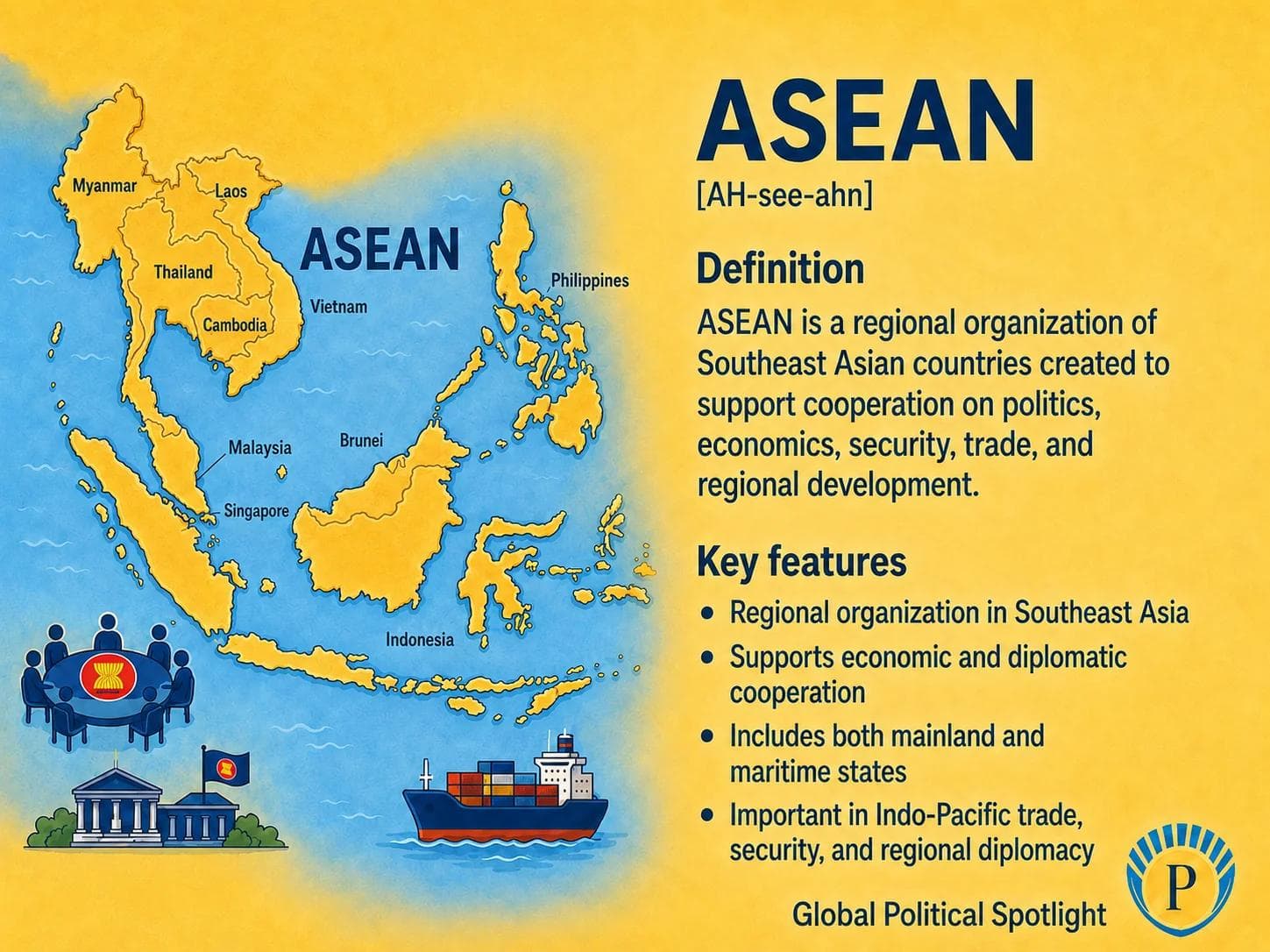
Definition
ASEAN, the Association of Southeast Asian Nations, is a regional organization that brings together Southeast Asian states to promote cooperation, stability, economic integration, and diplomatic dialogue. It was founded in 1967 by Indonesia, Malaysia, the Philippines, Singapore, and Thailand, and later expanded to include Brunei Darussalam, Viet Nam, Lao PDR, Myanmar, Cambodia, and Timor-Leste.
ASEAN is known for the 'ASEAN Way': a diplomatic style that emphasizes consensus, consultation, informality, gradualism, respect for sovereignty, and non-interference in the internal affairs of member states. This approach helps keep a diverse region at the same table, but it also limits the bloc's ability to enforce decisions.
ASEAN's institutional role extends beyond Southeast Asia through ASEAN-led forums such as the East Asia Summit, ASEAN Regional Forum, and ASEAN Defence Ministers' Meeting-Plus. These platforms support ASEAN centrality by placing Southeast Asian states at the center of wider Indo-Pacific diplomacy.
Why It Matters
ASEAN matters because Southeast Asia sits at the intersection of major sea lanes, manufacturing supply chains, energy flows, digital markets, and strategic competition between the United States and China. Its members are individually diverse, but collectively they represent a major diplomatic and economic bloc.
The organization is central to regional trade architecture, including the ASEAN Economic Community and ASEAN's role in wider agreements such as the Regional Comprehensive Economic Partnership. Its economic integration affects investment, production networks, customs cooperation, labor mobility, and regional supply-chain resilience.
ASEAN also shows the trade-off between inclusiveness and enforcement. Consensus and non-interference allow states with different political systems and foreign-policy alignments to cooperate, but the same rules constrain responses to the Myanmar crisis, South China Sea disputes, and pressure from great-power rivalry.
GPS should track ASEAN as a long-term indicator of Southeast Asia's strategic autonomy, economic integration, maritime diplomacy, and ability to manage pressure from U.S.-China competition. Key watchpoints include whether ASEAN preserves centrality in Indo-Pacific diplomacy, whether it can negotiate meaningful South China Sea norms, how it handles Myanmar without breaking consensus, and whether economic integration keeps pace with supply-chain shifts and regional infrastructure needs.
Key Facts
- Type
- Regional intergovernmental organization
- Full name
- Association of Southeast Asian Nations
- Founded
- 8 August 1967, through the Bangkok Declaration
- Secretariat
- Jakarta, Indonesia
- Members
- 11 member states: Brunei Darussalam, Cambodia, Indonesia, Lao PDR, Malaysia, Myanmar, Philippines, Singapore, Thailand, Timor-Leste, and Viet Nam
- Decision style
- Consensus, consultation, non-interference, and respect for sovereignty are core features of the ASEAN Way
- Economic role
- Promotes regional economic integration through the ASEAN Economic Community and trade frameworks with external partners
- Strategic limit
- Consensus rules make ASEAN inclusive but can slow or dilute action on Myanmar, maritime disputes, and great-power competition
FAQ
What is ASEAN?
ASEAN is the Association of Southeast Asian Nations, a regional organization that promotes cooperation among Southeast Asian states on diplomacy, security dialogue, trade, economic integration, development, and regional stability.
Which countries are members of ASEAN?
ASEAN's member states are Brunei Darussalam, Cambodia, Indonesia, Lao PDR, Malaysia, Myanmar, the Philippines, Singapore, Thailand, Timor-Leste, and Viet Nam.
What is the ASEAN Way?
The ASEAN Way refers to ASEAN's diplomatic style of consensus, consultation, informality, gradual decision-making, respect for sovereignty, and non-interference. It helps maintain unity among diverse states but can make strong collective action difficult.
Why does ASEAN matter in U.S.-China competition?
ASEAN matters because Southeast Asian states sit between major U.S. and Chinese strategic, economic, and maritime interests. Many ASEAN members seek to benefit from both powers while avoiding exclusive alignment, making ASEAN central to Indo-Pacific balancing.
How does ASEAN affect the South China Sea?
ASEAN provides a diplomatic platform for Southeast Asian states to discuss maritime security, freedom of navigation, crisis management, and negotiations with China over a code of conduct. However, member states have different threat perceptions and economic ties, which limits collective pressure.
What are the limits of ASEAN?
ASEAN's limits come mainly from consensus rules, non-interference, institutional caution, and differing national interests. These constraints are visible in the Myanmar crisis, South China Sea diplomacy, and efforts to balance relations with both China and the United States.
Recent Developments
Timor-Leste was admitted as ASEAN's 11th member state
ASEAN formally admitted Timor-Leste as its 11th member state during the 47th ASEAN Summit in Kuala Lumpur. The accession expanded ASEAN's membership to all states widely recognized as part of Southeast Asia and added a young democracy with significant development needs to the bloc.
ASEANASEAN adopted the Five-Point Consensus on Myanmar
ASEAN leaders agreed on a Five-Point Consensus after Myanmar's 2021 military coup, calling for an end to violence, dialogue among all parties, humanitarian assistance, and a special envoy process. The limited implementation of the consensus remains a major test of ASEAN's non-interference norm and crisis-management capacity.
ASEANSources6 references
- ASEAN
Official overview of ASEAN's purpose, history, and institutional role.
- ASEAN
Official list of ASEAN member states.
- ASEAN
Official ASEAN Charter setting out the organization's purposes, principles, membership, and institutional framework.
- ASEAN
Official ASEAN Economic Community information on regional economic integration.
- ASEAN
Official ASEAN announcement on Timor-Leste's admission as ASEAN's 11th member state.
- ASEAN
Official chairman's statement setting out ASEAN's Five-Point Consensus on Myanmar.

GPSNews App
Read GPSNews on iPhone
Daily geopolitical briefings, government updates, and prediction signals in one focused app.
Newsletter
Stay Ahead Of The Next Signal
Get briefings in your inbox when new analysis and reports are published.