
SADC
Southern Africa’s regional organization for development, trade, security, and political cooperation
SADC is a southern African regional organization focused on economic integration, infrastructure, development, peace and security, election observation, and political cooperation among its member states.
Definition
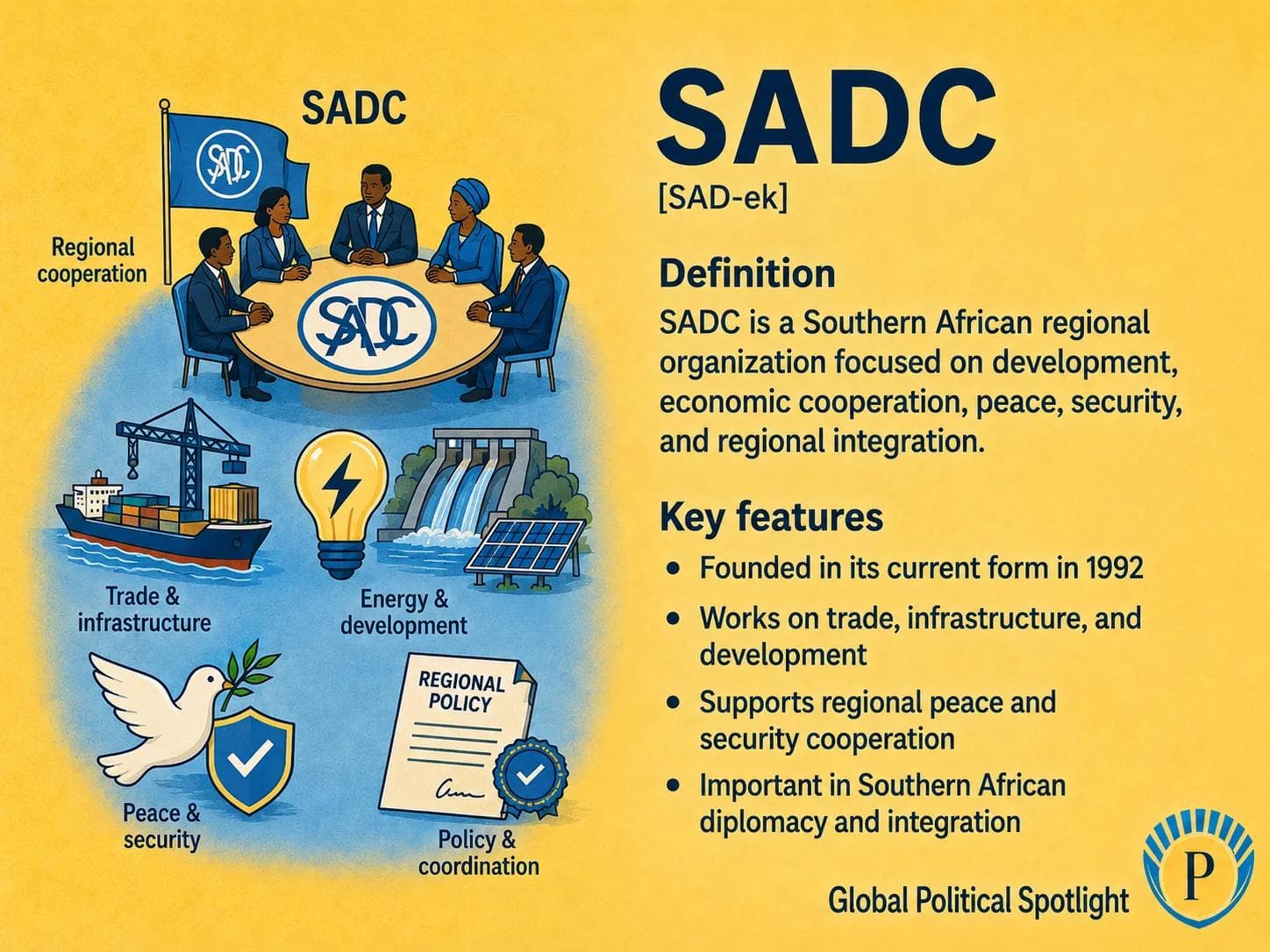
The Southern African Development Community, usually known as SADC, is a regional intergovernmental organization that brings together countries in southern Africa and nearby island states. It was established in 1992, replacing the earlier Southern African Development Coordination Conference, and its secretariat is based in Gaborone, Botswana.
SADC’s agenda covers economic development, trade integration, transport corridors, energy cooperation, food security, industrialization, climate resilience, political cooperation, election observation, and regional peace and security. Its members include South Africa, Angola, Botswana, Democratic Republic of the Congo, Mozambique, Tanzania, Zambia, Zimbabwe, and several smaller mainland and island economies.
The organization is structurally important because southern Africa’s economies are linked by ports, power grids, mining supply chains, migration routes, and transport corridors. However, differences in state capacity, political systems, infrastructure quality, and economic size affect how deeply the region can integrate.
Why It Matters
SADC matters because it sits across some of Africa’s most important mineral, energy, transport, and agricultural corridors. Regional cooperation affects how landlocked states reach ports, how electricity is traded across borders, how mining exports move to global markets, and how governments coordinate responses to drought, food insecurity, and infrastructure gaps.
The organization also matters for security and governance. Through its political and security structures, SADC has supported election observation, mediation, and regional deployments, including missions linked to instability in Mozambique and the Democratic Republic of the Congo. These activities make SADC a practical mechanism for regional crisis management, even when outcomes are uneven.
South Africa’s role gives SADC additional geopolitical weight. As the region’s largest and most industrialized economy, South Africa influences trade flows, investment, logistics, finance, diplomacy, and security policy, while smaller states use SADC to amplify bargaining power and coordinate regional development priorities.
SADC should be watched as a regional integration and security platform linking southern Africa’s trade corridors, energy systems, mineral supply chains, and political stability. Key signals include South Africa’s regional leadership, cross-border power and transport projects, election observation credibility, peacekeeping mandates, instability in eastern DRC and northern Mozambique, and whether regional trade rules translate into practical industrial and infrastructure gains.
Key Facts
- Full name
- Southern African Development Community
- Type
- Regional intergovernmental organization
- Established
- 1992, through the SADC Declaration and Treaty signed in Windhoek, Namibia
- Headquarters
- Gaborone, Botswana
- Members
- 16 member states across southern Africa and the western Indian Ocean
- Core agenda
- Development, regional integration, trade, infrastructure, industrialization, food security, peace and security, and political cooperation
- Security role
- SADC operates political and security mechanisms that can support election observation, mediation, and regional deployments
- Strategic constraint
- Integration is limited by infrastructure gaps, uneven economic capacity, border frictions, political differences, and dependence on a few major regional economies
FAQ
What is SADC?
SADC is the Southern African Development Community, a regional organization created to promote development, economic integration, trade, infrastructure cooperation, peace and security, and political cooperation among southern African states.
Which countries are members of SADC?
SADC has 16 member states: Angola, Botswana, Comoros, Democratic Republic of the Congo, Eswatini, Lesotho, Madagascar, Malawi, Mauritius, Mozambique, Namibia, Seychelles, South Africa, Tanzania, Zambia, and Zimbabwe.
Why does SADC matter geopolitically?
SADC matters because it connects mineral producers, energy systems, ports, transport corridors, agricultural zones, and security challenges across southern Africa. Its decisions can affect trade routes, power supply, investment, migration, crisis response, and regional diplomacy.
What role does South Africa play in SADC?
South Africa is the region’s largest and most industrialized economy, so it plays a major role in SADC trade, finance, logistics, electricity demand, investment, and diplomacy. At the same time, SADC gives smaller member states a forum to balance interests and coordinate regional priorities.
Does SADC conduct peacekeeping?
SADC can support regional security deployments through its peace and security structures. Its missions and interventions have included operations linked to instability in Mozambique and the Democratic Republic of the Congo, although their effectiveness depends on mandates, resources, local politics, and cooperation from member states.
What are the limits of SADC integration?
SADC integration is limited by poor infrastructure in some corridors, border delays, uneven industrial capacity, political disagreements, fiscal constraints, power shortages, and the challenge of coordinating very different economies and political systems.
Recent Developments
SADC deployed a regional mission to eastern DRC
SADC deployed the SADC Mission in the Democratic Republic of Congo to support the Congolese government in addressing insecurity in the eastern DRC, illustrating the organization’s role in regional peace and security even as such missions face difficult political and operational conditions.
SADCSADC moved to end the mandate of its eastern DRC mission
SADC leaders decided to terminate the mandate of the regional mission in eastern Democratic Republic of the Congo and begin a phased withdrawal, underscoring both the bloc’s willingness to intervene in regional crises and the limits of peace operations in complex conflicts.
ReutersSources6 references
- SADC Secretariat
Official institutional source for SADC membership, programs, governance structures, and policy areas.
- SADC History and Treaty
Official SADC background on the organization’s origins, treaty basis, and transformation from SADCC to SADC.
- SADC Treaty
Foundational treaty text establishing SADC’s institutional framework, objectives, and legal basis.
- SADC Election Observation
Official explanation of SADC Electoral Observer Missions and related electoral advisory mechanisms.
- African Union Regional Economic Communities: SADC
African Union reference page describing SADC as one of Africa’s regional economic communities.
- World Bank Southern Africa
Institutional development source for regional economic, infrastructure, energy, poverty, and resilience context in Africa.

GPSNews App
Read GPSNews on iPhone
Daily geopolitical briefings, government updates, and prediction signals in one focused app.
Newsletter
Stay Ahead Of The Next Signal
Get briefings in your inbox when new analysis and reports are published.