
CARICOM
A Caribbean regional organization for economic integration, diplomacy, development, disaster response, and small-state coordination
CARICOM is a Caribbean regional organization that coordinates economic integration, foreign policy, development, disaster response, migration, trade, and collective bargaining for small island and coastal states.
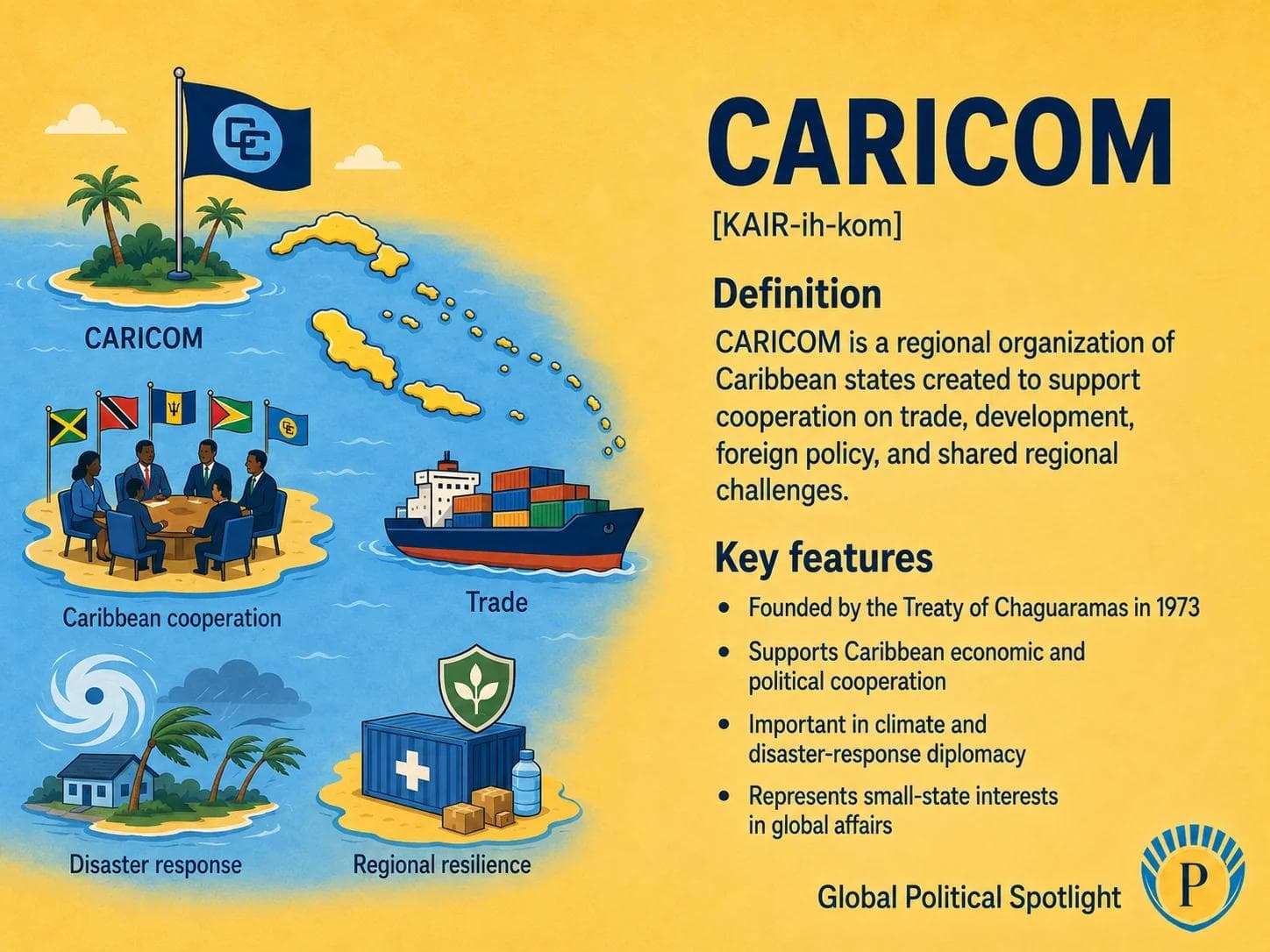
Definition
CARICOM, formally the Caribbean Community, is a regional organization of Caribbean states and territories created to support economic integration, foreign-policy coordination, development, and functional cooperation. It was established by the Treaty of Chaguaramas in 1973 and later deepened through the Revised Treaty of Chaguaramas.
The organization brings together mostly small island and coastal states whose individual populations and markets are limited but whose collective diplomatic weight matters in the Americas, the Commonwealth, the United Nations, climate negotiations, trade talks, and development-finance debates.
CARICOM's agenda includes the CARICOM Single Market and Economy, regional trade rules, labor mobility, disaster management, public health, crime and security cooperation, climate resilience, food security, energy, digital development, and shared positions on external relations.
Why It Matters
CARICOM matters because Caribbean states face structural vulnerabilities that are difficult to manage alone: small domestic markets, import dependence, exposure to hurricanes, high climate adaptation costs, tourism shocks, food and energy insecurity, debt burdens, and limited bargaining power with larger economies.
The organization gives members a mechanism for collective diplomacy. By coordinating positions, CARICOM states can amplify their influence in climate finance negotiations, trade discussions, development lending, disaster response, migration policy, regional security, and relations with the United States, European Union, China, Canada, and Latin America.
Haiti gives CARICOM a particularly important political and security dimension. The country's instability affects migration, humanitarian planning, regional diplomacy, organized crime concerns, and external intervention debates, making Haiti a recurring test of CARICOM's ability to coordinate regional responses.
GPS should track CARICOM as the main Caribbean platform for small-state coordination, climate diplomacy, regional trade, disaster response, migration, and bargaining with larger powers. Key watchpoints include Haiti crisis diplomacy, implementation of the CARICOM Single Market and Economy, climate-finance advocacy, food and energy security, hurricane response capacity, Caribbean positions in the UN and OAS, and how U.S., EU, Chinese, Canadian, and Latin American engagement affects regional autonomy.
Key Facts
- Type
- Regional organization and Caribbean integration bloc
- Founded
- 1973 through the Treaty of Chaguaramas
- Secretariat
- Georgetown, Guyana
- Membership
- 15 full members and 5 associate members
- Core framework
- Revised Treaty of Chaguaramas and the CARICOM Single Market and Economy
- Main agenda
- Economic integration, foreign-policy coordination, trade, labor mobility, climate resilience, disaster response, public health, security, and development
- Strategic role
- Amplifies Caribbean small-state bargaining power in global climate, trade, development, and security diplomacy
- Institutional limit
- CARICOM depends on consensus, national implementation, limited fiscal capacity, and political will among diverse member states
FAQ
What is CARICOM?
CARICOM is the Caribbean Community, a regional organization that coordinates economic integration, diplomacy, development, disaster response, trade, public health, security, migration, and climate advocacy among Caribbean states and territories.
Who are the members of CARICOM?
CARICOM has 15 full members: Antigua and Barbuda, The Bahamas, Barbados, Belize, Dominica, Grenada, Guyana, Haiti, Jamaica, Montserrat, Saint Kitts and Nevis, Saint Lucia, Saint Vincent and the Grenadines, Suriname, and Trinidad and Tobago. It also has associate members including Anguilla, Bermuda, British Virgin Islands, Cayman Islands, and Turks and Caicos Islands.
Why does CARICOM matter for small states?
CARICOM matters because small states often have limited individual bargaining power. Collective diplomacy helps Caribbean governments negotiate on climate finance, trade access, disaster assistance, debt vulnerability, migration, health, and external partnerships with larger powers.
What is the CARICOM Single Market and Economy?
The CARICOM Single Market and Economy is a regional integration project intended to make it easier for goods, services, capital, businesses, and certain categories of workers to move across participating member states. Implementation has been gradual and uneven.
Why is climate change central to CARICOM?
Climate change is central because Caribbean states are highly exposed to hurricanes, sea-level rise, coastal erosion, coral reef loss, flooding, drought, water stress, and climate-related debt pressures. CARICOM helps members coordinate climate diplomacy and resilience planning.
What are the limits of CARICOM?
CARICOM's limits include small national administrations, different economic structures, uneven implementation of regional commitments, fiscal constraints, sovereignty concerns, dependence on external financing, and difficulty coordinating responses to complex crises such as Haiti.
Recent Developments
CARICOM helped convene regional diplomacy on Haiti's political transition
CARICOM leaders and international partners supported talks on Haiti's political transition during a period of severe insecurity and institutional crisis. The diplomacy highlighted CARICOM's role as a regional forum for Haiti-related coordination, even when implementation depends on Haitian actors and external support.
CARICOMCARICOM marked fifty years since the Treaty of Chaguaramas
CARICOM marked its fiftieth anniversary in 2023, underscoring the durability of Caribbean regionalism and the continuing importance of small-state cooperation on trade, climate, development, health, disaster response, and shared external representation.
CARICOMSources6 references
- CARICOM
Official website of the Caribbean Community.
- CARICOM
Official overview of CARICOM, its purpose, structure, and membership.
- CARICOM
Official text of the Revised Treaty of Chaguaramas establishing the CARICOM Single Market and Economy.
- CARICOM Single Market and Economy
Official CARICOM portal for the Single Market and Economy.
- Caribbean Disaster Emergency Management Agency
Official regional disaster-management agency linked to Caribbean emergency response and resilience.
- Caribbean Community Climate Change Centre
Regional institution supporting Caribbean climate adaptation, resilience, and policy coordination.

GPSNews App
Read GPSNews on iPhone
Daily geopolitical briefings, government updates, and prediction signals in one focused app.
Newsletter
Stay Ahead Of The Next Signal
Get briefings in your inbox when new analysis and reports are published.