
East African Community
East Africa’s regional bloc for economic integration, infrastructure, security, and political cooperation
The East African Community is a regional intergovernmental organization pursuing customs union, common market, monetary union, infrastructure connectivity, security cooperation, and long-term political federation among East African states.
Definition
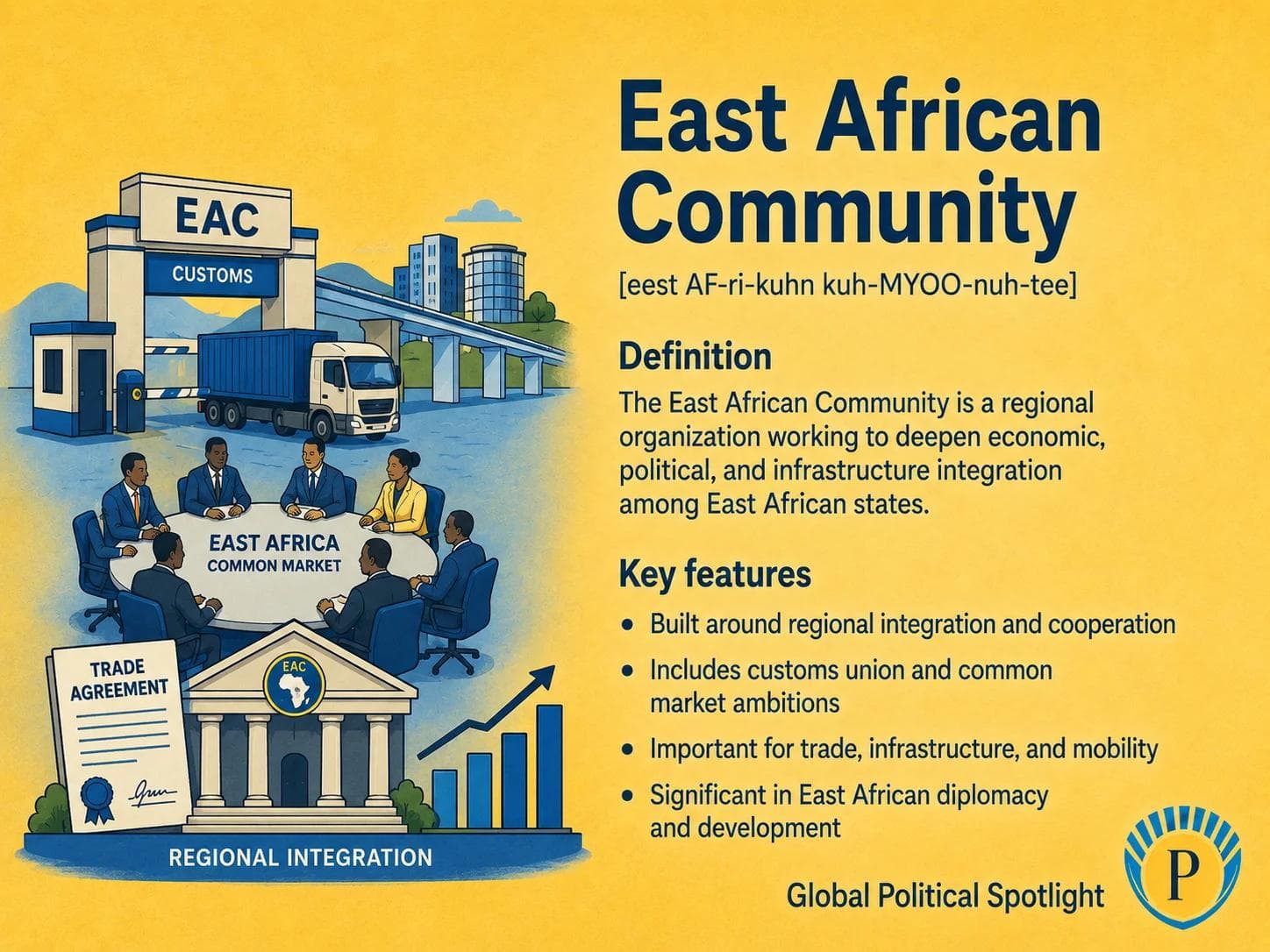
The East African Community, usually abbreviated EAC, is a regional intergovernmental organization headquartered in Arusha, Tanzania. It brings together East African states through a treaty-based integration project focused on trade, customs cooperation, free movement, infrastructure, security, and long-term political coordination.
The EAC’s integration model is organized around four main pillars: a customs union, a common market, a monetary union, and an eventual political federation. These ambitions make it one of Africa’s more advanced regional integration projects, although implementation remains uneven across member states.
As of 2026, the EAC has eight partner states: Burundi, Democratic Republic of the Congo, Kenya, Rwanda, Somalia, South Sudan, Uganda, and Tanzania. Its expansion has increased the bloc’s demographic, geographic, and strategic weight, but it has also widened the gap between its integration ambitions and the political, security, and infrastructure constraints of its members.
Why It Matters
The EAC matters because it connects inland African economies to Indian Ocean ports, links major population centers to trade corridors, and sits across strategically important routes between the Great Lakes, the Horn of Africa, the Nile Basin, and the wider Indian Ocean economy.
Its customs union and common market ambitions affect tariffs, labor mobility, investment, logistics, and cross-border services. If implemented effectively, the EAC can reduce trade costs, expand regional value chains, and improve infrastructure coordination across some of Africa’s fastest-growing economies.
The bloc is also important for security and diplomacy. Instability in eastern Democratic Republic of the Congo, South Sudan, Somalia, and border regions creates pressure for regional mediation, military coordination, refugee management, and counterterrorism cooperation, while political rivalries among member states can slow common action.
The East African Community should be watched as a test case for African regional integration under conditions of rapid expansion, infrastructure deficits, security crises, and uneven state capacity. Key indicators include progress on customs and common market implementation, regional railway and port corridors, South Sudan and Somalia integration, eastern DRC stabilization, Kenya-Tanzania-Rwanda-Uganda trade frictions, and whether monetary union or political federation ambitions remain credible.
Key Facts
- Full name
- East African Community
- Type
- Regional intergovernmental organization
- Headquarters
- Arusha, Tanzania
- Modern treaty basis
- Treaty for the Establishment of the East African Community, signed in 1999 and entering into force in 2000
- Members
- Burundi, Democratic Republic of the Congo, Kenya, Rwanda, Somalia, South Sudan, Uganda, and Tanzania
- Integration pillars
- Customs union, common market, monetary union, and eventual political federation
- Strategic corridors
- The bloc is shaped by transport links from inland states to Indian Ocean ports, especially through Kenya and Tanzania
- Main constraints
- Implementation gaps, non-tariff barriers, infrastructure deficits, political mistrust, security crises, and uneven economic capacity
FAQ
What is the East African Community?
The East African Community is a regional organization that brings together East African states to promote economic integration, trade, infrastructure connectivity, free movement, security cooperation, and long-term political cooperation.
Which countries are in the East African Community?
As of 2026, the EAC partner states are Burundi, Democratic Republic of the Congo, Kenya, Rwanda, Somalia, South Sudan, Uganda, and Tanzania.
What are the main goals of the EAC?
The EAC’s main integration goals are a customs union, a common market, a monetary union, and eventual political federation. In practice, the bloc also works on infrastructure, trade facilitation, security, health, education, agriculture, and industrial development.
Why does the EAC matter geopolitically?
The EAC matters because it links inland states to Indian Ocean ports, connects the Great Lakes and Horn of Africa to regional trade routes, and provides a forum for managing cross-border security, migration, investment, infrastructure, and diplomatic disputes.
What are the limits of EAC integration?
EAC integration is limited by non-tariff barriers, customs delays, inconsistent implementation of common market rules, infrastructure gaps, political rivalry, insecurity in some member states, and the challenge of integrating economies at very different levels of development.
Is the East African Community becoming one country?
Not currently. The EAC treaty includes a long-term goal of political federation, but member states remain sovereign. Political federation would require major legal, constitutional, fiscal, and political decisions that have not yet been completed.
Recent Developments
Somalia became a full member of the East African Community
Somalia became the EAC’s eighth partner state after depositing its instrument of ratification, expanding the bloc toward the Horn of Africa and increasing the importance of security, trade, maritime access, and institutional integration questions.
East African CommunityThe EAC launched consultations on political confederation
The EAC continued public consultations on a proposed political confederation as part of its long-term federation agenda, illustrating that the bloc’s integration project extends beyond trade policy into political and institutional cooperation.
East African CommunitySources6 references
- East African Community
Official institutional source for EAC membership, organs, integration pillars, policies, and public updates.
- EAC Treaty
Official EAC document repository containing the treaty framework and key legal instruments.
- EAC Customs Union
Official source explaining the customs union framework and regional customs cooperation.
- EAC Common Market
Official source explaining the common market framework, including movement of goods, labor, services, capital, and establishment rights.
- African Union Regional Economic Communities: EAC
African Union reference page describing the EAC as one of Africa’s regional economic communities.
- World Bank East Africa
Institutional development source for regional economic, infrastructure, poverty, and resilience context in Africa.

GPSNews App
Read GPSNews on iPhone
Daily geopolitical briefings, government updates, and prediction signals in one focused app.
Newsletter
Stay Ahead Of The Next Signal
Get briefings in your inbox when new analysis and reports are published.