
Pacific Islands Forum
The main regional organization for Pacific island states and partners, centered on climate security, ocean governance, development, and regional diplomacy
The Pacific Islands Forum is the main regional organization for Pacific island states and partners, coordinating on climate security, ocean governance, fisheries, development, regional diplomacy, and strategic competition in the Pacific.
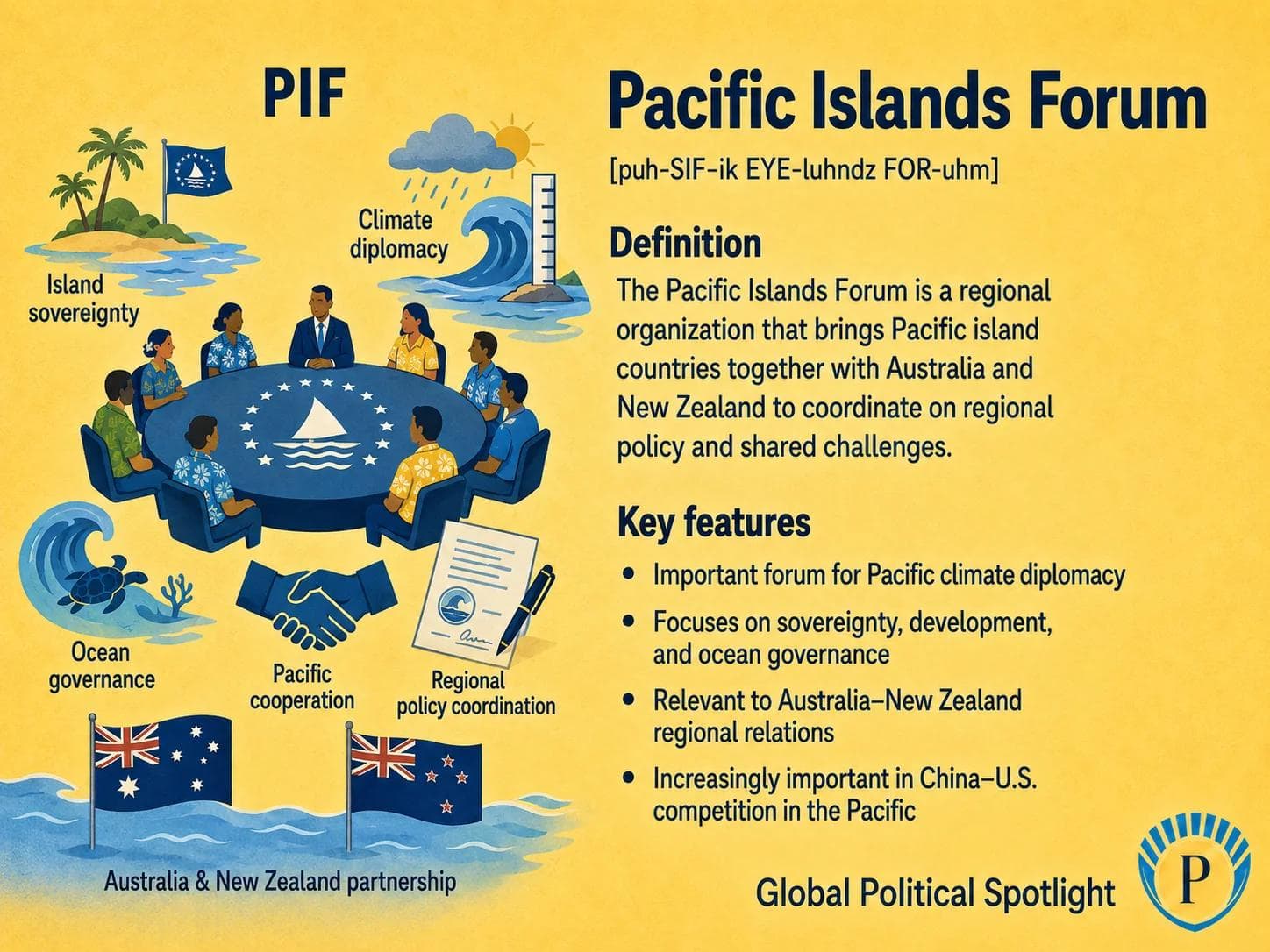
Definition
The Pacific Islands Forum, or PIF, is the main political and diplomatic organization for Pacific island states and several regional partners. It brings together island countries, Australia, New Zealand, and Pacific territories to coordinate on regional security, development, climate, ocean governance, fisheries, health, connectivity, and diplomatic priorities.
The Forum is built around Pacific regionalism and the idea of the Blue Pacific: the Pacific Ocean as a shared strategic, cultural, environmental, and economic space. Its secretariat is based in Suva, Fiji, and supports leaders' meetings, ministerial processes, regional strategies, and coordination with development partners.
Although it is not a military alliance, the Pacific Islands Forum has become increasingly important in geopolitical debates over climate security, maritime zones, fisheries, infrastructure, debt, policing, digital connectivity, and strategic competition involving China, the United States, Australia, New Zealand, France, Japan, and other external actors.
Why It Matters
The Pacific Islands Forum matters because Pacific island states control vast ocean areas, key fisheries, strategic sea lanes, and important votes in international institutions. Their territories and exclusive economic zones give the region significance far beyond its population size.
Climate change is central to the Forum's geopolitical relevance. Sea-level rise, cyclones, coastal erosion, water security, food systems, and climate-related mobility make climate policy a security issue for many Pacific governments, not only an environmental issue.
The Forum also acts as a regional gatekeeper in an increasingly contested Pacific. Australia and New Zealand are influential members, while the United States and China compete for diplomatic access, infrastructure influence, security partnerships, and development cooperation with Pacific island governments.
GPS should track the Pacific Islands Forum as a central institution for Pacific regional diplomacy, climate security, ocean governance, fisheries, development finance, and great-power competition. Key watchpoints include implementation of the 2050 Strategy for the Blue Pacific Continent, regional positions on climate and sea-level rise, fisheries and maritime-zone governance, Australia and New Zealand security roles, U.S.-China competition, partner-access rules, and whether Pacific states can preserve regional unity despite external pressure.
Key Facts
- Type
- Regional intergovernmental organization
- Founded
- 1971, originally as the South Pacific Forum
- Secretariat
- Suva, Fiji
- Membership
- 18 members, including Pacific island states and territories as well as Australia and New Zealand
- Core strategy
- 2050 Strategy for the Blue Pacific Continent
- Main agenda
- Climate security, ocean governance, fisheries, development, regional security, health, connectivity, and economic resilience
- Strategic role
- Provides a collective Pacific voice in diplomacy with larger powers and multilateral institutions
- Institutional limit
- The Forum relies on consensus, regional solidarity, and member implementation rather than strong enforcement powers
FAQ
What is the Pacific Islands Forum?
The Pacific Islands Forum is the main regional organization for Pacific island states and partners. It coordinates diplomacy on climate security, ocean governance, fisheries, development, regional security, economic resilience, and relations with external powers.
Who are the members of the Pacific Islands Forum?
The Forum has 18 members: Australia, Cook Islands, Federated States of Micronesia, Fiji, French Polynesia, Kiribati, Nauru, New Caledonia, New Zealand, Niue, Palau, Papua New Guinea, Republic of the Marshall Islands, Samoa, Solomon Islands, Tonga, Tuvalu, and Vanuatu.
Why does the Pacific Islands Forum matter for climate security?
The Forum matters for climate security because many Pacific states face existential risks from sea-level rise, coastal erosion, stronger storms, water stress, food insecurity, and climate-related mobility. Forum diplomacy frames climate change as a security and sovereignty issue.
How does the Pacific Islands Forum affect ocean governance?
The Forum helps coordinate regional positions on marine resources, fisheries, maritime zones, ocean conservation, and sustainable development. Pacific island states control vast exclusive economic zones, making ocean governance central to their sovereignty and economic security.
Why are Australia and New Zealand important in the Forum?
Australia and New Zealand are influential Forum members because they provide major development assistance, security cooperation, disaster support, labor-mobility pathways, and diplomatic engagement. Their role is important but sometimes sensitive because Pacific island states emphasize regional ownership and equality.
How does U.S.-China competition affect the Pacific Islands Forum?
U.S.-China competition affects the Forum through infrastructure funding, diplomatic recognition disputes, security agreements, telecommunications, aid, policing, ports, and development partnerships. Pacific governments often seek to preserve autonomy and regional unity while engaging multiple external powers.
Recent Developments
Forum leaders endorsed the 2050 Strategy for the Blue Pacific Continent
Pacific Islands Forum leaders endorsed the 2050 Strategy for the Blue Pacific Continent, setting a long-term regional framework for political leadership, climate change, ocean governance, people-centered development, technology, resources, peace, and security.
Pacific Islands ForumThe Honiara Summit emphasized sustainable fisheries and ocean action
The 2025 Honiara Summit in Solomon Islands focused on SDG14 and the sustainable management of ocean resources, reinforcing the importance of fisheries, marine conservation, and ocean governance to Pacific regional diplomacy.
Pacific Islands Forum Fisheries AgencySources6 references
- Pacific Islands Forum
Official website of the Pacific Islands Forum Secretariat.
- Pacific Islands Forum
Official overview of the Forum, its history, membership, and institutional role.
- Pacific Islands Forum
Official 2050 Strategy for the Blue Pacific Continent.
- Pacific Islands Forum Fisheries Agency
Official regional fisheries agency connected to Pacific fisheries governance and cooperation.
- Pacific Data Hub
Regional dashboard tracking indicators connected to the 2050 Strategy for the Blue Pacific.
- Pacific Islands Forum Fisheries Agency
Regional source on the 2025 Honiara Summit outcomes for sustainable fisheries management.

GPSNews App
Read GPSNews on iPhone
Daily geopolitical briefings, government updates, and prediction signals in one focused app.
Newsletter
Stay Ahead Of The Next Signal
Get briefings in your inbox when new analysis and reports are published.